

Kalshi is the best prediction market app for most people in October 2026. It has the deepest sports markets, an easy-to-use interface, and built-in spending limits. Polymarket US is a close second if you want to trade more than sports (politics, culture, economy, etc.). Novig rounds out the top three with fee-free trading.
The rest of our best prediction market apps include PrizePicks, ProphetX, OG.com, Crypto.com, FanDuel Predicts, and Betr.
- Best overall and for beginners: Kalshi
- Most markets beyond sports: Polymarket US
- No trading fees on pregame sports: Novig
- Familiar app for DFS players: PrizePicks
- Best for building parlays: ProphetX
We funded accounts on all nine apps in September 2026, placed real money trades on NFL games and the 2027 Oscars, and tested multiple payout methods.
Best Prediction Market Apps, Ranked









Comparing the Top Prediction Market Apps in October 2026
The following table shows our nine best prediction market apps as of September 2026 along with what they’re known best for and their listed trading fees.
Methodology: How We Rated Our Top Prediction Market Apps
We evaluated each prediction app using the same weighted scoring for all nine platforms. Our first-hand testing included opening accounts, funding them, placing trades across numerous markets including the NFL, trying out key app features and performance, and examining the user experience from signup through withdrawal.
Here's a detailed breakdown of the criteria we used to rate each app:
- App quality (25%): We used each app on both Android and iOS to find markets, place trades, track prices, and manage our account. We looked at how smooth and reliable the app is. We also gave weight to apps with user-friendly experiences for both casual traders and beginners migrating from sportsbooks.
- How busy the markets are (20%): We placed real trades to see whether the price we got was shown (no slippage) and how quickly we could sell when we wanted to cash out early. More traders means fairer prices and faster order fills.
- What you can trade (20%): We looked at the markets available, from sports and politics to the economy, crypto, weather, and entertainment.
- How much are the fees (20%): We compared each app's published fees with what we were really charged on our trades, and checked how easy it is to see the cost before you place a trade.
- Regulation and safety (10%): We checked who regulates each app, whether your money is kept separate from company funds, and how likely legal fights are to cut off access in your state.
- Deposits and withdrawals (5%): We moved real money in and out and timed how long it took to reach our account. We scored each app on payout speed, payment method options, and ease of funding.
1. Kalshi App: Cleanest App for Beginners & Casual Traders
The Kalshi app tops our list with the strongest combination of regulatory credibility, wide market selection, and user-friendly mobile experience. As a CFTC-regulated Designated Contract Market, Kalshi lets users trade event contracts covering sports, politics, economics, crypto, weather, entertainment, and more through a polished, beginner-friendly platform.
👍 PROS
- First U.S. prediction market with CFTC regulation
- Reliable website and mobile app for year-long markets besides sports
- No settlement fee or membership fees
👎 CONS
- Taker fees can peak higher ($1.75) than Polymarket US ($1.50)
- Combos add maker fees (50% of taker fee)
Kalshi App Overview
Kalshi was founded in 2018 by Tarek Mansour and Luana Lopes Lara, who met while studying at MIT. They created the platform around the idea that people should be able to trade directly on real-world outcomes rather than rely on traditional financial assets as proxies. Kalshi ultimately launched an exchange where users can buy and sell Yes/No event contracts tied to everything from economic data and elections to sports and culture.
Kalshi made history in 2020 when it became the first financial exchange dedicated to event contracts to receive Designated Contract Market (DCM) status from the CFTC. It remains federally regulated by the CFTC today, putting it on par with the regulation and market depth of Polymarket in the U.S.
Kalshi Markets & Liquidity
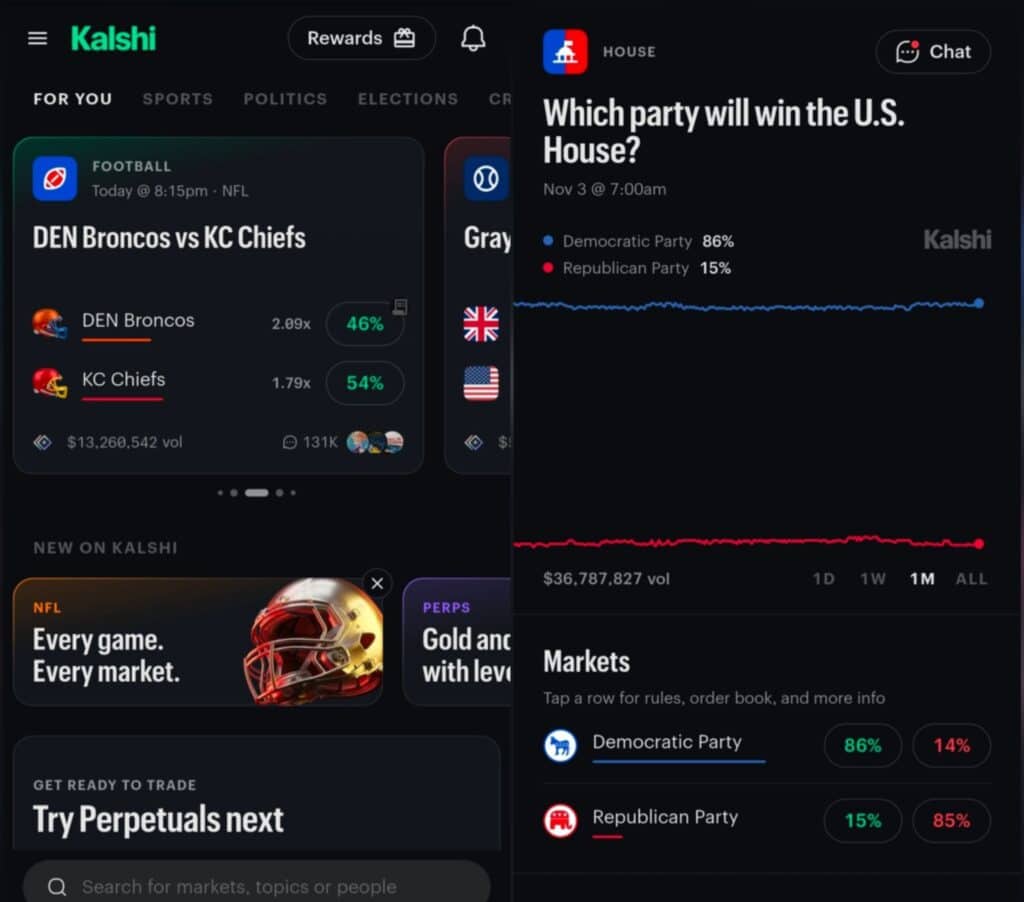
The Kalshi app has sections for a variety of markets, including sports, politics, elections, crypto, culture, mentions (specific words used in speeches), economics, commodities, finance, climate, and tech and science.
Liquidity at Kalshi is best for its wide breadth of sports contracts, which you can find for the big leagues as well as more niche markets like cricket, table tennis, and Esports. There is less liquidity for combos where you can combine multiple legs into a parlay, as even the popular ones listed usually only have 100-2,000 traders at a time.
Kalshi Fees & Trading Costs
Kalshi trading fees are based on the expected earnings of each event contract rather than a flat percentage of the amount you spend. For standard trades that immediately match an existing order, the fee varies with the contract price and number of contracts purchased. Because of that formula, fees are generally highest on contracts trading near 50 cents and decrease as the price moves closer to $0 or $1.
Most markets have a fee range (per 100 contracts) of $0.07-$1.75 in taker fees. Combos (excluding uncorrelated NFL) have maker fees that are 50% of taker fees. Additionally, the Kalshi app lists non-standard fees for a variety of unique markets, including the US gas price and certain ATP tennis matches. Kalshi fees do not include any settlement fees, and certain markets carry no fees at all.
Kalshi App Experience & Payments
For the Kalshi app experience, you’ll find a smooth interface to jump between market events, track your portfolio, and can even chat with other users on the social page. For the payment section, there is a 2% processing fee for deposits for certain methods only, and the minimum deposit is usually $10. Here are the available payment methods:
- Google Pay (2% fee)
- PayPal (2% fee)
- Venmo (no fees)
- Cash App Pay (no fees)
- Debit Card (2% fee)
- Bank transfer/ACH (no fees)
- Crypto ($500k per deposit; 0.05% fee)
- Wire transfer ($1,000 minimum; ready same business day or next)
Withdrawal methods include PayPal (payout speed is within 24 hours), debit card (within 30 minutes), bank account (within 1 business day), and crypto (varies by network).
2. Polymarket App: Widest Market Variety in One App
The Polymarket app is our runner-up choice because it offers the deepest market variety with the liquidity needed to make those markets genuinely useful. Traders can find contracts covering politics, sports, crypto, economics, technology, culture, weather, world events, and plenty of niche topics that competing prediction market apps simply don't offer.
👍 PROS
- Huge variety of CFTC-regulated event contracts beyond sports
- Strong liquidity in popular markets (sports and politics)
- Can fast-track registration by signing in with your Google or Apple account
👎 CONS
- Two products (Polymarket vs. Polymarket US) can confuse American users.
- Runs a scheduled maintenance window every Thursday from 2:00-4:00 AM ET when no trading is permitted
Polymarket App Overview
Founded in 2020, Polymarket has become one of the biggest names in prediction markets. Its core value proposition is simple: Instead of betting against a sportsbook’s house odds, users trade event contracts against other traders with market prices reflecting the crowd's estimated probability of an outcome. Contracts cover everything from sports and politics to economics, culture, and crypto.
Today, Polymarket operates separate U.S. and international platforms. Polymarket US is operated by QCX LLC, which Polymarket identifies as a CFTC-regulated Designated Contract Market (DCM). The international Polymarket.com platform operates independently and is not regulated by the CFTC, which is why U.S. residents must use Polymarket US as their access path to trading on the Polymarket platform.
Polymarket Markets & Liquidity
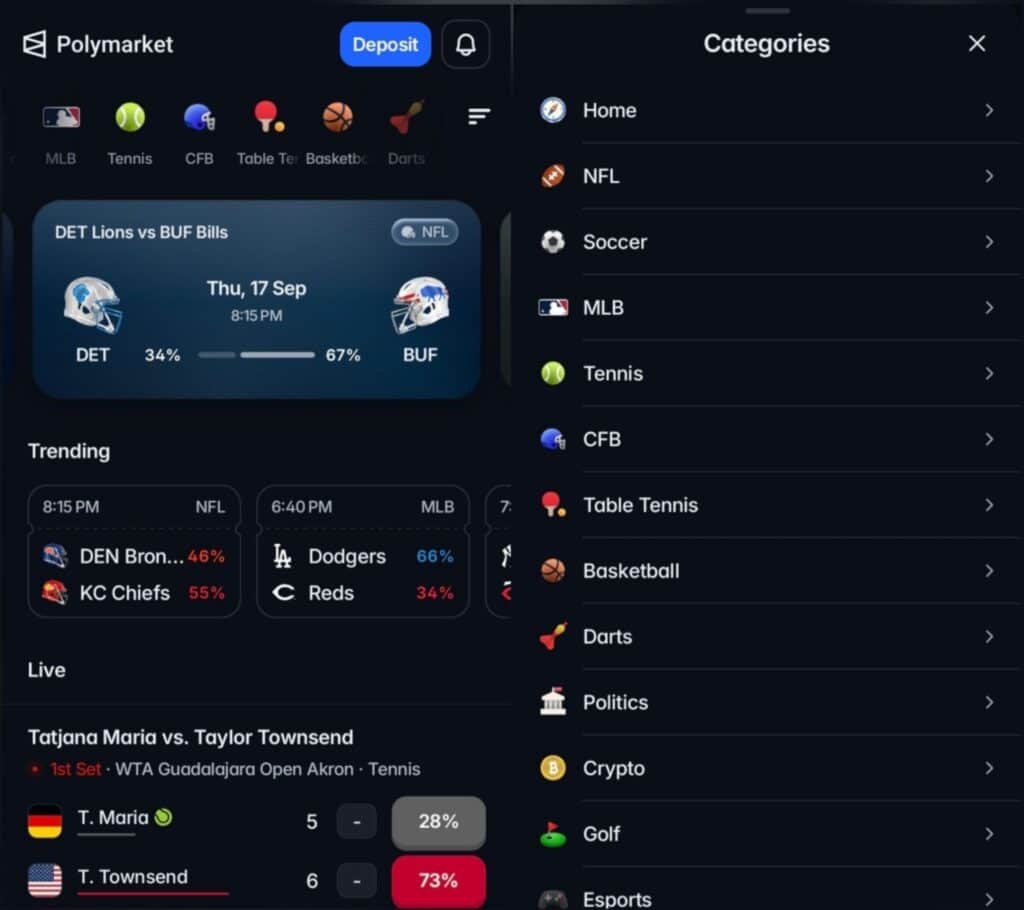
In using the Polymarket app, you’ll find markets available for various sports, from the big leagues (NFL, MLB) to more niche markets (table tennis, chess, darts, cricket) as well as Esports. But Polymarket is not a sports-only prediction market app as you’ll also find event contracts for politics, crypto, weather, tech, economics, and culture/entertainment.
Liquidity will vary by market size and popularity. An order on the moneyline for NFL games in prime time (like Chiefs vs. Broncos) will fill immediately at the displayed ask. The same size on an Emmy award longshot could take over a minute to fill, and the app will also alert you to when a contract has high slippage or limited liquidity.
Polymarket Fees & Trading Costs
On the Polymarket US product, trading fees follow a single formula applied exchange-wide, which has been in effect since July 1, 2026:
- Fee = Θ × C × p × (1 − p)
Where C is the number of contracts and p is the trade price. The taker fee coefficient is 0.06, and the maker rebate coefficient is -0.0125, meaning only takers pay a fee, while makers receive a rebate. The fee is symmetric and peaks at the 50-cent midpoint, where a 100-contract trade costs a taker $1.50 and pays a maker $0.31. It shrinks toward the price extremes, dropping to just a few cents on contracts priced near $0.01 or $0.99. High-volume takers (min. $250,000) can also qualify for weekly rebates of 10% to 50% depending on prior-month trading volume.
Polymarket App Experience & Payments
For the app experience, Polymarket has a clean interface with well-defined categories to trade. The app also makes it easy to deposit and withdraw with the following payment methods available:
- PayPal
- Venmo
- Bank transfer (ACH)
- Wire transfer
- Debit card
The payout speed for a withdrawal varies by method, with 3-4 business days for debit card and bank transfers, while a wire transfer can be completed in one business day. A withdrawal to PayPal or Venmo takes up to one business day as well.
3. Novig App: Sportsbook-style App with No Vig
Novig ranks No. 3 on our list because its peer-to-peer trading model offers sports fans something traditional sportsbooks won't: The ability to trade directly with other users without a built-in house vig. Hence, the company is named Novig. Instead of a sportsbook setting the price and taking a margin, Novig's odds are driven by its marketplace, and users can either accept the available price or create an order at their own preferred odds.
👍 PROS
- No trading fees on pre-game straights
- Deep selection of sports props
- CFTC DCM regulation via Ludlow Exchange
👎 CONS
- Fewer payment methods compared to competitors (no PayPal or wire transfers)
- Must be 21+ to use (competitors are usually 18+)
- Only sports contracts (no politics, economics, culture, etc.)
Novig App Overview
Founded in 2021 by Harvard graduates Jacob Fortinsky and Kelechi Ukah, Novig was built to disrupt the traditional sportsbook model by introducing financial exchange mechanics to sports trading. Novig is built for traders with the user experience in mind, including a promise not to exclude profitable winners like some sportsbooks allegedly do. Novig believes in a free market with transparent odds and limits where the best traders win.
NFL legend Joe Montana, a Novig investor, has called the company “an absolute game changer,” and he believes “the future of sports trading is here.” The key differentiator is Novig's peer-to-peer, no-vig pricing model. Users can accept the best available odds or use “Make Order” to name their own price and wait for another participant to take the opposite side. When users trade directly with each other, Novig doesn't build the traditional sportsbook vig into the transaction, allowing prices to develop through supply and demand instead of a house-set margin.
Novig Markets & Liquidity
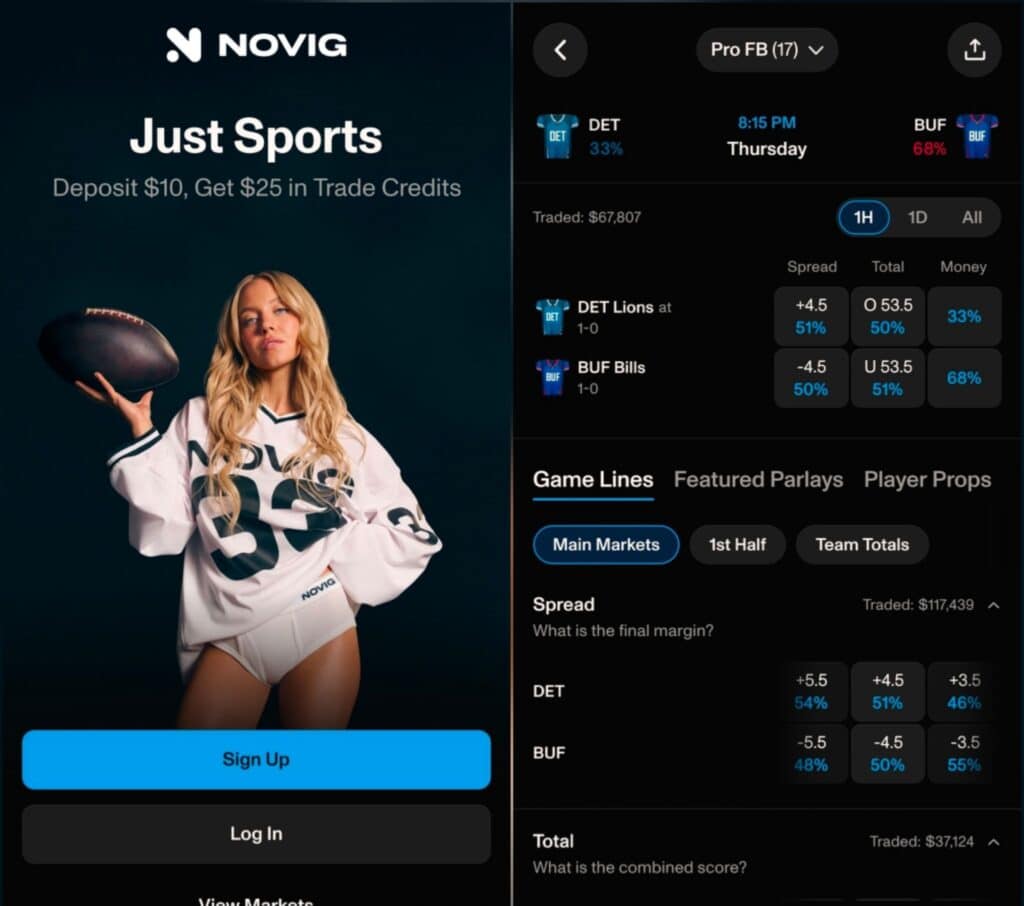
Novig offers a deep selection of sports markets despite being much more specialized than all-purpose prediction markets. Available market types include moneylines, spreads, team totals, expanding player props, along with futures markets, parlays, and same-game parlays (SGPs). Novig currently lists markets across the following, with more to come in the near future:
- Pro Football (NFL)
- Pro Baseball (MLB)
- Tennis
- UFC
- College Sports (NCAAF, NCAAB, NCAAW)
- Pro Basketball (NBA, WNBA)
- Pro Hockey (NHL)
- Soccer (EPL, La Liga, MLS, Ligue 1, Serie A, BUN, Champions League, etc.)
- PGA Golf
Liquidity varies by sport and individual market, which is important on a peer-to-peer platform. Compared with a sports-only competitor such as ProphetX, the popular sports markets on Novig tend to offer superior liquidity while niche markets can experience wider spreads during off-peak hours.
Novig Fees & Trading Costs
Unlike other trade exchanges and traditional sportsbooks that utilize built-in margins or commission fees, Novig operates on a commission-free no-vig pricing structure for standard peer-to-peer trades. Traditional sportsbooks build a 4% to 5% house margin (“juice” or “vig”) directly into their odds (i.e. standard -110/-110 lines), while competitors such as Kalshi or Polymarket US charge dynamic percentage-fee rates on contracts.
In contrast, Novig matches orders directly between users at true market-derived probabilities without taking a fee percentage off the wager or net payout for basic pregame trades. This no-vig fee model significantly reduces trading costs for the vast majority of its traders. Novig makes money by sometimes acting as a market maker on the platform to provide liquidity for thinner markets, and it has a fee structure for highest-volume users (think hedge funds).
Novig App Experience & Payments
What is a feature of the Novig app experience that Polymarket and Kalshi do not have? For starters, a Sydney Sweeney pic as their newest spokesperson when you open the app for the first time. But once you’re verified, the user interface looks familiar to those apps while also taking on the look of a traditional sportsbook with spread, total, and moneyline markets visible for top events.
The payment methods for deposits and withdrawals are currently:
- Credit or debit card (3% fee)
- Bank transfer/ACH (no fee)
4. PrizePicks App: Familiar DFS App, Now with Contracts
PrizePicks ranks No. 4 because its biggest advantage is brand familiarity for daily fantasy sports (DFS) players rather than being a prediction-market-first platform. PrizePicks built a large U.S. audience around simple pick ‘em DFS contests before adding federally regulated prediction markets in 2025. In certain states, customers can now access Culture Picks along with Team Picks and Player Picks.
👍 PROS
- Partnership with Kalshi’s order book provides solid depth of markets
- Familiar app for fans of the DFS product
- CFTC-regulated event contracts on more than just sports
👎 CONS
- Only 25 states have access to all three types of picks
- Limited deposit methods on the app
PrizePicks App Overview
PrizePicks was founded in 2015 as “PredictPicks” before changing the name in 2018 after the company established itself in the daily fantasy sports industry with its lineup games where you choose More/Less on a player’s stats. While those Player Picks are still the core product here, PrizePicks extended into event contracts in November 2025 with the launch of PrizePicks Predict, organized in-app as Team Picks and Culture Picks.
Rather than building its own regulatory infrastructure from scratch, PrizePicks created a separate entity, Performance Predictions II, LLC, which is registered with the CFTC as a Futures Commission Merchant and is a member of the National Futures Association. Through this structure, PrizePicks offers Kalshi-listed event contracts directly inside its native app, giving its DFS user base a path into CFTC-regulated prediction markets without needing to create a separate account elsewhere.
PrizePicks Markets & Liquidity
The Player Picks at PrizePicks are still the core game offered, and those are essentially player prop picks in popular markets like the NFL, MLB, NHL, NBA, WNBA, and college sports (basketball and football) alongside soccer, tennis, Esports, MMA, and PGA Golf.
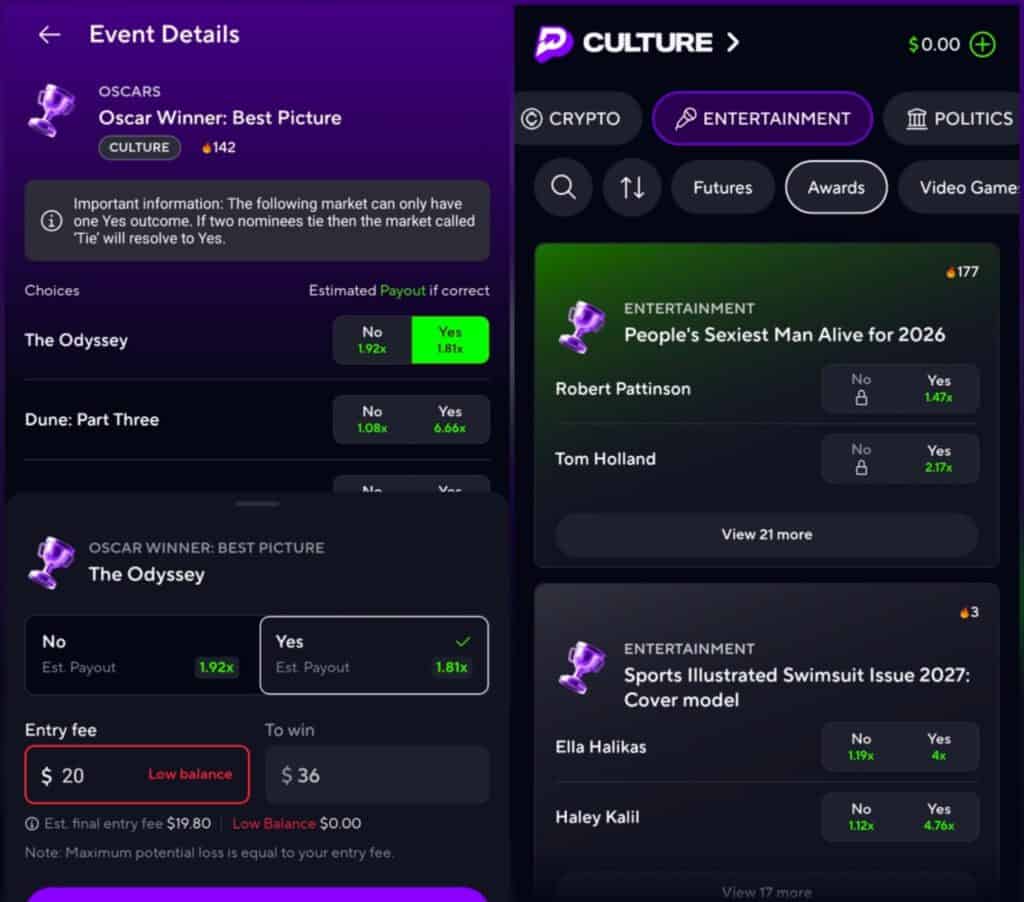
But with the new prediction market side of the app, you’ll find “Culture Picks” for topics such as TV, mentions, climate, crypto, entertainment, politics, music, elections, movies, companies, financials, economics, and AI. On this Culture and Team Picks side of PrizePicks, it uses Kalshi’s order book for liquidity. Marquee NFL/NBA games will usually show tighter prices than a thin culture contract or a midweek golf market. It could be harder to get out of a position early on a thin market.
PrizePicks Fees & Trading Costs
PrizePicks uses different fee structures for its DFS contests compared to the prediction market. For traditional Player Picks, customers pay an entry fee that is disclosed before submitting a lineup. For Team Picks and Culture Picks, PrizePicks instead charges trading fees when contracts are bought or sold.
The service fee for Team and Culture Picks currently ranges from $0.005 to $0.02 per contract. Fees are rounded up to the nearest cent, and they are added to every buy or early sell of a contract. There is no settlement fee if you hold the contract until it is resolved.
PrizePicks App Experience & Payments
Your PrizePicks app experience may differ based on which state you live in, as the types of available picks vary by state. Some will have access to all three types (Culture, Player, Team) while others may have one or two categories only. But they all use the same PrizePicks app that has powered the DFS product for years.
Here are the payment methods currently available on the PrizePicks app, where the minimum deposit is $10, and these methods are the only ones available for all three pick types:
- Online banking via Aerosync
- Debit card (Visa and Mastercard only; min. deposit is $10)
5. ProphetX App: Best Parlay Builder, Up to 12 Legs
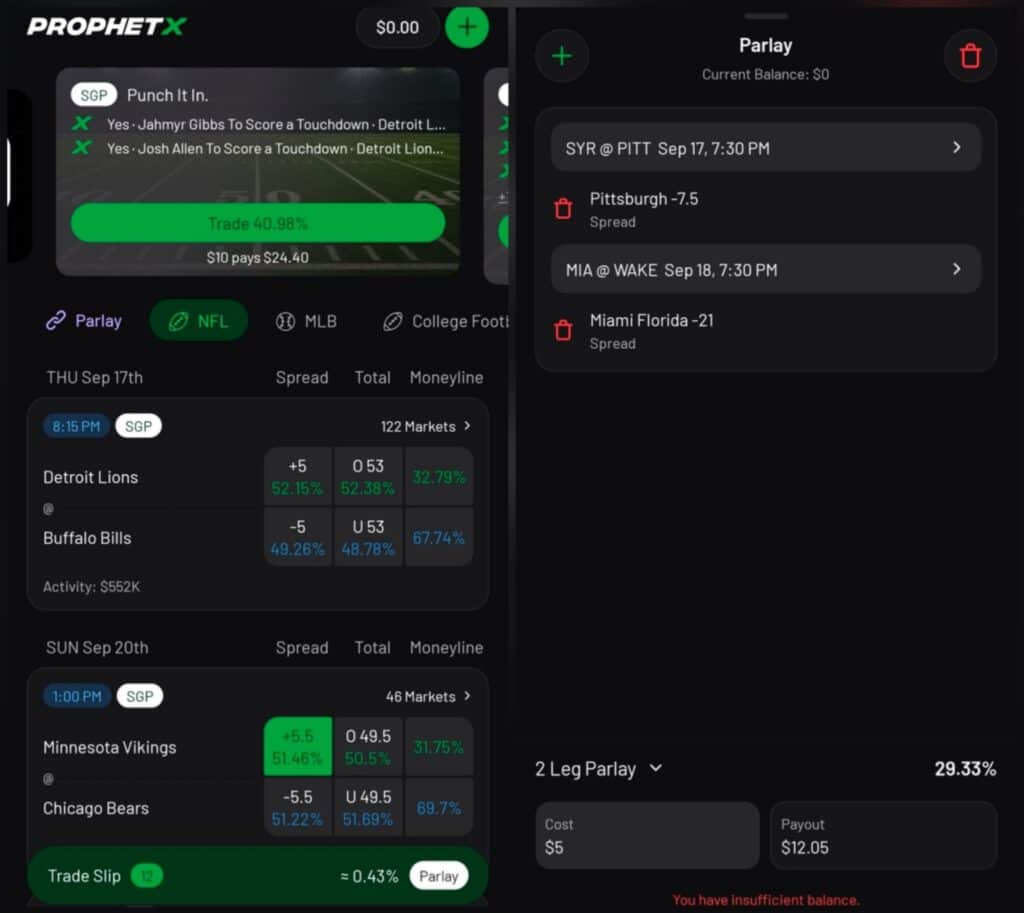
ProphetX ranks No. 5 on our list thanks largely to its distinctive approach to parlay trading. The ProphetX app operates as a sports prediction exchange, allowing users to take positions against other participants rather than simply accepting house-set sportsbook odds. Its biggest differentiator from Novig is its Request for Quote (RFQ) engine, which brings the exchange model to parlays by letting users build a combination of picks and request a price from the marketplace, getting better value on a parlay than a traditional sportsbook.
👍 PROS
- Top choice for building sports parlays (up to 12 legs) with RFQ system
- More deposit methods than Novig
- American odds display will be familiar to sportsbook users
👎 CONS
- Limited experience (since June 2026) as a CFTC-regulated exchange
- Parlays carry an extra fee that straight positions do not have
- Liquidity is not guaranteed on custom parlays
ProphetX App Overview
Founded in 2018 by Dean Sisun and Jake Benzaquen, ProphetX began as a UK-licensed peer-to-peer sports marketplace, later operated in the U.S. as a sweepstakes product, then relaunched nationwide as both a Designated Contract Market (DCM) and Derivatives Clearing Organization (DCO) in June 2026 with CFTC regulation.
This regulation makes ProphetX “America’s first federally regulated sports-native exchange.” Users of the app will see familiar American odds listed for sporting events, including choices for the spread, total, and moneyline like a traditional sportsbook offers. But you can trade on these markets, or combine them into parlays, as part of a peer-to-peer network instead of trading against the house odds.
ProphetX Markets & Liquidity
In the ProphetX app, you’ll find the following sports markets available, with futures markets as well as your traditional options for spread, moneyline, totals, and player props:
- NFL
- MLB
- College Football
- Premier League
- La Liga
- Bundesliga
- Serie A
- Ligue 1
- WTA
- Golf Outrights
- English Championship
- UFC (MMA)
For parlay construction, you can add anywhere from two to 12 selections to form your parlay. ProphetX also supports live trading where you can enter a position after the event has already started, then you can decide to hold or exit as the live probabilities shift in real time. Liquidity varies by event and market. When there is a correlated Same Game Parlay without much liquidity, that combo may be restricted from executing an order.
ProphetX Fees & Trading Costs
For straight positions, ProphetX keeps its trading fees relatively simple. The platform charges a 2% fee on net gains per market, meaning the fee is applied to profits rather than the total amount traded. ProphetX advertises this as a “winnings only” fee, so a losing straight trade does not generate the standard 2% trading charge.
Parlay fees work differently. ProphetX applies a separate fee schedule to parlay contracts rather than using the standard 2% straight-trade fee. Because parlay pricing is generated through ProphetX's RFQ system and can vary with the individual contract, traders should review the displayed price and fee before accepting a parlay opportunity. But according to ProphetX’s own fees page, an order to buy 100 contracts at a price of $0.65 generates a fee of roughly $0.98 based on their formula. Makers are not charged a trading fee on parlays.
ProphetX App Experience & Payments
The ProphetX app experience is most similar to Novig, with a sportsbook-like display of sports trading markets with sections for spread, total, moneyline, and you can build your parlays and Same Game Parlays.
For withdrawals, most can be completed within 24 hours, but some methods can take up to 5 business days. The payment methods at ProphetX for deposits and withdrawals currently include:
- Online Banking via Aeropay
- Cryptocurrency with Zerohash (deposit only)
- Debit Card (deposit only)
- Apple Pay (deposit only)
- Wire Transfer (min. $1,000 deposits or $5,000 withdrawals; may take 72 hours to complete)
- Edge Real-Time Payment (must be 21+ years old; deposits only)
- Paper check (withdraw only)
6. OG.com App: Most Social Features in the App
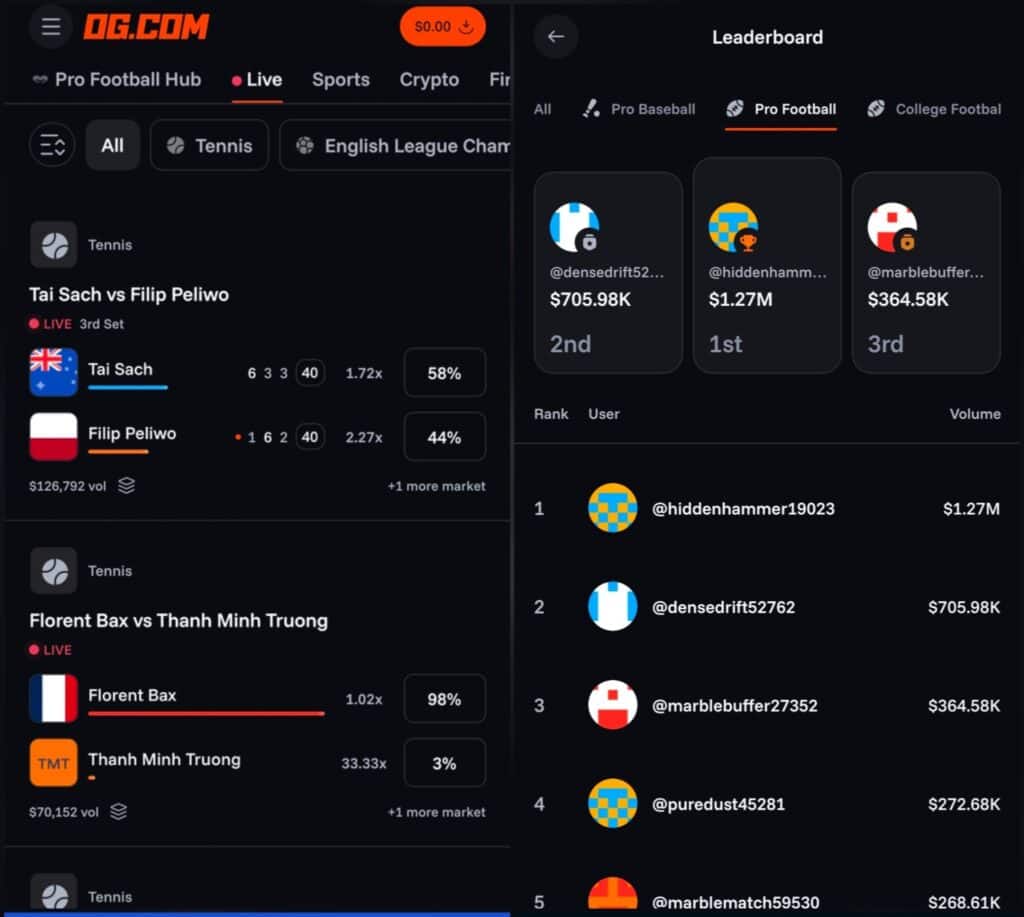
OG.com bridges the gap between quantitative event trading and community-driven engagement. While the top four competitors prioritize wide-range liquidity or sports-only order matching, the OG app distinguishes itself by embedding social trading directly into the market interface. Built around real-time public leaderboards, copy-trading feeds, and market-specific live chat streams, OG.com transforms prediction trading into a shared, interactive experience.
👍 PROS
- The most social features (AI assistant, live chat, dynamic leaderboards) of any prediction market app
- Strong CFTC regulatory structure thanks to the Crypto.com brand
- Broad event variety (not just sports)
👎 CONS
- Lower-liquidity markets may be harder to exit at the desired price
- A relatively new platform (launched in 2026) with fewer traders than Kalshi and Polymarket
- High minimum deposits for debit cards and wire transfers
OG.com App Overview
Launched in 2026 by Crypto.com co-founder Kris Marszalek as a standalone prediction market app, OG.com combines two decades of regulated infrastructure with a new approach for community trading. OG combines event contracts with social features such as leaderboards, live chat, and an AI called “Alpha” that creates an experience designed to feel social rather than a conventional financial exchange.
OG.com operates within a federally regulated framework as a rebrand of NADEX, which does business under the OG Prediction Markets brand. It is registered with the CFTC as both a Designated Contract Market (DCM) and Derivatives Clearing Organization (DCO). Through that infrastructure, OG users can trade event contracts covering sports, culture, politics, economics, and other real-world outcomes.
OG.com Markets & Liquidity
OG.com is more similar to Polymarket US and Kalshi than our previous two sports-only markets, Novig and ProphetX. Here are the categories of markets you can expect to find on the OG app:
- Sports (major leagues and niche markets like Esports, motorsports, and sailing)
- Crypto
- Financials
- Commodities
- Economics
- Politics
- Culture
- Climate
For the combo builder at OG, it is designed for sports markets with 2-to-8 legs maximum. Some events support live games or same-game parlays. You cannot combine cross-market legs for a parlay, such as trading on the Super Bowl LXI winner and the 2027 Oscars Best Picture winner. High-profile sporting events and major political elections will have the strongest liquidity, while niche markets like economic futures are more prone to wider spreads. Liquidity can affect whether you can sell a position early at OG.com.
OG.com Fees & Trading Costs
OG.com uses a contract-based fee structure rather than charging one simple percentage of your deposit or overall account balance. When you enter an event contract, your total cost consists of the contract price plus any applicable trading fees, with the specific charge depending on the contract and transaction. OG displays the applicable cost as part of the trade, so users can review what they're expected to pay before confirming a position.
For markets like crypto and commodities, it is usually a fee of $0.02 to open a contract and another $0.02 to close it before expiry. Since OG's contract fees can vary, traders should not assume that every market carries the same trading cost. The best practice is to check the order details (click the circled “i” for full fee breakdown as pictured below) and current fee schedule before placing a trade, particularly when comparing OG with platforms that use a flat commission or winnings-based fee model like our first four entries above.
OG.com App Experience & Deposits
The OG.com app experience is different from most thanks to the AI-powered Alpha feature where you can ask for advice on positions to take. Also, some of the social features include dynamic leaderboards that show which users have the most trade volume in a variety of categories, and you can enter a live chat right on an event contract page to further gauge the wisdom of the crowd.
For payment methods on the OG.com app, here are the current choices for a deposit or withdrawal:
- Debit Card (1.49% fees; min. $10 deposit)
- Venmo (1.99% fees)
- PayPal (1.99% fees)
- Google Pay (1.49% fees)
- Bank account via Plaid (no fees)
- ACH bank transfer (no fee; takes 1-5 business days; min. $1 deposit)
- Wire transfer (no fee; takes 1-2 business days; min. $1,000 deposit)
- Crypto-to-Cash (fee may apply; can take 20 minutes)
You can withdraw to your debit card or ACH bank transfer, which takes 1-5 business days to complete.
7. Crypto.com App: Crypto Wallet & Trading in One App
Crypto.com is the best prediction market if cryptocurrency is your desired method of funding your account. The Crypto.com app’s differentiator is the wallet instead of the book itself, thanks to delivering a seamless bridge between digital assets and regulated contracts. Users can trade real-world event contracts directly alongside their crypto portfolios with simple crypto-to-USD conversions and plenty of supported tokens.
👍 PROS
- Maker orders have no trading fees
- Supports 400+ cryptocurrency tokens for conversion
- All-in-one app for crypto and stock trading with huge established user base
👎 CONS
- Registration process has extra steps (driver's license photos, selfie video); the others don't
- Non-crypto fans and first-time traders may feel overwhelmed
Crypto.com App Overview
Crypto.com was founded in 2016 in Hong Kong and had 10 million users in February 2021. They have reported over 100 million customers by June 2023 as they have expanded from a global crypto exchange and wallet to also offering stock trading and a prediction market platform with event contracts on their inclusive app.
From a regulatory standpoint, Crypto.com operates its prediction trading in the U.S. through Crypto.com Derivatives North America (CDNA), a designated contract market regulated by the Commodity Futures Trading Commission (CFTC).
Crypto.com Markets & Liquidity
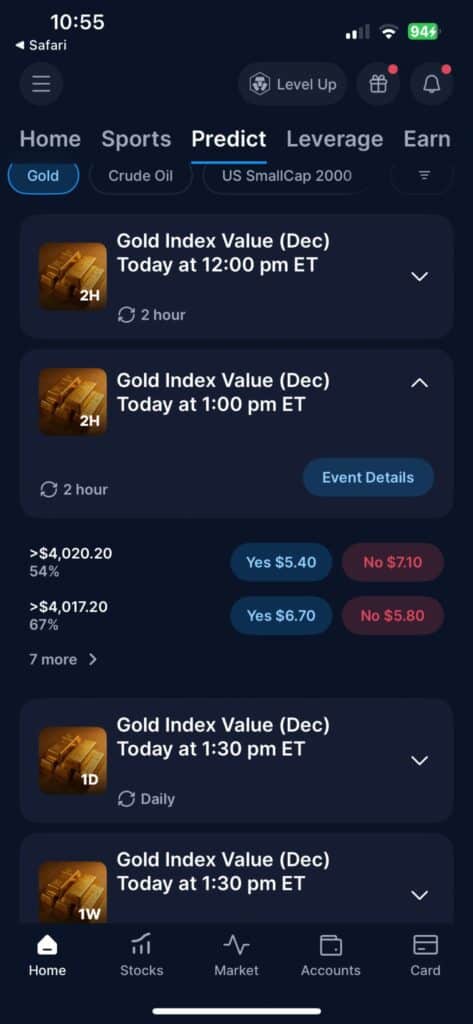
Crypto.com offers 2,000+ prediction markets spanning politics, financials, economics, sports, culture, climate, technology, and cryptocurrency. Its crypto markets are a particularly natural fit for the platform, with event contracts covering cryptocurrency price movements alongside more conventional prediction topics. Crypto.com specifically highlights Bitcoin price predictions as a popular category, and its current market listings include both Bitcoin and Ethereum price contracts.
Crypto.com does not publish one platform-wide liquidity figure, and trading conditions can vary significantly from contract to contract. The company boasts 400+ supported crypto tokens for funding. Crypto.com acknowledges that some contracts can have low trading volume, which may make positions harder to exit and produce wider spreads. More popular markets generally provide better liquidity and smoother pricing, so traders should check the available prices and depth of a specific contract.
Crypto.com Fees and Trading Costs
On the Crypto.com app, trading fees follow a maker-taker fee schedule. For $1 prediction contracts, maker orders carry no fee, while taker fees currently range from $0.01 to $0.0175 per contract, depending on the contract value. There is also no settlement fee when the contract is resolved. Crypto.com displays the transaction cost before a trade is confirmed.
One extra cost to prepare for is crypto conversion fees. Crypto.com lets users fund prediction trades with cash or by converting crypto but converting cryptocurrency can introduce additional costs. You may be charged an admin fee when buying, selling, or transacting in crypto, with the amount affected by factors such as market conditions, volatility, and liquidity. Any applicable conversion fees are shown in the trade preview, so crypto-funded users should review the final conversion rate and fee before submitting their transaction.
Crypto.com App Experience and Deposits
Our Crypto.com app experience got off to a rocky start as the sign-up process involved more steps than the competitors, including screenshots of your driver’s license and recording a selfie to prove your identity. But once inside, we found the app easy enough to use to make trades.
While conversions of 400+ cryptocurrencies are the main appeal of Crypto.com, there are other payment methods for deposits and withdrawals:
- ACH bank transfer (US): No Crypto.com fee; $1 minimum deposit; 1–5 business days to settle
- Instant Deposit via Plaid-linked bank account: Funds available within minutes, though withdrawals are held for 7 business days
- Wire transfer: Available for larger transfers, typically slower to initiate than ACH
- Debit/credit card or Apple Pay/Google Pay: Near-instant, but usually the highest-cost funding option
- Existing crypto wallet transfer: Deposit supported coins directly from an external wallet, generally fee-free on the receiving end
8. FanDuel Predicts App: Get the FanDuel Look & Feel
FanDuel is one of America’s top-rated sportsbooks, but it is our No. 8 prediction market app with its latest product, a standalone prediction market app called FanDuel Predicts. Users can take positions on some non-sports markets, but the real sell here is the trust of a huge sportsbook backed by this new joint venture with CME Group.
👍 PROS
- Strong brand recognition with a top sportsbook/DFS product
- Users in states without legalized sports betting can trade sports contracts
- FanDuel-style responsible gaming tools are available
👎 CONS
- Users in states with legalized sports betting cannot trade sports contracts (must face house odds instead of peer-to-peer sports trading)
- Lacks the market depth of Kalshi and Polymarket
FanDuel Predicts App Overview
You are likely familiar with FanDuel’s story from being founded in 2009 as a leading DFS company before throwing its hat into the sportsbook industry ring in the late 2010s, where it has become a respected brand, paving the way for popularizing Same Game Parlays for sports bettors.
But in November 2025, FanDuel announced the launch of FanDuel Predicts as a separate prediction market app that allows it to operate in states where sports betting is not yet legalized. FanDuel Predicts is a joint venture with the CME Group, which handles the exchanges under CFTC oversight. Customer accounts and event contracts are managed by FanDuel Prediction Markets LLC, a registered Futures Commission Merchant (FCM) and National Futures Association (NFA) member. Customer funds in FanDuel Predicts are kept separate from the FanDuel Sportsbook.
FanDuel Predicts Markets & Liquidity
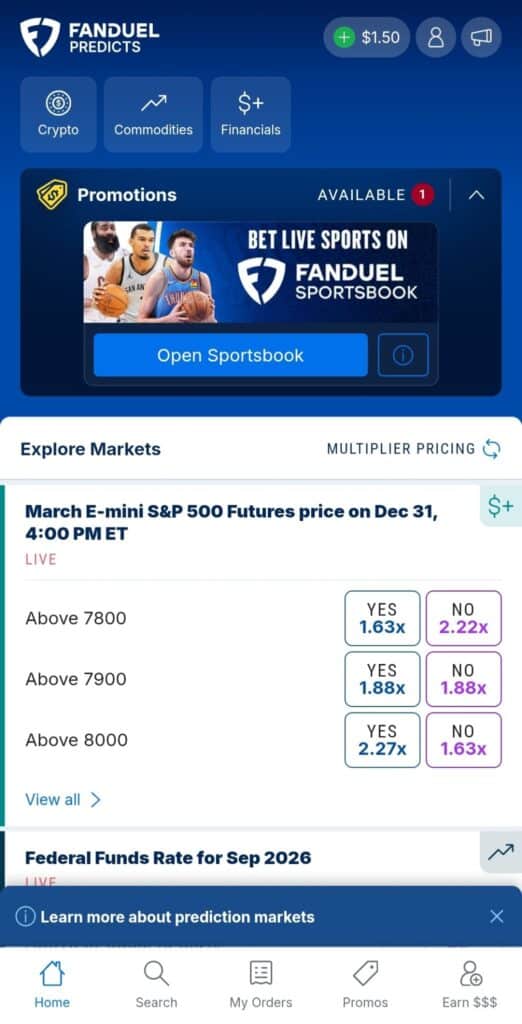
FanDuel Predicts offers markets in culture/entertainment, crypto, economics, commodities, and financials. You can also trade sports contracts, including combos/parlays, for popular leagues (NFL, NBA, etc.) but that is only in states where sports betting with FanDuel is not currently legal. As FanDuel advances its sportsbook into other states, they will remove their sports contracts on the FanDuel Predicts app.
Liquidity varies by individual contract. We did not personally test the sports predictions since we are located in a sportsbook-legal state, but FanDuel Predicts does not necessarily share the same underlying liquidity source as CME, something worth keeping in mind when comparing depth across contract types. In thinner markets, it could be hard to exit a position early.
FanDuel Predicts Fees & Trading Costs
The trading fees at FanDuel Predicts are fairly straightforward. There is a flat 2% transaction fee included at checkout based on your potential payout. If you cash out early, the 2% transaction fee applies to your payout as well.
FanDuel Predicts App Experience & Payments
Your FanDuel Predicts app experience will feel similar to using the FanDuel Sportsbook, with a similar blue/white color scheme and design. But you’ll find YES/NO contracts instead of traditional American betting odds, and there are responsible trading tools for deposit limits and alerts that you can turn on.
The minimum deposit on FanDuel Predicts is $5, like the sportsbook, and the payment methods for deposits and withdrawals include:
- Debit card
- Online banking
9. Betr App: All-in-one Gaming Super App
Betr ranks No. 9 on our list of apps primarily because they are still rolling out their prediction market product in late 2026. The company advertises itself as the “World’s First Real Money Gaming Super App” by offering player picks similar to the DFS games at PrizePicks, and they also have a social sportsbook, social casino, arcade games, and the new prediction market. It stands out among the pack as a gaming super app, but we are early days on Betr as a leading trade exchange.
👍 PROS
- Super gaming app with social sportsbook/casino, arcade games, and more
- Prediction market is powered by a Polymarket partnership
- No trading fees on maker orders
👎 CONS
- Very early stages for the prediction market
- No mobile site gaming (app only)
Betr App Overview
Betr launched in 2022 as a mobile-first sports gaming company co-founded by Joey Levy and social media star Jake Paul. The platform initially centered on sports products, including its simplified Betr Picks DFS experience, before developing into what Betr identifies as a “real money gaming super app.” Its lineup has since expanded to include fantasy sports, social sportsbook and casino products, arcade games, and eventually prediction markets in 2026.
For the new prediction market, Betr has added event contracts powered by Polymarket directly into the established Betr app. Polymarket runs the underlying prediction-market infrastructure and separate identity-verification requirements while Betr provides the front-end experience for buying and selling positions. Betr describes Polymarket as a CFTC-regulated exchange, making the regulatory structure distinct from Betr’s fantasy and social gaming products.
Betr Markets & Liquidity
Market coverage on Betr is heavily concentrated on sports markets, reflecting the platform’s roots in real-time sports betting and daily fantasy pick'em contests. The app’s primary product spans all major North American leagues (NFL, NBA, MLB, college football, etc.) along with niche and international offerings like soccer and combat sports (UFC). You’ll find moneylines, spreads, totals, player props, parlays, and micro-betting live markets like the result of the next plate appearance in baseball games.
We were not able to test the prediction market’s liquidity as it’s not yet live in our area as of writing. But Betr promotes its prediction market as being “predictions on sports and more,” with more meaning politics, finance, entertainment, crypto, economics, culture, weather, mentions, tech, geopolitics, and more, given the partnership with Polymarket, our No. 2 ranked app that has a wide breadth of markets.
Betr Fees & Trading Costs
Betr Picks has an entry fee, as is standard for the DFS industry. But for trading fees on the prediction market, we were not able to see the fee structure in practice given the product not being live as of writing. However, we found on the Betr site a fee structure that sounds comparable to the Polymarket way of charging fees for contracts.
- Maker orders have no fees.
- The current taker fee rates are 7% for crypto, 5% for sports, economics, culture, weather, and general markets, and 4% for finance, politics, technology, and mentions.
- Geopolitical and world events carry zero fees at all times.
- Depositing or withdrawing USDC never costs anything on Betr’s end.
Betr App Experience & Payments
The Betr app experience is certainly easier if you’ve used the platform before. For beginners, it can get confusing when you switch between the different platforms (sportsbook, arcade, prediction market) and when you try to fund your account, as certain methods only work for certain parts. For example, PayPal and Venmo are not supported on Social Sportsbook or Casino even though they work for withdrawals on the Arcade and Betr Picks.
Betr has a $10 minimum deposit or withdrawal for its Fantasy Wallet. But the Polymarket-powered Predictions are said to use USDC (a cryptocurrency stablecoin) that will carry no fees for deposit or withdrawal. We can later confirm the payment methods for the Betr Prediction Market, but these were the options we had for the other deposit methods:
- Debit cards (Visa and Mastercard)
- Instant bank transfers
- PayPal (Fantasy Wallet only)
- Venmo (Fantasy Wallet only)
What Are Prediction Market Apps?
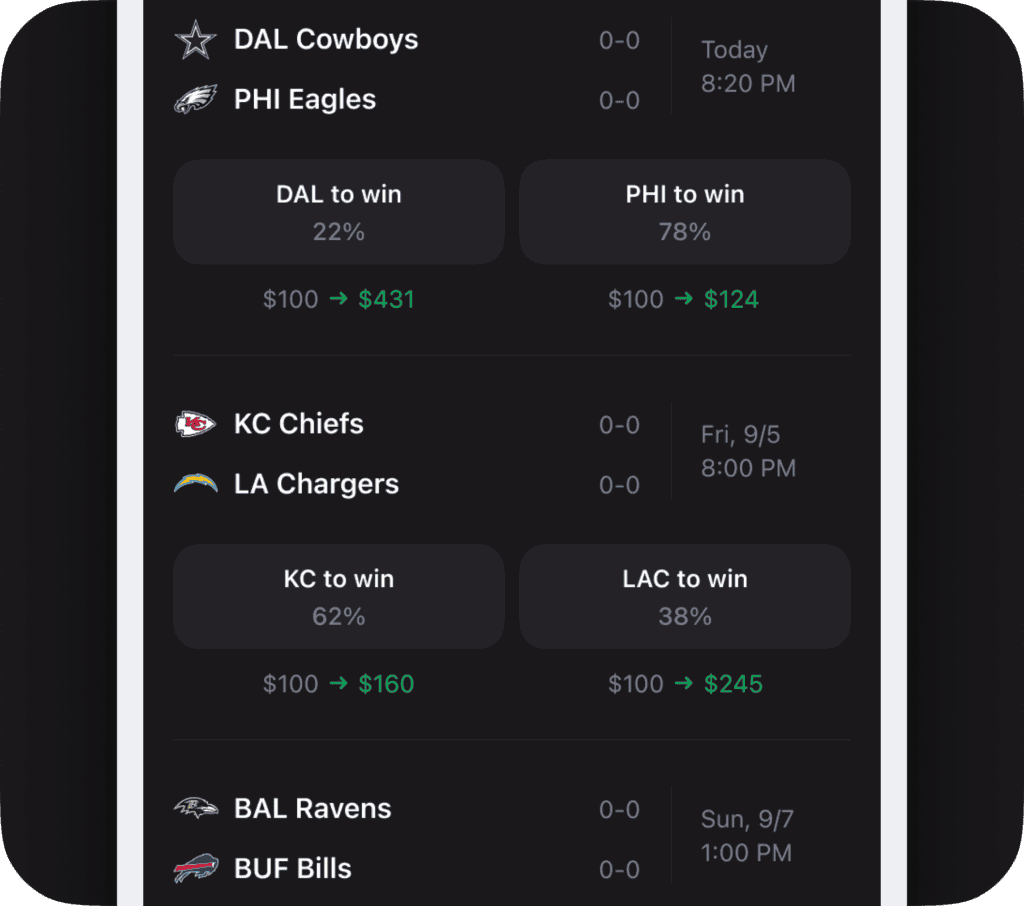
Prediction market apps are platforms where users trade event contracts based on whether a future outcome will happen. Instead of placing a traditional bet with a sportsbook, users buy and sell contracts whose prices change with market demand, allowing those prices to represent the market's estimated probability of an event occurring.
Many prediction markets use yes/no contracts that settle at $1 or $0. For example, if a “Yes” contract trades at $0.70, its price implies roughly a 70% probability of that outcome occurring. Traders can buy or sell as expectations change, and those who hold a correct position through settlement receive the contract's specified payout.
How Do Prediction Markets Work?
Understanding how prediction markets work starts with the contracts themselves. Most markets pose a question with defined outcomes, such as whether a team will win a championship or if the weather will produce precipitation in a specified region tomorrow. Traders then buy and sell positions based on what they believe will happen.
With probability pricing, prices fluctuate as traders buy and sell, allowing you to exit before the event ends rather than waiting for contract settlement. If your position becomes more likely and its price rises, you may be able to sell for a profit. If the market moves against you, you can sell to limit your loss. Alternatively, you can hold the contract until the outcome is officially decided.
A simple event trading lifecycle looks like this:
- Buy a position: You purchase a contract at the Yes/No position you think is the most valuable.
- Watch the price move: New information and trading activity can push the contract's market price higher or lower.
- Sell early or keep holding: You can generally sell the position before settlement to realize a gain or loss, provided there is sufficient market liquidity, or continue holding it.
- Settle the contract: If you hold through the event, the platform settles the contract according to its predetermined rules. A winning $1 binary contract pays $1, while the losing side settles at $0.
How Is It Different from Sports Betting?
The biggest difference between prediction markets and sportsbooks is who sets the price. A traditional sportsbook acts as the house, posting fixed odds that include a built-in margin (“vig”). Prediction markets use exchange-style trading, where participants buy and sell contracts and market activity determines the price. That price can shift as traders react to news, injuries, or other information.
This structure also explains the no-vig concept often associated with prediction markets. Instead of a sportsbook embedding its edge directly into both sides of the odds, an exchange matches buyers and sellers and may charge trading or transaction fees. Traders can also generally sell a position before an event settles, making the experience closer to trading a financial contract than placing a conventional fixed-odds sports bet.
Are Prediction Market Apps Legal in the US?
Prediction market apps operate under a different legal framework than traditional online gambling. Most of the major prediction apps are regulated as derivatives exchanges by the Commodity Futures Trading Commission (CFTC) rather than by individual state gaming commissions. This is what allows platforms like Kalshi and Polymarket US to offer event contracts nationwide even in states where traditional sports betting remains restricted.
However, “legal” and “available” at the state level are two different things. Several states have pushed back with lawsuits against certain contracts (sports, namely), including active cases in Nevada, Tennessee, Connecticut, and Wisconsin. With a shifting landscape, state-by-state availability should always be confirmed directly in each app before signing up.
How to Choose the Best Prediction Market App?
Deciding how to choose a prediction market app comes down to matching the platform to what you want to trade, how you want to fund your account, and how actively you plan to trade.
- Market focus: If you strictly want broad macro, political, and world event contracts, Polymarket US and Kalshi lead the pack, while users looking exclusively for dedicated sports markets should try Novig or ProphetX.
- Fee tolerance: Active traders seeking zero-commission, peer-to-peer pricing should prioritize Novig, while those comfortable with flat, transparent fees for sports derivatives will prefer com over high-fee alternatives like FanDuel Predicts.
- Funding preference: Traders who are most comfortable with cryptocurrency for funding event contracts will find com to be the best prediction market app fit, and users preferring traditional ACH and USD methods should opt for Kalshi or Polymarket US.
- Experience level: For casual fans seeking the best prediction market app for beginners, PrizePicks and Betr offer highly accessible, simplified player-prop interfaces, whereas sophisticated market traders will get the most value from Polymarket US and Kalshi.
- State availability: Those prioritizing full CFTC federal oversight and widespread state access across US prediction market trading apps should target Kalshi or Polymarket US while checking local state availability for sports-centric platforms, as availability status is always in flux.
What Can You Trade on Prediction Market Apps?
Prediction market apps let you trade on the outcomes of real-world events across far more than just sports and elections. Market selection varies by platform and your location, but the biggest prediction markets generally cover these major categories:
- Sports markets: Trade contracts tied to game winners, championships, playoff results, awards, statistical achievements, and other sporting outcomes.
- Politics markets: Trade on elections, candidate performance, government appointments, legislation, and other political events.
- Economics: Markets can cover inflation, interest-rate decisions, unemployment, GDP growth, and other economic indicators.
- Weather markets: Some platforms host contracts based on temperatures, hurricanes, snowfall, rainfall, and other objectively measurable weather events.
- Crypto markets: Trade on outcomes involving Bitcoin and other cryptocurrencies, including whether an asset will reach a certain price by a specific date.
- Culture and entertainment: Markets may cover box-office movie performance, award show outcomes (Emmys, Oscars), music releases, television, celebrity events, and other pop-culture outcomes.
Prediction Market Apps vs. Traditional Sportsbooks: What’s the Difference?
While they share some similarities, the main difference between prediction market apps and sportsbooks is who determines the price. A prediction market is built on exchange-style trading between peers where the amount of buying and selling shifts the price. At a traditional sportsbook, they set their own fixed odds, and you are betting against the house. They also differ in regulation, fee structures, and how easily you can exit a position early, as the following table shows:
Responsible Trading: Know the Risks
Please note that trading on a prediction market app carries real financial risk and is fundamentally different from risk-free investing and sportsbook betting. Prices can undergo significant volatility as real-world information is gained, and there is always the possibility of losing the full amount of capital invested in any trade. You should only trade with risk capital that you can afford to lose entirely.
Also, there are age-eligibility requirements to open an account and trade real funds. It is typically 18 years old in the U.S., though exact age restrictions can vary by platform and local jurisdictions. For additional information about event contracts, their risks, and the protections available on regulated U.S. exchanges, consult the CFTC’s Prediction Markets and Event Contracts guide.
Which Prediction Market App Should You Download?
If you were to only download one app from this list, we'd recommend either Kalshi or Polymarket US. There's a reason why these two dominate in terms of popularity. Their market variety, liquidity, and how quickly odds move to reflect real-world info are the best in the business. Additionally, they are the most user-friendly options for those unfamiliar with trading contracts or who spend most of their time on sportsbooks.
But the best prediction market app totally depends on what you plan to use it for. If regulatory peace of mind and a beginner-friendly interface matter more to you than raw market depth, Kalshi is the safer pick that’s going to give you the most enjoyable first hour. If you're purely interested in sports outcomes rather than political or cultural events, Novig or ProphetX are worth a look for their sports-first approach and more favorable pricing structures compared to conventional sportsbooks.
In the end, there's no harm in signing up and trying multiple prediction market apps. They each offer solid new user bonuses, and if you sign up at multiple, you can compare prices across each to find the best.