
Polymarket is one of the most active prediction markets in the US, with markets on sports, politics, the economy, and more. Our Polymarket review found prices close to FanDuel's and sometimes slightly better. The downsides, though, are high fees on toss-up games, which is most of what sports bettors wager on. There are also no odds boosts, fewer parlays and props, and no tools to set spending limits.
We tested the Polymarket US app in October 2026. We signed up and deposited $200, traded on numerous markets (including the NFL), and compared prices to sportsbooks to determine which offers more value.
Overall rating: 4.8/5
- Who it's for: Traders who want more than sports, who frequently take hefty favorites or underdogs, or who live in a state without legal sports betting
- Who it's not for: Bettors who live on parlays, deep props, and sportsbook promos
This review covers Polymarket US, the federally regulated app for US users. It's a separate product from Polymarket's global platform.

Polymarket Review at a Glance: Key Details
Contents
- 1 Polymarket Review at a Glance: Key Details
- 2 Polymarket US: Pros & Cons
- 3 How Polymarket Works: Trading, Markets, and Prices Explained
- 4 What Polymarket Actually Costs
- 5 Polymarket vs. Sportsbooks: Which is Cheaper for NFL Games?
- 6 Polymarket vs. Kalshi: Which Prediction Market Is Better in October 2026?
- 7 Polymarket Prediction Market Review: What Can You Trade, and What's Missing
- 8 Where Can You Use Polymarket?
- 9 Deposits & Withdrawal Methods
- 10 The Risks of Using Polymarket that Most Reviews Don't Mention
- 11 How Polymarket is Taxed
- 12 Is Polymarket Right For You?
- 13 Polymarket Prediction Market Review | FAQs
- 14 Methodology
Polymarket US: Pros & Cons
Here are some of the key pros and cons about Polymarket US.
👍 PROS
- Most active prediction market on big games, so you typically get the price you see
- Take profits or minimize losses by selling anytime
- Prices shown as percentages, so you see each outcome's chances at a glance
- Set your own price to skip fees and earn a small rebate
- Deposit with debit, bank, PayPal, or Venmo
- Federally regulated (funds kept separate from company funds)
- Available in many states where sportsbooks aren't
👎 CONS
- High fees on 50/50 markets ($1.74 per 100 contracts)
- Fewer promotions than sportsbooks (no odds boosts)
- Fewer parlays and player props than a sportsbook
- Access is uncertain in many states (ongoing court battles)
- Prices can jump on smaller markets and niche sports
- Does not currently offer responsible trading tools
How Polymarket Works: Trading, Markets, and Prices Explained
Polymarket runs on the same basic idea as a sportsbook: you pick an outcome and get paid if you're right. However, the mechanics are quite different. Here's a breakdown of how Polymarket works and how it differs from traditional sportsbooks.
| At a sportsbook | On Polymarket |
|---|---|
| Odds (-110, +150) | A price in cents (52¢, 40¢) |
| You place bets | You buy contracts (also called shares) |
| Payout based on odds and vig/juice | $1 per share if you're right, $0 if you're wrong (minus fees) |
| The sportsbook sets the line | Other users set the price by purchasing/selling contracts |
| Cash out | Exit early by selling your shares to another user |
| The house's cut is built into the odds | A separate fee on some trades (highest for near 50-50 markets) |
Lesson #1: What You're Buying: ‘YES' or ‘NO' Shares
Every Polymarket market is essentially a “YES” or “NO” question. If the answer is yes, each YES share pays $1. If it's no, it pays nothing. There are no half-wins or pushes. That goes for spreads and totals too. “Bears win by 5+ points” either happens, or it doesn't (every share ends at $1 or $0).
Lesson #2: How to Read Prices at Polymarket
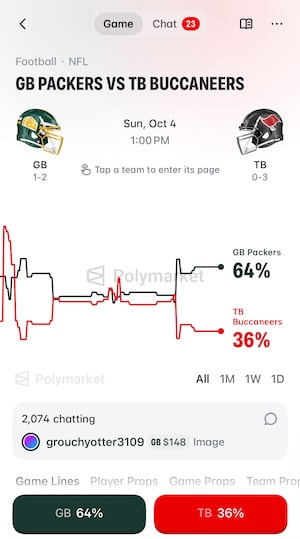
Put simply, the price tells you how likely an outcome is to occur (according to traders). A share at 62¢ means traders see about a 62% chance of an outcome playing out.
If you're used to American odds, a 50¢ share is roughly equivalent to +100 (a toss-up). A 40¢ share is about +150, a 25¢ share is about +300, and a 75¢ share is about -300, all before fees.
Lesson #3: How Prices Are Set
At a sportsbook, you bet against the house, and your odds are locked in the moment you place the bet. Polymarket and other prediction market sites are different. You buy from and sell to other users. The price rises and falls as people trade, similar to a stock.
No house cut (the vig/juice) is built into the price like at a sportsbook. However, trading still isn't free. Polymarket charges a fee on some trades, which we will break down in detail a bit later.
Lesson #4: Two Ways to Place a Trade
There are two types of trades you can make. These also determine the fee you'll pay.
- Buy now (taker): You take the best price currently on offer. You pay a fee, and it's highest on expected close games.
- Name your price (maker): You post the price you want and wait for someone to accept it. You pay no fee and even earn a small fee rebate, but your order may never go through if the price moves away from your offer.
Lesson #5: Selling Before the Game Ends
You don't have to wait until the game ends. You can sell your shares at any time to lock in a profit or limit a loss. It works similarly to a sportsbook cash out, but with one key difference.
At a sportsbook, the house decides what your cash-out is worth. On Polymarket, other users do, based on what they're willing to pay right now. You typically get a fairer exit price using prediction market apps.
Real-World Example: What a $100 Trade on an NFL Underdog Looks Like
Say you take the Eagles to win against the Rams priced at 40¢ and you spend $100. That buys you 250 shares. Here's how it could play out (before fees):
| What happens | What you get back | Profit or loss |
|---|---|---|
| The Eagles win at 40¢ | $250 (250 shares × $1) | +$150 |
| The Eagles lose at 40¢ | $0 | -$100 |
| The Eagles take a 17-10 lead and the price rises to 55¢, so you sell | $137.50 | +$37.50 |
| The Eagles fall behind 10-0 and the price drops to 25¢, so you sell | $62.50 | -$37.50 |
What Polymarket Actually Costs
Polymarket built its global brand on the promise of zero trading fees. That changed in 2026 with Polymarket US, which does charge fees for trades. Before trading on Polymarket US, you should understand who pays the fees and what it actually costs to trade on the exchange.
How Polymarket Fees Work When You Buy Now (Taker Fees)
When you buy or sell at the price already on offer, Polymarket calls you a “taker”, and you pay a trading fee. For example, if shares are listed at 55¢ and you buy them right away at 55¢, you pay the taker fee.
The fee scales on how likely the outcome is to happen, not a flat percentage. Fees are the highest when a share costs around 50¢ (toss-up odds) and are the lowest as the price moves toward 1¢ or 99¢ (longshot or odds-on favorite). At 50¢ (true 50-50 odds), 100 shares cost $50 plus a $1.74 fee.
For readers who want the math, Polymarket US uses the following formula to determine fees:
- Fee = Θ × C × p × (1 – p)
- Θ (theta) is the fee rate, set at 0.0695 as of September 17, 2026.
- C is the number of shares.
- p is the share price, from $0.01 to $0.99.
One thing to keep in mind: A small fee on a cheap share can still be a big slice of what you spend. On a 10¢ longshot, the fee is about 6% of your cost. At 50¢, it's about 3.5%. At 90¢, it's under 1%.
Name Your Price: No Fee, But No Guarantee (Maker Fees)
At Polymarket, it's possible to skip the fee entirely by posting your own price and waiting for someone to accept it. Polymarket calls you a “maker” when you do this. For example, if shares are listed at 55¢, you can post an offer to buy at 53¢ and wait for a seller to accept that trade.
Makers pay no fee. In fact, they also earn a small rebate when their order goes through, worth up to about $0.31 per 100 shares at 50¢. However, the catch is that your order might never go through if a taker doesn't accept the price you set. Say you post a buy at 49¢, but the price climbs from 50¢ to 54¢ instead. You saved the fee, but you missed the trade, and buying now costs more than it did before.
Polymarket Fee Schedule: What You Pay at Every Price
Here's what you pay (or earn) on 100 shares at different prices:
| Share price | Cost of 100 shares | Fee if you buy now | Rebate if you name your price |
|---|---|---|---|
| $0.01 | $1 | $0.07 | $0.01 |
| $0.02 | $2 | $0.14 | $0.02 |
| $0.10 | $10 | $0.63 | $0.11 |
| $0.25 | $25 | $1.30 | $0.23 |
| $0.40 | $40 | $1.67 | $0.30 |
| $0.48 | $48 | $1.73 | $0.31 |
| $0.49 | $49 | $1.74 | $0.31 |
| $0.50 | $50 | $1.74 | $0.31 |
| $0.51 | $51 | $1.74 | $0.31 |
| $0.52 | $52 | $1.73 | $0.31 |
| $0.60 | $60 | $1.67 | $0.30 |
| $0.75 | $75 | $1.30 | $0.23 |
| $0.90 | $90 | $0.63 | $0.11 |
| $0.99 | $99 | $0.07 | $0.01 |
Polymarket vs. Sportsbooks: Which is Cheaper for NFL Games?
Is Polymarket actually cheaper than a sportsbook? To find out, we priced the same NFL bets on FanDuel and Polymarket at the same moment and compared what a $100 bet would win you on each.
How We Tested
We used the Week 2 Thursday Night Football game between the Detroit Lions and Buffalo Bills on September 17, 2026. On the morning of September 16, we recorded FanDuel's odds and Polymarket's prices for the moneyline and the spread (Bills -4.5).
We then worked out the profit on a $100 bet at each. FanDuel's cut is already built into its odds (the cut the sportsbook takes on every bet). For Polymarket, we included its current fee for buying at the listed price, so both numbers show what you'd actually take home in the example.
The Result: Polymarket Isn't Always Cheaper
| $100 bet on | FanDuel profit (after vig/juice) | Polymarket profit (after fees) | Better deal |
|---|---|---|---|
| Bills moneyline | $44.44 | $43.86 | FanDuel (+$0.58) |
| Lions moneyline | $188.00 | $189.55 | Polymarket (+$1.55) |
| Bills -4.5 | $90.91 | $89.62 | FanDuel (+$1.29) |
| Lions +4.5 | $90.91 | $93.28 | Polymarket (+$2.37) |
What We Found
- It was close: On a $100 bet, the biggest gap was $2.37. Neither option was a clear winner.
- Polymarket paid more on the underdog: Both Lions bets paid more on Polymarket, while both Bills bets paid slightly more on FanDuel.
- Fees can tip the balance: Polymarket raised its fee at midnight before kickoff. Every Polymarket payout above would have been slightly bigger under the old fee schedule.
- Naming your price pays more: If you post your own price instead of buying now, you pay no fee and earn a small rebate. The catch is that your order may never go through.
Keep In Mind
This was one game, captured at one moment, and prices can change right up to kickoff. We also only tested moneylines and spreads, the busiest markets on the board. Player props and parlays have fewer traders on Polymarket, meaning thinner markets and worse prices when compared to a sportsbook.
Polymarket vs. Kalshi: Which Prediction Market Is Better in October 2026?
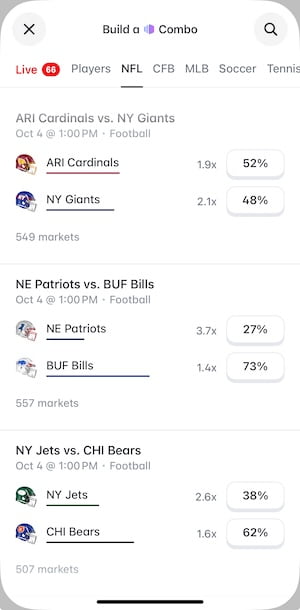
Polymarket and Kalshi are the two most notable prediction markets in the US, and they have a lot in common. Both are federally regulated, open to users 18+, and have similar exchange structures. However, the real differences come down to fees, parlays, and what markets you want to trade.
| Polymarket US | Kalshi | |
|---|---|---|
| Best for | Politics, economics, culture, and big sports markets | Sports markets (especially NFL and parlays) |
| Taker fees | Up to $1.74 per 100 shares | Up to $1.75 per 100 shares |
| Maker fees | No fee, plus a rebate of up to $0.31 per 100 shares | Up to $0.88 per 100 shares |
| Parlays | Available, but limited options and uneven pricing | Combos across games and props, often paying more than sportsbooks |
| Spending limits and self-exclusion | No responsible trading tools | Deposit limits, session timers, and self-exclusion |
| Deposit options | Debit card, bank transfer, wire, PayPal, Venmo | Debit card, bank transfer, wire, PayPal, Venmo, Cash App, crypto |
| Where you can use it | 49 states (currently blocked in Nevada) | All 50 states, but sports are restricted in several, including Nevada, Washington, Michigan, and Utah |
| Sign-up bonus | Deposit $10, get $25 (code SFA) | Trade $25, get $25 (code WSHARP) |
| Regulated by | CFTC (QCX LLC, doing business as Polymarket US) | CFTC (KalshiEX LLC) |
*Fees and availability checked in October 2026. Both can change, so confirm in each app before you trade.
Where Polymarket Wins
- Cheaper if you name your price: Polymarket pays you a small rebate, while Kalshi still charges a fee (up to $0.88 per 100 shares).
- Bigger sign-up bonus: $25 for a $10 deposit, with no trading required to unlock it.
- More ways to trade beyond sports: It's the stronger pick for politics, the economy, and pop culture markets.
- Fewer state restrictions on sports: Outside Nevada, sports markets are currently open in more states than Kalshi.
Where Kalshi Wins
- Better for parlays: In our Kalshi review, a $3 three-leg Combo paid $18.75, compared with $15.91 at FanDuel.
- Built-in safety tools: You can set deposit limits, add session timers, or lock your account (Polymarket offers none).
- Deeper sports menu: Sports made up 89% of Kalshi's 2025 revenue, and it shows in its NFL props and live markets.
- More ways to deposit: It adds Cash App and crypto in addition to all the options that Polymarket provides.
Which One Should You Choose?
From our testing of both prediction market apps, we recommend Polymarket if you like setting your own prices, want a bigger welcome bonus, or trade more than just sports. On the other hand, go with Kalshi if parlays are your thing or you mainly trade on sports or NFL markets.
Many traders use both. Opening an account on each lets you compare prices on the same game and take whichever pays more, and snag both welcome offers.
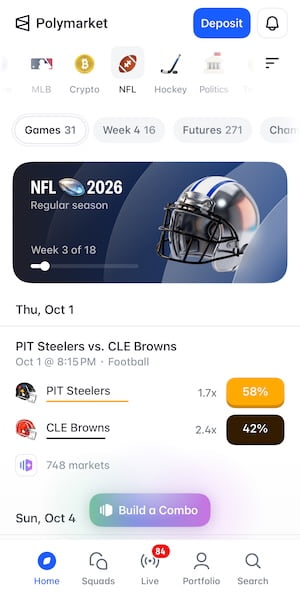
Polymarket Prediction Market Review: What Can You Trade, and What's Missing
While Polymarket US is known for having a wide variety of markets for trading (politics, crypto, weather, economics, etc.), sports markets are still a major and growing part of the platform. According to Finance Magnates, roughly 64% of all Polymarket trades are on sports.
Sports Markets at Polymarket
On the Polymarket app, you’ll find categories for the following sports leagues/types: NFL, MLB, NHL, NBA, soccer, tennis, college football, college basketball, boxing, MMA, and numerous niche sports.
In the most popular sports (NFL, MLB, NHL, and NBA), you’ll find the following prediction markets that you can wager on:
- Game winners
- Spreads
- Totals
- Game props
- Player props
- Futures (division/conference/championship winners)
- Award winners
Props and Parlays Are Limited
While you’ll find deep liquidity on marquee games like NFL Sunday matchups, MLB playoff games, and NBA games on Christmas Day, the same isn't true for deep props and parlay markets. For example, a typical NFL game might have over 250+ props and alternative markets you can wager on, whereas Polymarket may only have 20+.
And for obscure props and niche sports like table tennis and darts, you’ll run into high slippage, as fewer trades mean the market price can change drastically due to a single trade, resulting in a worse price.
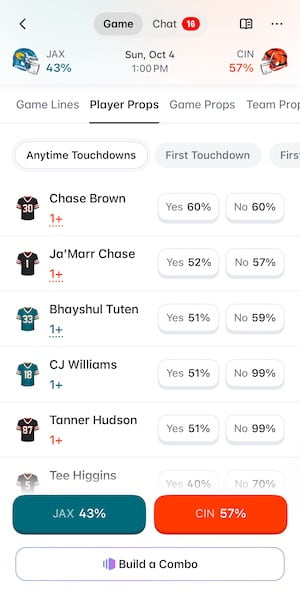
What Markets are Missing at Polymarket
Despite its growth in the sports prediction markets, Polymarket still lacks some of the features sportsbook fans have come to love, including promotions like deposit matches, no-sweat bets, and odds boosts.
There are options for parlays and same-game parlays, but it is not nearly as deep as FanDuel or DraftKings, and the pricing can get unpredictable on these prediction markets.
Also, live betting has really improved on sportsbooks with micro events like being able to bet on the outcome of the next pitch in MLB or who catches a pass on the next drive in the NFL. Polymarket still has some gaps to close in offering the same breadth of events for live trading.
The bottom line: If you’re a bettor who mainly wants deep parlays or props, Polymarket doesn’t replace a sportsbook. Not yet, at least.
Where Can You Use Polymarket?
Polymarket US is federally regulated and legal in all 50 states as of October 2026. However, “legal” and “available” are two different things. For starters, trading is blocked in Nevada, so that’s one state you definitely cannot trade contracts at this time.
But the map is always moving, as current litigation is ongoing in numerous states against Polymarket US, primarily over who has the authority to regulate prediction markets and whether or not they qualify as sports betting.
For this reason, it's vital to always check the Polymarket app to see if it's available in your state, as well as to determine which markets you can trade on. For example, Polymarket is available in some states, except for sports trading.
| State | Sports contracts available | Non-sports contracts available |
|---|---|---|
| Alabama | ✅ | ✅ |
| Alaska | ✅ | ✅ |
| Arizona | ❌ | ✅ |
| Arkansas | ✅ | ✅ |
| California | ✅ | ✅ |
| Colorado | ✅ | ✅ |
| Connecticut | ❌ | ❌ |
| Delaware | ✅ | ✅ |
| Florida | ✅ | ✅ |
| Georgia | ✅ | ✅ |
| Hawaii | ✅ | ✅ |
| Idaho | ✅ | ✅ |
| Illinois | ✅ | ✅ |
| Indiana | ✅ | ✅ |
| Iowa | ✅ | ✅ |
| Kansas | ✅ | ✅ |
| Kentucky | ✅ | ✅ |
| Louisiana | ✅ | ✅ |
| Maine | ✅ | ✅ |
| Maryland | ❌ | ✅ |
| Massachusetts | ✅ | ✅ |
| Michigan | ❌ | ✅ |
| Minnesota | ✅ | ✅ |
| Mississippi | ✅ | ✅ |
| Missouri | ✅ | ✅ |
| Montana | ✅ | ✅ |
| Nebraska | ✅ | ✅ |
| Nevada | ❌ | ❌ |
| New Hampshire | ✅ | ✅ |
| New Jersey | ✅ | ✅ |
| New Mexico | ✅ | ✅ |
| New York | ✅ | ✅ |
| North Carolina | ✅ | ✅ |
| North Dakota | ✅ | ✅ |
| Ohio | ✅ | ✅ |
| Oklahoma | ✅ | ✅ |
| Oregon | ✅ | ✅ |
| Pennsylvania | ✅ | ✅ |
| Rhode Island | ✅ | ✅ |
| South Carolina | ✅ | ✅ |
| South Dakota | ✅ | ✅ |
| Tennessee | ❌ | ✅ |
| Texas | ✅ | ✅ |
| Utah | ✅ | ✅ |
| Vermont | ✅ | ✅ |
| Virginia | ✅ | ✅ |
| Washington | ✅ | ✅ |
| West Virginia | ✅ | ✅ |
| Wisconsin | ✅ | ✅ |
| Wyoming | ✅ | ✅ |
*Last checked September 29, 2026. Availability can change quickly, so confirm in the Polymarket US app before you sign up.
Deposits & Withdrawal Methods
| Payment method | Min / max deposit | Deposit fee | Withdrawal speed |
|---|---|---|---|
| Bank transfer (ACH) | $10 min / $50,000 daily | Free | 3–4 business days |
| Debit card | $10 min / $50,000 daily ($25,000 per deposit) | Free | 3–4 business days |
| Wire transfer | $1,000 min / No max | Free | 1 business day |
| PayPal and Venmo | $10 min / $50,000 daily (Venmo: $2,900) | None listed | 1 business day (ours took about 30 mins) |
Our experience: We deposited and withdrew with PayPal, and our winnings arrived in about 30 minutes. PayPal and Venmo showed up in the app, but Polymarket's help center only lists debit card, bank transfer, and wire. So, options may vary by account or by the state you are trading from.
Verification Requirements
Since Polymarket US operates as a CFTC-regulated Designated Contract Market (DCM), full identity verification is mandatory prior to depositing or trading.
Users must complete a Know Your Customer (KYC) check, which requires a government-issued ID (Driver's License, Passport, or State ID) and SSN verification. This marks a stark change from the company’s global brand, which allowed unverified wallet access.
The Risks of Using Polymarket that Most Reviews Don't Mention
Polymarket carries a few risks that those coming from sportsbooks may not be aware of. These include:
- You may pay more than the price shown: On busy markets like NFL moneylines, you'll usually get the listed price you see when placing a trade. However, on niche sports and obscure props, there are fewer traders and less liquidity, so a larger order can fill at a worse price than you see (slippage).
- Heavy favorites aren't always safe bets: A 95¢ share risks 95¢ to win 5¢. On average, expect one loss to wipe out the profit from 19 wins.
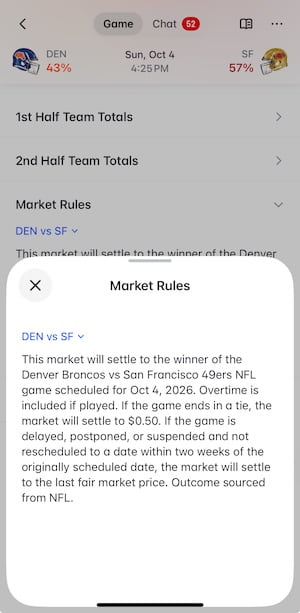
- Markets settle on their exact wording: Always read a market's rules before you trade. Polymarket US always provides rules for a market that determine what constitutes a win and a loss.
- No spending limits or self-exclusion: Unlike Kalshi and sportsbooks, the app has no deposit limits, time-outs, or self-exclusion. Sportsbooks are required to provide responsible gambling tools; Polymarket is not.
- Some markets cover sensitive topics: Polymarket has faced criticism for listing markets on wars and other real-world tragedies.
If gambling or trading is becoming a problem, call 1-800-GAMBLER for free, confidential help.
How Polymarket is Taxed
Polymarket US is a CFTC-regulated exchange, so the tax treatment and reporting users receive may differ from traditional sportsbook winnings, which have clearly defined tax rules. You may get different forms from standard gambling tax forms.
How you classify this activity could impact your taxes. This review does not constitute as tax advice. If you are uncertain about how to treat taxes with Polymarket, consult a qualified tax professional about your trading history.
Is Polymarket Right For You?
Polymarket is a good fit if you:
- Want to trade other markets than just sports, such as world events, the economy, and pop culture (all in one app)
- Don't mind posting your own price and waiting, since that skips the fee and even earns you a small rebate
- Mostly back heavy favorites, where fees are lowest
- Live in a state without legal sports betting, like Texas, California, or Georgia
- Compare prices across apps and want one more place to find a better number
Look elsewhere if you:
- Mostly bet parlays and player props, since sportsbooks and Kalshi offer far more
- Usually buy close games at the listed price, where fees are highest
- Want the app to help you set spending limits or take a break
- Count on odds boosts, deposit matches, or free bets to stretch your bankroll
- Live in Nevada, or in a state where Polymarket sports markets are restricted
Polymarket Prediction Market Review | FAQs
Is Polymarket legal in the US?
What states is Polymarket available in?
Is Polymarket free to use?
How does Polymarket make money?
Does Polymarket offer better odds than a sportsbook?
How do Polymarket markets resolve?
Is Polymarket legit?
Polymarket US is completely legit and regulated by the federal government, which ensures that users' funds are separate from company funds. It is one of the most reputable prediction market apps in the US, along with Kalshi.
How old do you have to be to use Polymarket?
Is Polymarket the same as Kalshi?
Methodology
For this review, we created an account on the Polymarket US app, funded it with PayPal, traded NFL contracts, and withdrew funds. We used the official Polymarket site for fact-checking the current fee structure formula and rates. We verified state availability through Polymarket support to ensure the most up-to-date and accurate information.