

Kalshi is the most established prediction market in the US and the best starting point for most traders. But it isn't automatically cheaper than a sportsbook.
Our Kalshi review tested every aspect of the platform over several weeks. In particular, we priced identical NFL bets on Kalshi, FanDuel, and BetMGM for the Giants vs. Rams matchup in September 2026. Kalshi won on the parlay and the spread, but lost on the moneyline. Its trading fee peaks at exactly the price point sports bettors use most: on a near-even market, 100 contracts at 50¢ costs $50 plus $1.75 in fees, which ends up being more than the vig.
Overall Kalshi rating: 4.9/5.0
- Who it's for: Those who think in probabilities and want parlay pricing that beats a sportsbook SGP.
- Who it isn't: Those who live on the deep props and promotions offered at sportsbooks.
Read our full Kalshi prediction market review below. We opened and funded an account, traded sports and politics contracts, built a Combo parlay, held positions to settlement, and withdrew via PayPal.

Kalshi Review at a Glance
Contents
- 1 Kalshi Review at a Glance
- 2 Kalshi Pros and Cons
- 3 How Kalshi Works: Prediction Markets & Exchange, Explained
- 4 What Kalshi Actually Costs: Trading Fees Breakdown
- 5 Kalshi vs. Sportsbooks: Straight Bets and Parlays, Priced
- 6 Kalshi vs. Polymarket: Which is Better?
- 7 Prediction Markets on Kalshi: What You Can Trade and What's Missing
- 8 State Availability: Where Can You Trade with Kalshi?
- 9 Funding, verification and withdrawals
- 10 The Risks of Using Kalshi & Prediction Markets
- 11 How is Kalshi Taxed?
- 12 Final Thoughts: Who Kalshi is For—And Who It Isn't
- 13 Kalshi Review | FAQs
- 14 Methodology
Kalshi Pros and Cons
Before we dive into the deeper details, let's go over the main pros and cons of Kalshi prediction markets:
👍 PROS
- Won't limit or ban winning traders
- True market value on early cash-outs
- Better parlay payouts with no vig (combo trades)
- Limit orders let you name your price for lower fees
- Regulated USD banking with no crypto needed
- Wide state availability
- Best prediction site for sports trading
👎 CONS
- High fees on 50/50 spreads and toss-ups
- No boosts or deposit bonuses
- Not easy to understand for beginners
- State court battles risk sudden contract freezes
- Thinner prop coverage compared to sportsbooks
How Kalshi Works: Prediction Markets & Exchange, Explained
For those with sportsbook experience, a prediction market app like Kalshi has some familiarities and key differences. We'll guide you through the basics of how Kalshi actually works, free of jargon and explained in clear terms.
Lesson #1: Every Trade is a ‘YES' or ‘NO' Question
On Kalshi, you're not taking odds. You're buying “YES” or “NO” contracts on whether a certain outcome happens. Every contract pays out $1 if you're right and nothing if you're wrong.
Say the market is “Packers to win against the Falcons”. You can buy contracts at whatever the current price is (pricing explained below): 70¢ per contract at the time of writing. If the Packers win, every contract turns into $1, meaning you would snag a 30¢ profit on each contract you traded for. If they lose, each contract is worth nothing.
There are no partial payouts or half-wins. Spreads, totals, player props—every market on Kalshi resolves the same way.
Lesson #2: Price Equals Probability
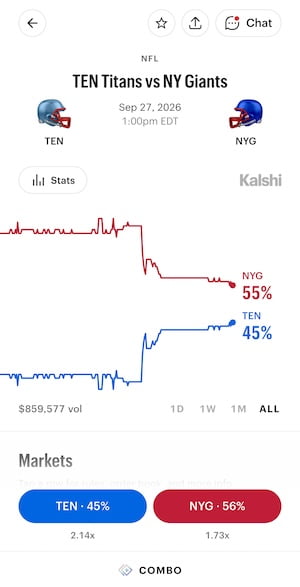
The best way to understand Kalshi prices is to imagine them as the likelihood of an outcome happening. If a YES contract is trading at 64¢, the market is essentially pricing that outcome at roughly a 64% probability of occurring.
For example, let’s say you buy 100 contracts at 64¢. The position costs $64 before any trading fees. If the outcome happens, those 100 contracts settle for $100, leaving you $36 in profit before fees. If it doesn't happen, the contracts settle at $0, and you lose the $64 you spent.
Lesson #3: You’re Trading Against Other Users, Not the House
Sportsbooks set betting lines and odds with a built-in margin known as the “vig” or “juice”. It's essentially the cut a sports betting site takes on each wager in order to make money on wagers. Once you place a bet, those odds are fixed.
At an exchange like Kalshi, you trade contracts with other peers, and the price is set based on trading activity and isn't fixed. You can often exit your position early or hold it until resolution. However, just because there is no built-in vig at prediction markets like Kalshi, that doesn’t mean there are no costs associated with trading.
Prediction market sites all have trading fees (although this varies by the type of trade and can be more or less expensive than using a sportsbook).
Lesson #4: Order Book Basics
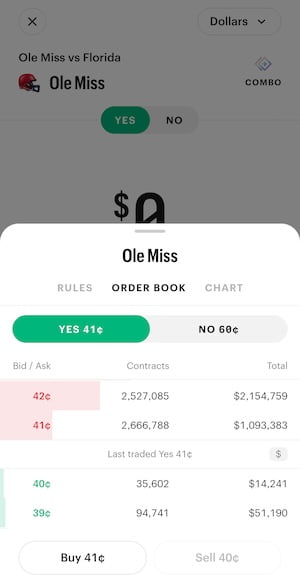
Think of Kalshi’s order book like a public bulletin board for buyers and sellers. It lists the prices people are currently willing to pay or accept for contracts.
How you trade on this board affects the fees you pay:
- Takers (Market Orders): You want to trade immediately, so you accept the best available price someone else already posted. Because you “take” an existing offer off the board, you pay a taker fee (calculated using Kalshi’s standard pricing formula).
- Makers (Limit Orders): You set your own price and wait for someone else to match it. Because your offer sits on the board and “makes” an option available for others, you may pay a different, often lower maker fee.
Lesson #5: Exiting Early
You don’t have to wait until an event ends to settle your trade. If you want to lock in a profit or cut losses, you can exit early by selling your contracts to other traders at the going rate.
While this sounds like a “Cash Out” at a traditional sportsbook, there is a key difference:
- Sportsbook Cash Out: The house calculates a take-it-or-leave-it buyout offer, usually factoring in a hefty cut for themselves.
- Kalshi Early Exit: You sell directly to other market participants. Your payout is determined by real-time supply and demand, meaning you get true market value based on what other traders are currently willing to pay for your contracts.
How it works in practice: Imagine you buy contracts on the Cincinnati Bengals to beat the Pittsburgh Steelers when the market is priced at 63¢ (a 63% implied win probability). However, Pittsburgh has a star player ruled out with an injury and the odds shift heavily in Cincinnati’s favor, pushing the contract price to 80¢.
Rather than risking game-day chaos or a fluke upset, you can sell your contracts right then for 80¢ each, banking a clean 17¢ profit per contract before kickoff even happens.
Real Life Example: NFL Moneyline Contract
Suppose you buy 100 “Yes” contracts for an NFL moneyline trading at 55¢ each. Ignoring fees, you pay $55 ($0.55 × 100) for the trade.
Here are three scenarios that could play out:
- You hold until the end, and the team wins (Resolves “Yes”): Every contract pays out $1.00. Your 100 contracts are now worth $100, yielding a $45 profit ($100 payout − $55 initial cost).
- You hold until the end, and the team loses (Resolves “No”): The contracts expire worthless at $0.00. You forfeit your initial $55 investment.
- The market moves in your favor, and you exit early: Mid-game, your team takes a two-touchdown lead, and the contract value climbs from 55¢ to 70¢. You decide to take the sure thing and sell all 100 contracts to another user. You collect $70, locking in a $15 profit ($70 payout − $55 initial cost). While you leave $30 of potential upside on the table compared to a full win, you eliminate all remaining risk if the opponent mounts a comeback.
What Kalshi Actually Costs: Trading Fees Breakdown
One of the ways Kalshi and other peer-to-peer prediction market apps make money is by charging trading fees. Before trading at Kalshi, you should understand who pays the fees and the actual cost to trade on the platform.
While it publishes its fee schedule, it may be confusing for those new to exchanges. We're here to explain it in a clear manner.
The Kalshi Fee Formula
At Kalshi, trading fees are only charged for orders that are immediately matched with orders sitting on the order book. Trading fees are not charged for orders that are not immediately matched and are instead left as resting orders on the order book.
A standard fee is charged as a variable percentage fee of the expected earnings of an individual contract.
- Fee Formula: Fees = M x 0.07 x C x P x (1-P)
- M is the multiplier for each contract (default is 1 unless otherwise noted)
- C is the number of contracts being traded.
- P is the price of a contract in dollars (50 cents is 0.5)
- The fee is rounded up to the next centicent (1/100th of a cent).
The 0.07 is not a flat 7% fee on your stake. It varies by price, peaking when the contract is basically even at 50 cents ($1.75 per 100 contracts) and tapering off toward the two extremes (1 cent and 99 cents). Therefore, the price range for the taker fee per 100 contracts runs from $0.07 to $1.75.
Maker Fees
Kalshi uses the same formula for the maker fee, except it is one-fourth the amount because the coefficient is 0.0175 instead of 0.07. Some markets do not charge any maker fee. Combos are one exception, as they charge 50% of the taker fee.
For that reason, the maker fee has a price range per 100 contracts from $0.04 to $0.88.
The maker fee is only charged for orders that are not immediately matched and are left as resting orders on the order book. The maker fee is only charged when the trade is executed. There is no fee for canceling a resting order or an order that doesn't get accepted by another trader.
There is a trade-off to using resting limit orders that pay fewer fees. For starters, your order may never fill, causing you to miss out on the price you wanted, but also a price that was lower than the market at the time of your order.
Kalshi Fee Table
Below, the table shows the taker fee and maker fee per 100 contracts at various price points (cents):
| Price | Trade Value (100 contracts) | Taker Fee (100 contracts) | Maker Fee (100 contracts) |
|---|---|---|---|
| $0.01 | $1 | $0.07 | $0.03 |
| $0.02 | $2 | $0.14 | $0.07 |
| $0.10 | $10 | $0.63 | $0.32 |
| $0.25 | $25 | $1.31 | $0.66 |
| $0.40 | $40 | $1.68 | $0.84 |
| $0.48 | $48 | $1.75 | $0.87 |
| $0.49 | $49 | $1.75 | $0.87 |
| $0.50 | $50 | $1.75 | $0.88 |
| $0.51 | $51 | $1.75 | $0.87 |
| $0.52 | $52 | $1.75 | $0.87 |
| $0.60 | $60 | $1.68 | $0.84 |
| $0.75 | $75 | $1.31 | $0.66 |
| $0.90 | $90 | $0.63 | $0.32 |
| $0.99 | $99 | $0.07 | $0.03 |
Sourced from formulas on Kalshi’s published fee schedule on September 24, 2026.
Key takeaway: Fees are highest for contracts priced around 50 cents (toss-ups), which you can compare to -110 odds on both sides at a sportsbook. The lowest fees come at the ends of the table at 1 cent and 99 cents, meaning those who back longshots and heavy favorites pay the lowest fees while the ones trading even markets are paying the most.
Kalshi vs. Sportsbooks: Straight Bets and Parlays, Priced
We placed straight and parlay bets on the NFL at sportsbooks, while also taking the same trade positions on Kalshi to compare pricing between the most popular prediction market available and top-rated sportsbooks (odds sourced from FanDuel and BetMGM).
Straight Bets/Binary Markets: Kalshi vs. FanDuel
We analyzed the moneyline and spread for the Week 2 Monday Night Football game between the New York Giants and Los Angeles Rams on September 21, 2026.
Below are the results:
| Market | Sportsbook Odds | Kalshi Price | Sportsbook Cost (To Win $100) | Kalshi Cost (To Win $100) | Better Value |
|---|---|---|---|---|---|
| Rams ML | -310 | 74¢ | $310.00 | $301.40 | Kalshi (Saves $8.60) |
| Giants ML | +250 | 28¢ | $40.00 | $42.03 | Sportsbook (Saves $2.03) |
| Rams Spread | -120 | 53¢ | $120.00 | $116.49 | Kalshi (Saves $3.51) |
| Giants Spread | -118 | 47¢ | $118.00 | $92.00 | Kalshi (Saves $26.00) |
Parlays/Combos: Kalshi vs. BetMGM & FanDuel
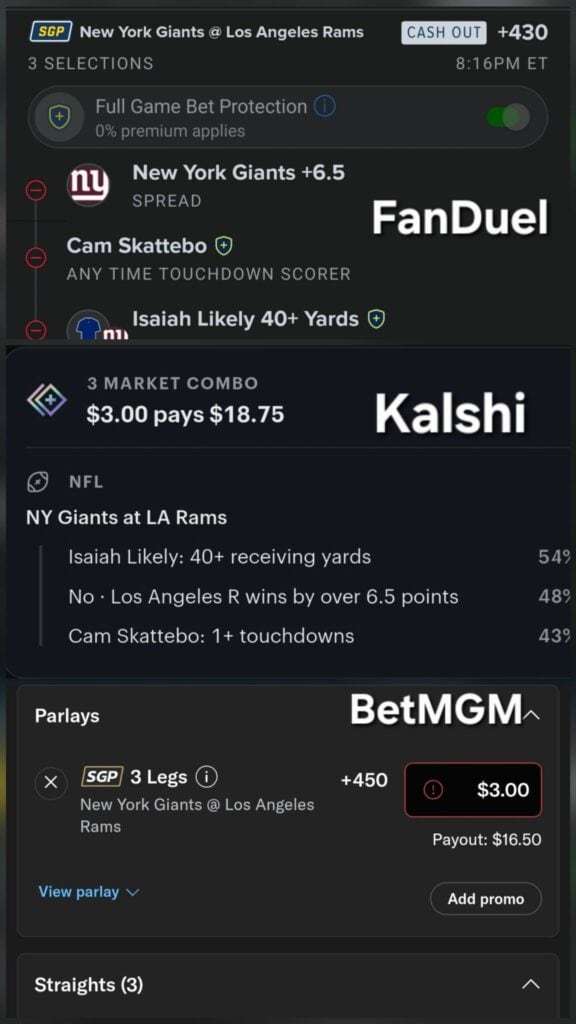
Next, we compared a 3-leg Same Game Parlay (SGP)/Combo trade at Kalshi and BetMGM to see which offers the best value. Again, we used the Rams vs. Giants game on September 21, 2026.
Here were the three legs we took:
- Giants +6.5
- Cam Skattebo Anytime Touchdown Scorer
- Isaiah Likely 40+ Receiving Yards
These were the parlays and combo trade we built on the three platforms and the potential profit from a $3 bet/trade:
- Kalshi: $3 position returns $18.75 total ($15.75 profit)
- FanDuel: $3 bet returns $15.91 total ($12.90 profit)
- BetMGM: $3 bet returns $16.50 ($13.50 profit)
So, Is Kalshi Cheaper than Sportsbooks?
From our testing of this specific NFL game example, it's hard to say that Kalshi is significantly cheaper than sportsbooks. Here are the key findings:
- 3-Leg Parlay: Kalshi priced the Combo trade much more favorably than BetMGM and FanDuel. A $3 position on Kalshi returned 5.25x our investment compared to 4.3x and 4.5x at the two sportsbooks.
- Moneyline: Both BetMGM (3.57%) and FanDuel (4.18%) edged out Kalshi (4.77%) as cheaper on the moneyline.
- Spread: Kalshi (3.5%) was priced cheaper than BetMGM (4.63%) and FanDuel (5.05%).
For this game, Kalshi fared better on the parlay and spread but was worse on the moneyline. So, the common myth that prediction markets are always cheaper to use than sports betting sites doesn't always hold true.
Kalshi vs. Polymarket: Which is Better?
Kalshi and Polymarket reign supreme as the best prediction market sites in 2026. You’ve seen commercials with celebrities like Timothée Chalamet for Kalshi and LeBron James for Polymarket.
Our breakdown below compares which is better across numerous metrics:
| Feature | Kalshi | Polymarket US |
|---|---|---|
| Primary Edge | Sports betting volume & NFL Combos | Global politics, macroeconomics, & tech |
| How You Fund Your Account | USD (Bank transfer, Debit, PayPal, Venmo) | USD (Bank transfer, Debit, Apple Pay, Wire) |
| Trading Fees (Market Orders) | Peaks at $1.75 per 100 contracts on 50/50 bets | Virtually identical (peaks just under $1.75) |
| Maker Fees (Limit Orders) | Discounted fee (up to $0.88 per 100 contracts) | $0 maker fees plus occasional liquidity rebates |
| Parlay / Combo Trading | Yes (Combos across game outcomes & props) | No built-in multi-leg combo builder |
| Responsible-Trading Tools | Deposit limits, session timers & self-exclusion | None (No in-app deposit limits or self-exclusion) |
While both platforms operate as federally regulated exchanges where winning contracts settle at $1.00, they are built for two entirely different types of traders:
- Go with Kalshi for sports and convenience: Kalshi functions much closer to a modern betting app. You can fund your account straight from your bank or PayPal account in dollars, build multi-leg parlays using Combos, and trade deep NFL markets.
- Go with Polymarket for politics and limit orders: Polymarket dominates high-stakes markets for politics, global elections, and tech/pop-culture forecasting. If you like using limit orders to set your own entry prices, Polymarket charges zero maker fees and even offers rebates for adding liquidity to the book.
- The fee reality check: Neither exchange gives you a “free” trade. Both use virtually the same mathematical formula for immediate market orders, meaning fees are the highest right at the 50¢ mark (toss-ups)—the exact price point most sports bettors trade.
Prediction Markets on Kalshi: What You Can Trade and What's Missing
While sports prediction markets reportedly made up 89% of Kalshi’s 2025 revenue, the platform does offer a breadth of contracts in other markets, including politics, elections, culture, crypto, climate, commodities, economics, mentions, tech & science, and finance. It has the most coverage of any prediction market app.
We'll run down everything you can trade on and also the few things that are missing.
Sports Markets at Kalshi
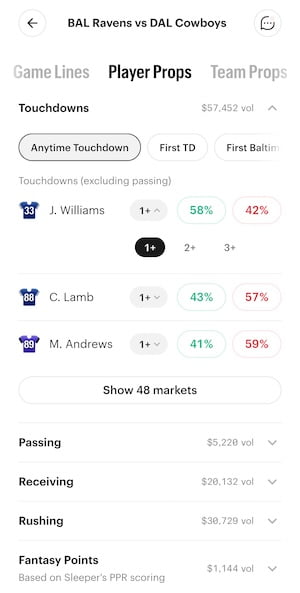
Kalshi really stands out when it comes to major sports prediction markets (game winners, spreads, totals, player props, and futures) as well as live in-play contracts and parlays known as “Combos,” where users can combine multiple contracts together into one.
You’ll find everything from the major professional leagues (NFL, NBA, NHL, MLB) to college sports (football and basketball) to international sports (tennis, soccer), and niche markets (darts, table tennis, esports, and MMA).
The NFL is one of the deepest markets, with player props now available in 2026 as well as futures markets on award winners and the Super Bowl winner.
Where Liquidity Actually Exists
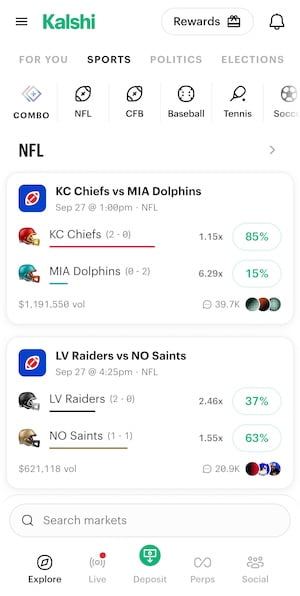
Liquidity (the amount traded on a market) makes or breaks the trading experience on Kalshi. Where you choose to trade determines whether your orders fill instantly at the price you see or slip to a worse one:
- High-Liquidity Markets (Tight Spreads, Fast Fills): The deepest order books sit in marquee sports and major national events. Think prime-time NFL matchups, Super Bowl futures, and high-profile political races (like presidential elections). These all draw heavy trading volume. Orders here execute cleanly with minimal price gap between buyers and sellers.
- Low-Liquidity Markets (Thin Books, High Slippage): Niche sports, lower-tier leagues, and specific player props have far fewer participants. With fewer contracts sitting on the board, market orders often suffer from slippage, which is the gap between the price you clicked and the worse price at which your order actually fills.
If you are trading thin markets, skip market orders entirely. Use limit orders so you set an exact entry price and avoid overpaying on a sparse order book.
What’s Absent at Kalshi Compared to a Sportsbook
While Kalshi is known for having many sports markets, it's still early days for prediction markets for sports trading. With users starting to migrate over to test Kalshi and other platforms, they will find some stark differences between the two, such as:
- Lack of promos: Despite the $25 free trade credit users get when signing up, Kalshi lacks the promotions that sportsbooks compete on, like deposit matches, no-sweat bets/free bets, and odds boosts.
- Shoddy live sports trading: The in-play live markets are not nearly as deep as what sportsbooks offer in 2026.
- Thin props markets: The props in general lack compared to the depth of markets and alternate lines found at sportsbooks.
If you are a user who loves deep prop markets, live betting, and consistent promotions, Kalshi won't replace your sportsbook. But it can be another tool, a price comparison, and they have done a lot in 2026 to narrow the gap.
State Availability: Where Can You Trade with Kalshi?
As a CFTC-regulated exchange, Kalshi argues federal commodities law supersedes state gambling rules. Multiple states disagree, classifying sports contracts as unauthorized sports wagering. This conflict has triggered numerous ongoing state legal battles as of October 2026:
- In New Jersey, the Third Circuit ruled 2-1 in favor of Kalshi on April 6, 2026, that its sports event contracts qualify as swaps under the Commodity Exchange Act and affirmed a preliminary injunction preventing New Jersey from enforcing its gambling laws against them.
- In Nevada, the Ninth Circuit ruled the other way on August 28, 2026, by determining state gambling laws can apply, potentially setting up a push toward the Supreme Court with the circuit split.
- Earlier in January 2026, a Massachusetts court ruled against Kalshi, leading to an appeal by the company.
- In Maryland, a federal district court denied Kalshi's request for a preliminary injunction in August 2025 after finding that it had not demonstrated a likelihood of success on its federal-preemption argument.
- Michigan Attorney General Dana Nessel also sued Kalshi in March 2026, alleging that its sports contracts violated the Michigan Lawful Sports Betting Act. A state court then issued an order prohibiting Kalshi from offering sports contracts to Michigan residents.
- The CFTC sued Arizona, Connecticut, and Illinois in April 2026, seeking to block state enforcement, as roughly 19 federal suits are reported as pending.
This uncertainty has led to a messy view of where you can use Kalshi. That said, we've included a table of all 50 states and our best description of Kalshi’s availability as of October 2026. This includes whether sports contracts are available and whether non-sports contracts are available (culture, politics, cryptocurrency, finance, etc.).
| State | Sports Contracts Available | Non-Sports Contracts Available |
|---|---|---|
| Alabama | ✅ | ✅ |
| Alaska | ✅ | ✅ |
| Arizona | ✅ | ✅ |
| Arkansas | ✅ | ✅ |
| California | ✅ | ✅ |
| Colorado | ✅ | ✅ |
| Connecticut | ✅ | ✅ |
| Delaware | ✅ | ✅ |
| Florida | ✅ | ✅ |
| Georgia | ✅ | ✅ |
| Hawaii | ✅ | ✅ |
| Idaho | ✅ | ✅ |
| Illinois | ✅ | ✅ |
| Indiana | ✅ | ✅ |
| Iowa | ✅ | ✅ |
| Kansas | ✅ | ✅ |
| Kentucky | ✅ | ✅ |
| Louisiana | ✅ | ✅ |
| Maine | ✅ | ✅ |
| Maryland | ✅ | ✅ |
| Massachusetts | ✅ | ✅ |
| Michigan | ❌ | ✅ |
| Minnesota | ✅ | ✅ |
| Mississippi | ✅ | ✅ |
| Missouri | ✅ | ✅ |
| Montana | ✅ | ✅ |
| Nebraska | ✅ | ✅ |
| Nevada | ❌ | ✅ |
| New Hampshire | ✅ | ✅ |
| New Jersey | ✅ | ✅ |
| New Mexico | ✅ | ✅ |
| New York | ✅ | ✅ |
| North Carolina | ✅ | ✅ |
| North Dakota | ✅ | ✅ |
| Ohio | ✅ | ✅ |
| Oklahoma | ✅ | ✅ |
| Oregon | ✅ | ✅ |
| Pennsylvania | ✅ | ✅ |
| Rhode Island | ✅ | ✅ |
| South Carolina | ✅ | ✅ |
| South Dakota | ✅ | ✅ |
| Tennessee | ✅ | ✅ |
| Texas | ✅ | ✅ |
| Utah | ❌ | ✅ |
| Vermont | ✅ | ✅ |
| Virginia | ✅ | ✅ |
| Washington | ❌ | ✅ |
| West Virginia | ✅ | ✅ |
| Wisconsin | ✅ | ✅ |
| Wyoming | ✅ | ✅ |
While Kalshi is legal in all 50 states to customers 18+, availability to trade and what you are allowed to trade on varies by state. Nevada and Washington State recently restricted users from trading sports contracts and some other markets like culture and climate. Users in Michigan and Utah are prohibited from sports contracts but have access to other contracts.
But to prove how “available” can be a misleading title, consider that on September 17, 2026, the Ninth Circuit ruled in favor of two California tribes that Kalshi’s sports event contracts violate the Indian Gaming Regulatory Act. So, while California is listed as a “No Restrictions” state as of September 20, the truth is you likely won’t be able to exchange sports contracts on that tribal ground in California.
The best advice we can give you is to check the state availability in the Kalshi app before trying to execute any trades. No page, including this one, can be totally accurate in which states it is available for and at what, if any, limitations.
Funding, verification and withdrawals
Kalshi has four types of deposit and withdrawal methods that traders can use to move funds. These include:
| Payment Method | Min / Max Deposit | Deposit Fee | Withdrawal Speed |
|---|---|---|---|
| Bank Transfer (ACH) | $10 min / $2,500 daily | Free | 1 business day |
| Debit & Wallets (PayPal, Venmo, Cash App) | $10 min / No set max | 2% | 30 mins (up to 2 days) |
| Crypto | No min / $500K max | 0.05% | ~30 mins |
| Wire Transfer | $1,000 min / No max | Free | 1 business day |
Note: In our Kalshi review testing, the only withdrawal method we used was PayPal, which took about 30 minutes to receive the funds. The app did not have a wire transfer as a withdrawal method, but we also never used wire transfer as a deposit method, so it may show up when you do. Wire transfers are listed as an official withdrawal method on Kalshi.
Verification requirements
Since Kalshi operates as a CFTC-regulated Designated Contract Market (DCM), full identity verification is mandatory prior to depositing or placing trades. This means users must complete a Know Your Customer (KYC) check requiring a live picture of their government-issued ID (Driver's License, Passport, or State ID) and SSN verification.
The registration process takes just a few minutes to complete. In some cases, Kalshi could request proof of address, employment information, or source-of-funds documentation.
The Risks of Using Kalshi & Prediction Markets
Trading on a prediction market carries distinct risks that traditional sports bettors don't normally encounter, which are vital to be aware of.
- State Regulatory & Position-Closure Risk: As state courts and gaming boards clash with the CFTC, legal access can shift overnight. In disputed jurisdictions (like Nevada), court challenges can force Kalshi to freeze contracts or prematurely close out open positions at current market prices rather than letting you hold them to full settlement.
- Thin Liquidity & Slippage: While marquee NFL moneylines have deep books, niche sports and obscure player props often suffer from thin volume. If there aren't enough resting limit orders to absorb your size, you will suffer negative slippage—filling at a significantly worse average price than what is displayed on screen.
- Severe Asymmetry on Heavy Favorites: Buying high-probability contracts (like a 95¢ “Yes”) carries brutal risk-reward math. You are risking $0.95 to profit just $0.05. A single fluke loss wipes out the gross profits of 19 winning trades.
- Fee-Drag on 50/50 Markets: Kalshi’s taker fees peak at contracts priced near 50¢ ($1.75 per 100 contracts). That creates an immediate 3.5% fee drag on even-money trades—and if you actively enter and exit positions before settlement, you pay that fee on both sides, compounding the cost.
- Self-Regulation Requirements: Because Kalshi is a federal financial exchange rather than a state-licensed sportsbook, it isn't bound by standard state responsible gaming frameworks (like automatic statewide exclusion lists). However, it does provide voluntary tools inside the app—including deposit limits, session timers, and account self-exclusion.
How is Kalshi Taxed?
Kalshi trades event contracts on a CFTC-regulated exchange, so the tax treatment and reporting users receive may differ from traditional sportsbook winnings, which have defined tax rules. You may receive different tax forms than standard gambling tax forms.
How you classify this activity could impact your taxes. This review does not qualify as tax advice. If you are uncertain about how to treat taxes with Kalshi, consult a qualified tax professional about your trading history.
Final Thoughts: Who Kalshi is For—And Who It Isn't
You should use Kalshi if you:
- Think in probabilities, not American betting odds
- Like to use limit orders to add liquidity to the order book
- Want a published fee you can calculate before you trade
- Want to price shop parlays (Combos) to get better prices than traditional sportsbooks
- Need responsible-trading tools like self-exclusion, trade limits, and timeouts
- Want to trade sports contracts in a state where sportsbooks are not legal
- Want to keep it as a second option for line shopping to compare to other prediction markets or sportsbooks to find the best prices
Don’t use Kalshi if you:
- Want to bet primarily on parlays, same-game combinations, or deep props, as the depth doesn't match sportsbooks
- Mostly trade toss-up markets as a taker where fees are highest
- Rely on sportsbook-style promotional offers to boost your account
- Live in a contested state where your access could be at risk on certain contracts
- Expect it to fully replace your sportsbook wagering
Kalshi Review | FAQs
Is Kalshi legal in the US?
What are Kalshi's fees?
Kalshi doesn't take a cut of your winnings. It just charges a small fee when you trade. If you buy or sell instantly at the current price, you pay between 7¢ and $1.75 per 100 contracts, with the highest fees hitting 50/50 toss-up bets. If you set your own price and wait for someone to take it, your fee is slashed by 75%, costing at most 44¢ per 100 contracts.
Is Kalshi cheaper than a sportsbook?
Can you parlay on Kalshi?
How do Kalshi markets settle?
Each Kalshi market has rules that cover the exact wording of how the market settles as well as the information agency it uses to determine the outcome. For sports markets, official league statistics are used. Government contracts use official government releases as a determiner. Climate/weather markets use the National Weather Service.
Is Kalshi the same as Polymarket?
How old do you have to be to use Kalshi?
Is Kalshi safe?
Kalshi is financially safe and federally regulated under the Commodity Futures Trading Commission (CFTC) as a Designated Contract Market (DCM). The platform segregates customer funds from operational funds. However, financial safety does not erase the risks associated with trading on prediction markets, including losing access to contracts due to court rulings, the risk of losing 100% of your capital, slippage creating a worse final price than expected, or a fee drag on near-even markets.
Methodology
For this review, we created an account on the Kalshi app, funded it with PayPal (debit card only), traded contracts (including Combos) in sports and politics markets, and completed a withdrawal of funds using PayPal. We used the official Kalshi site to fact-check the current fee structure formula and rates as of October 2026.
All information in our Kalshi review was double-verified for accuracy, and testing was conducted firsthand by our team of seasoned sportsbook and prediction markets reviewers.