

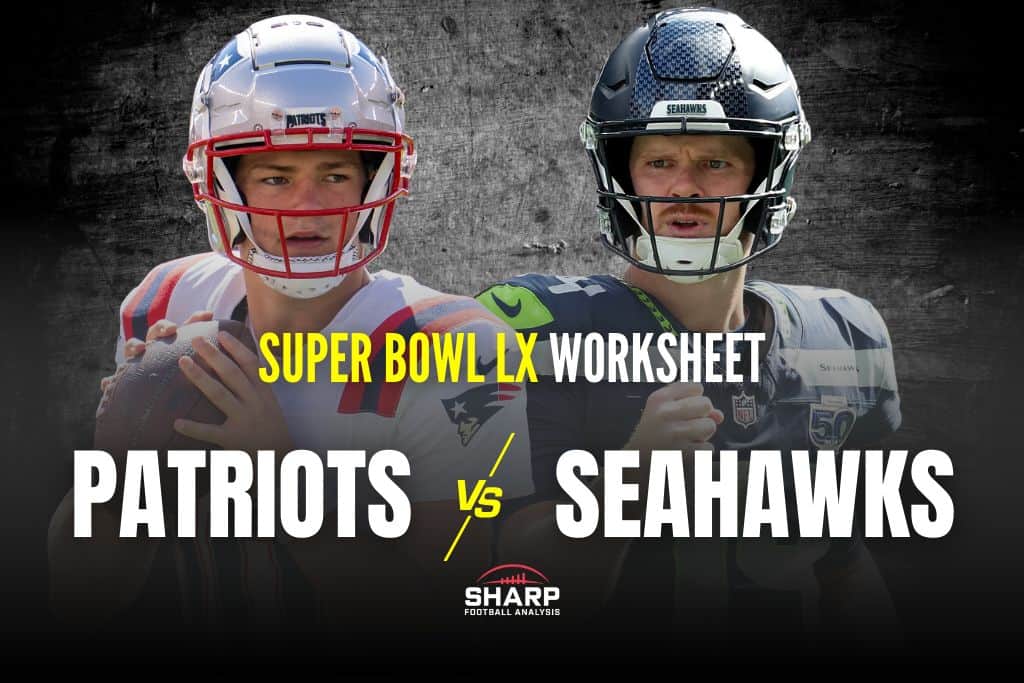
The Worksheet, a comprehensive fantasy football preview by Rich Hribar, breaks down everything you need to know about the Super Bowl 60 matchup between the Seahawks and Patriots.
| New England | Rank | @ | Seattle | Rank |
|---|---|---|---|---|
| 4.5 | Spread | -4.5 | ||
| 20.75 | Implied Total | 25.25 | ||
| 27.2 | 8 | Points/Gm | 29.2 | 2 |
| 17.3 | 2 | Points All./Gm | 17.1 | 1 |
| 61.8 | 17 | Plays/Gm | 59.6 | 24 |
| 58.1 | 3 | Opp. Plays/Gm | 62.3 | 21 |
| 5.9 | 4 | Off. Yards/Play | 5.9 | 6 |
| 4.9 | 7 | Def. Yards/Play | 4.7 | 4 |
| 47.98% | 5 | Rush% | 50.00% | 2 |
| 52.02% | 28 | Pass% | 50.00% | 31 |
| 41.22% | 10 | Opp. Rush % | 39.48% | 3 |
| 58.78% | 23 | Opp. Pass % | 60.52% | 30 |
- Seahawks ATS: 14-5
- Patriots ATS: 13-6-1
- Seahawks ATS as Favorite: 12-4
- Patriots ATS as Underdog: 4-2
Game Overview
The stage has been set.
We are getting a rematch of Super Bowl 49 and the Malcolm Butler interception at the goal line game.
Hopefully, the outcome of a competitive game is the same as it was in 2015 (the 2014 season), when these franchises last met in the Super Bowl.
Both of these teams were 14-3 in the regular season.
Neither of these teams has lost by more than one score this season, with the largest defeats for both coming in Week 1 home games.
The Patriots lost games by 7, 7, and 4 points.
The Seahawks lost by 7, 3, and 2 points.
These teams faced seven common opponents in 2025: Pittsburgh, New Orleans, Tampa Bay, Houston, Atlanta, Carolina, and Tennessee.
Both teams were 6-1 in those games, with Seattle posting a point differential of +101 compared to New England’s +64.
Seattle is going back to the Super Bowl for the fourth time.
We have long argued that Seattle has been the best three-phase team in the NFL this season.
On offense, Seattle sits sixth in yards per play (5.9) and eighth in success rate (44%).
Seattle made significant changes to their offense this season.
Klint Kubiak was hired as the new offensive coordinator.
Sam Darnold replaced Geno Smith at quarterback.
The team traded star receiver DK Metcalf.
They signed Cooper Kupp, but that trade opened the runway for Jaxon Smith-Njigba to ascend into star status, leading the league in receiving yards in his third NFL season.
Seattle leads the NFL in the rate of passing plays that gain 10 or more yards (33.2%).
They are sixth in points per drive on offense (2.44).
This will be the best defense Seattle has faced in a while, putting things to the test.
Strength of schedule gets thrown around a lot for New England (we are getting there).
Still, since their Week 8 bye, Seattle has only played three games against defenses in the top half of the league in defensive success rate, and two of those were against the Rams, who floundered to close the year on that side of the ball.
The other game over that stretch was against Minnesota, where they averaged a season-low 3.5 yards per play.
So much of Seattle’s offense is built on playing with offensive leverage.
If you are going to have success against them, you have to find a way to get Darnold on the ground and force them into clear passing situations.
When Seattle has taken a sack on a possession this season, they have averaged 0.97 points per drive (19th) compared to 2.70 points per drive without a sack taken (6th).
Seattle ranks 29th in the league in third-and-long (7+ yards) conversion rate (18.6%) and first in the league in third-down conversion rate otherwise (62.1%).
New England on defense also has the lowest conversion rate allowed on third-and-long situations (15.8%).
Defensively, this Seattle unit is as strong as you can find.
This is Mike Macdonald’s calling card.
The Seahawks are second in the NFL in expected points added per game on defense (7.6).
They are fourth in success rate on the defensive side of the ball (61.6%), ranking first in yards allowed per rushing play (3.8 yards) and fourth in yards allowed per passing play (5.3 yards).
Seattle has allowed 1.49 points per drive (3rd) and a touchdown on a league-low 15.3% of possessions.
They had a cozy run of opponents to close the season, but they are far more battle-tested with six games against the Rams and 49ers on their resume.
The Seahawks allowed 400 yards of offense only three times this season.
Two were against the Rams. The other was against Tampa Bay when the team was missing a handful of defensive starters.
Seattle has also had excellent special teams.
They are second in the NFL in expected points added per game on special teams (3.3)
Seattle has a league-high 5 touchdowns on special teams, while ranking second in the league in yards per kickoff return (29.3 yards) and yards per punt return (15.4).
Seattle has an edge in the kicking game.
Jason Myers is second in the league in field goals (44) and has made 86.3% of his field goals (14th).
He has made 22 of 27 (81.5%) of his field goals of 40-plus yards compared to rookie Andre Borregales, who has made 11 of 17 (64.7%).
45% of Michael Dickson’s punts have pinned opponents inside of the 20-yard line (9th) while averaging 48.7 yards per punt (8th).
With Seattle having an objective edge on paper in nearly every area, it's no wonder they are 4.5-point favorites.
If you are looking for an angle for New England here, it is that underdogs have been good in the Super Bowl in the modern era.
Since 2002 (when the NFL expanded to 32 teams), underdogs in the big game are 16-6 against the spread and have 12 wins outright.
We have not seen many large spreads in the recent Super Bowl era.
This is the fifth time since 2010 that we have an underdog of four or more points in the Super Bowl, and the 12th time since the field expanded to 32 teams in 2002 that there is a team favored by more than a field goal.
Underdogs getting more than a field goal have covered seven straight Super Bowls, winning five of those seven games outright.
They have covered 10 of those 12 games since 2002, winning six times outright.
Blowouts in the Super Bowl have typically come from tighter spreads in the modern era, while the lopsided victories have been by underdogs.
The top-five largest point differentials in the Super Bowl since the NFL went to 32 teams have all come from underdogs.
We have had 10 Super Bowls since 2002 decided by double-digit points.
Six of those were by the underdog in the game, with all six games decided by 14 or more points coming from underdogs.
Three of those teams were underdogs of more than a field goal.
There have been three Super Bowls over that span decided by 20-plus points, with all three being won by underdogs.
This will be the Patriots' 12th Super Bowl appearance.
Going 14-3 in the regular season after a 4-13 record in 2024, the Patriots are the first team to ever make the Super Bowl after losing 13 or more games the previous season.
The Patriots re-vamped their coaching staff this offseason, bringing in Mike Vrabel, a returning Josh McDaniels, and Terrell Williams.
A lot has been made of New England’s path to this point based on its strength of schedule.
They faced the third-easiest schedule by DVOA for any team to make the big game, behind only the 1991 Bills and the 1999 Rams.
This takes a little more to unpack than the Seattle side, with more impact for this specific game for the New England offense versus their defense.
During the regular season, New England averaged 6.2 yards per play (2nd) and had a 46% success rate (4th).
They produced a gain of 10 or more yards on 22.5% of their offensive snaps and a gain of 20-plus yards on 8.1%, both of which were the highest rates in the league.
In three playoff games, they have posted 4.3 yards per play and 33.3% success rate.
They have a gain of 10 or more yards on 14.1% of their plays and a gain of 20-plus yards on 6.3%.
The two lowest success rates for New England on offense this season have come over their past two games against Houston and Denver.
Even before the weather got ugly in the second half of the game in Denver, this offense was sputtering.
New England went from averaging 2.60 points per drive in the regular season (4th) down to 1.24 points per drive in the postseason, which is 12th out of the 14 playoff teams.
The Patriots have averaged 18.0 points per game in the postseason, the fewest for any team to make the Super Bowl since the 1979 Rams (15.0).
On the flip side, the Patriots are the first team to make a Super Bowl against three top-five defenses in the postseason.
They will draw a fourth straight in the Super Bowl.
That is where the strength of schedule surrounding these teams comes into play.
We will get into specifics in the player sections, but it is harder to make the case that New England’s offense can push Seattle’s defense than it is for the Patriots in the other phases of this game.
That places more emphasis on sustaining their defensive output.
The Patriots have won three postseason games despite their offense struggling because their defense has done its part.
The Patriots get called out for their schedule this year, but I believe that has made their defense a bit underrated.
Especially at full strength, this defense has a lot of talent.
The Patriots are seventh in the league in yards allowed per play (4.9) and third in points allowed per drive (1.60).
The Patriots allowed 26 points across their three playoff games.
Only the 2000 Ravens allowed fewer over three games to reach the Super Bowl (16 points).
Yes, they have faced a Chargers offense that has struggled to generate explosive plays since losing Joe Alt, a Houston team missing Nico Collins (and then losing Dalton Schultz after one drive), and a Denver team with a backup quarterback who had not thrown a pass this season.
They also did what good defenses should do in those situations and erased them.
When we are talking about weighing the strength of schedule for these teams, one thing that gets overlooked for both defenses is that they did what they were supposed to do against the bottom-shelf offenses they faced, which I believe is a sign of a good defense.
Apply whatever grains of salt you need for Pro Football Focus grades, but these are the top two defenses in pass coverage this season.
Yes, both New England and Seattle have had favorable runs to close the season, but they also largely never let those offenses get off the floor against them, which is noteworthy.
If New England is going to make this a competitive game and potentially pull off an upset against a front-end opponent that has edges in just about every department, their defense will need another strong showing.
The Patriots also have a strong punt returner in Marcus Jones, who is second in the league with 15.0 yards per return and has 2 touchdowns.
One thing to keep in mind here, if we do not get turnovers and a forced game script in one direction, is that both teams play slowly.
Seattle and New England average 30.6 seconds per play, ranking 28th and 29th in the league (decimal differences).
Adjusting for game scripts where the win probabilities are within 20-80% (commonly used for pass rate versus expectation), New England climbs to 22nd in seconds per play (32.9) while Seattle is 28th (33.2).
The Patriots ran 14 no-huddle snaps outside of the fourth quarter all season, which was ahead of only the Bengals (8).
Quarterback
Drake Maye: After leading the league in completion percentage (72%), yards per pass attempt (8.9 Y/A), rating (113.5), and finishing second in success rate (51.6%) during the regular season, Maye and this New England passing game have found resistance this postseason.
Over these past three playoff games, Maye has completed 55.8% of his passes for 6.9 yards per pass attempt, an 84.0 rating, and a 34.2% success rate.
His two lowest success rates in a game this season have come over the past two games.
Three of his four lowest completion rates this season have come in the three playoff games.
Maye did have to deal with some poor weather in both games against Houston and Denver, but this is where the strength-of-schedule stuff comes into play for the New England offense.
We just have not seen them operate on a high level against front-end defenses.
That does not mean they are incapable of punching it up and delivering a strong game through the air.
It just takes a larger step of faith and a bet on Maye’s talent, given the sample size we have so far.
This postseason, New England has faced opponents that rank second, fourth, and fifth in passing points allowed per attempt to opposing quarterbacks.
Seattle is third.
During the regular season, the only other opponent that the Patriots faced inside the top 10 in that department was Buffalo.
The Seahawks have allowed a 62.2% completion rate (7th), 6.2 yards per pass attempt (2nd), a 3.5% touchdown rate (5th), a first down or touchdown on 30.5% of attempts (6th), and a 79.4 rating (5th).
Outside of Matthew Stafford, no quarterback has found success against this Seattle defense through the air when they have been at full strength.
Baker Mayfield was the only other quarterback this season, outside of Stafford, to throw for 8.0 yards per pass attempt or better against Seattle, and that came with the Seahawks missing multiple starters.
A huge component of this New England passing game was built around downfield passing.
During the regular season, Maye completed 60.7% of throws 10 or more yards downfield (2nd) and 50% of his throws 20 or more yards downfield (3rd).
The league rates on those throws this season were a 48.6% completion rate on throws 10 or more yards downfield and 37.7% on throws 20 or more yards.
Maye was second in the NFL in completions of 10 or more yards (108) and second in completions on throws of 20-plus yards (35).
In the playoffs, Maye has completed 9 of 28 (32.1%) of his throws 10 or more yards downfield and 4 of 15 (26.7%) passes of 20-plus yards.
Seattle has allowed a 59.9 rating on throws 10 or more yards downfield (2nd) and a 51.0 rating on throws 20 or more yards downfield (3rd).
Only 40.8% of the passes 10-plus yards downfield against Seattle have been completed, the third-lowest rate in the league.
The Broncos (1st), Chargers (4th), and Texans (8th) all were in the top 10 in defending the vertical passing game as well.
If you are going to take shots downfield, you need to hold the football and have strong pass protection, something that has been a problem area for this passing game during the postseason.
Maye averages 2.90 seconds after the snap to throw the football, which is 27th among the 33 qualifiers for league passer rating this season.
35.2% of his passes have been within 2.5 seconds of the snap, which is 30th.
During the postseason, Maye has still been strong when he has gotten the ball out quickly.
On passes or sacks within 2.5 seconds of the snap, Maye is 29 of 41 (70.7%) for 6.7 Y/A with 3 touchdowns and 0 interceptions.
He has taken 3 sacks with a 6.8% sack rate.
On the plays where he has held the ball longer than 2.5 seconds, Maye is 14 of 36 (38.9%) for 7.1 Y/A with 1 touchdown, 2 interceptions, and taking 12 sacks (a 25% sack rate).
When opponents have held the football for more than 2.5 seconds against Seattle, they have posted a 72.0 rating (6th), a 55.4% completion rate (8th), a 7.2 Y/A (6th), and a 2.8% touchdown rate (2nd).
Seattle can create havoc, averaging 4.3 sacks and takeaways per game, which is seventh in the league.
They are seventh in the league in pressure rate (40.1%) and eighth without blitzing (36.6%).
Seattle does not play much man coverage and does not blitz much, which keeps bodies on the back end.
The Seahawks are 25th in the league in man-coverage rate (16.1%) and 28th in blitz rate (20.8%).
Against man coverage this season, Maye has thrown for a first down or touchdown on a league-high 48.3% of his passes, but that dips to 10th against zone coverage (36%).
The most comparable team in terms of pressure rate and structure that New England has faced this season was Houston.
The Patriots are starting two rookies on the left side of their offensive line in Will Campbell and Jared Wilson.
Campbell has allowed 11 pressures and 3 sacks during the playoffs, while Wilson has allowed 9 pressures and 2 sacks.
I also do not want to completely lose the plot on Maye, because he and this passing game have run into resistance in the postseason.
This is a year-two player who is in contention for the league’s MVP Award.
He is the second-youngest quarterback ever to start a Super Bowl.
Maye can perform well in a tough spot.
While Seattle did win each of the past two games against Maye's MVP cohort, Stafford still passed for 374 and 457 yards in the past two games against the Seahawks.
The difference in leaning all the way in on that outcome here is Maye does not have Puka Nacua, who Seattle could not cover in any of the three matchups.
Stefon Diggs has had a good season and is the most talented bet to win a tough matchup, but this New England offense is more of a sum of parts.
Over the past five games, New England has had five different players lead the team in receiving yards.
One area where Maye still has a spade is his ability to use his athleticism to escape pressure and create yardage.
New England’s best plays in the AFC Championship game were Maye runs.
Maye averages 27.7 scrambling yards per game, which is third in the league.
He has the highest scramble rate in the league on all dropbacks (10.1%) and is fourth in the league in scramble rate when pressured (13.8%).
This postseason, he has 9 scrambles for 125 yards.
Seattle is 28th in the league in scrambling yards allowed per game (19.5).
Jayden Daniels (50 yards), Kyler Murray (38), Cam Ward (36), Brock Purdy (34), Bryce Young (33), Jacoby Brissett (31), and C.J. Stroud (25) all scrambled for 25 or more yards in a game against Seattle this season.
Maye did pick up a shoulder injury on one of his runs against Denver.
He had an MRI that showed no significant concerns, but it limited his practice at the end of last week, and we will monitor it throughout the week.
Sam Darnold: Darnold was on fire in the NFC Championship against the Rams, connecting on 25 of 36 (69.4%) throws for 346 yards (9.6 Y/A) with 3 touchdowns.
If Darnold is playing that way in the Super Bowl, Seattle is a tough team to beat.
Darnold has done an excellent job closing out the season by minimizing mistakes.
After a 3.7% interception rate through Week 11 (31st in the league), he has a 1.6% interception rate over his past nine games (6th in the league).
Part of that reduction in mistakes is a shift to a shorter passing game, as opponents are playing more zone coverage and looking to limit Seattle’s dominant downfield passing attack on play action.
Over that nine-game span, Darnold is averaging 6.8 air yards per attempt (22nd) with 29.5% of his passes traveling 10 or more yards downfield (25th), and 7.4% 20 or more yards downfield (28th).
Before that, Darnold was averaging 9.0 air yards per pass attempt (3rd), with 39% of his passes going 10 or more yards (4th) and 14.7% of his throws 20 or more yards downfield (5th).
Opponents have played zone coverage on 77.2% of Darnold’s snaps over that nine-game run to close the season (5th highest).
Seattle saw a higher two-high look rate (49.5%) after a 43.4% rate previously.
When Darnold has gotten man coverage this season, he has completed a league-high 66% of his passes for 9.0 yards per pass attempt (2nd) and an 11.3% touchdown rate (8th).
If you are going to slow down Seattle, you have to be able to combat the play-action passing game.
Off play-action passing, Darnold averages 11.0 yards per pass attempt (2nd) with a league-high 16.1 yards per completion and a 10.1% touchdown rate (2nd).
If you can force Seattle out of its play-action passing game, that's where teams have had more success.
On non-play action passes, Darnold still averages 7.5 yards per pass attempt (4th), but also 11.1 yards per completion (13th) with a 3.7% touchdown rate (29th).
This is an area where New England is equipped to combat the Seattle offense.
Not only does New England have a run defense that can push Seattle to throw more, but they have also played well on the back end, especially with Christian Gonzalez on the field.
With Gonzalez on the field this season (492 attempts), the Patriots have allowed a 62.2% completion rate (7th), 5.9 yards per pass attempt (1st), and a 4.1% touchdown rate (10th).
With Gonzalez off the field (144 attempts), they have allowed a 69.4% completion rate (31st), 7.7 yards per pass attempt (29th), and a 4.9% touchdown rate (19th).
Against play-action passing this season, New England has allowed a 62.7% completion rate (10th), 6.7 yards per pass attempt (6th), and a 4.4% touchdown rate (11th).
The Patriots are another defense that has defended the vertical pass well this season.
On throws 10 or more yards downfield, New England has allowed a 44.3% completion rate (7th) and a 29% completion rate (3rd) on throws 20 or more yards downfield.
Strength of schedule gets brought up with New England a lot, but as noted in the open, they also never let any of those quarterbacks punch them up against, which is relevant.
Strength of schedule also cuts both ways, and Darnold and this Seattle passing game have had a favorable run themselves this season.
Seattle has faced only three defenses all season that are in the top 10 in passing points allowed per attempt, a statistic I hold in high regard because it is all-encompassing.
Those defenses were Houston, Carolina, and Minnesota.
Darnold did not throw multiple touchdown passes in any of those games.
Since their Week 8 bye, Seattle has played Washington (31st), Arizona (21st), the Rams three times (16th), Tennessee (29th), Minnesota (8th), Atlanta (20th), Indianapolis (18th), Carolina (9th), and San Francisco twice (23rd).
Heading into the NFC Championship, we highlighted how poorly the Rams' pass defense has played over the final stretch of the season.
Darnold has had five games this season with a yards per pass attempt below 7.0.
Three of those came in the matchups against Houston (6.9 Y/A), Carolina (5.4 Y/A), and Minnesota (4.9 Y/A).
Darnold completed fewer than 60% of his passes three times this year.
Two of those were against Houston (54.8%) and Minnesota (53.8%).
The other factor is that Seattle has not faced many effective pass rushes that can play coverage behind the rush this season.
The only defenses in the top 10 in pressure rate that Seattle has faced have been the Vikings, the Rams (three times), and the Texans.
Seattle has faced only three teams this season that are in the top 10 in blitz rate, which were the Vikings, Falcons, and Steelers.
New England is fifth in the league in pressure rate (40.9%) and ninth in blitz rate (29.5%).
The Patriots are also sixth in pressure rate without blitzing (37.7%).
The Patriots have disruptors in the middle of their defense in Cory Durden, Milton Williams, and Christian Barmore.
Durden is third this postseason in win percentage (21.2%) on pass rushes, while Williams is seventh (18.8%).
Williams has 15 pressures in these playoffs, which is second in the league.
53.4% of Darnold’s pressures this season have come guard-to-guard, which is the fifth-highest rate in the league.
New England must find a way to get to Darnold if they are going to have success, and Seattle has to slow down that interior pass rush of the Patriots to keep Darnold clean.
Without pressure this season, Darnold has completed 75.2% of his passes (7th) for a league-high 9.5 yards per pass attempt and only a 1.6% interception rate (14th).
When pressured, however, Darnold has completed 51.5% of his passes (10th) for 6.3 yards per attempt (14th) and a 4.9% interception rate (30th).
This is where the matchup gets intriguing and could be the deciding factor in whether the New England defense keeps them alive in this game.
The Patriots mix in a higher rate of man coverage and blitzes than the league average, something we have not seen opponents do much against Seattle.
New England is ninth in the rate of man coverage (28.3%).
While Seattle has tormented man coverage this season, they also have that strength-of-schedule note we mentioned.
They could adjust that based on how teams have approached Seattle to close the year, but they also have personnel that they may feel comfortable with in this matchup.
New England is not a static defense week to week.
In the playoffs, they had a 24.3% man coverage rate against the Chargers, 32% against the Texans, and 41.2% against the Broncos.
That Denver game was one of four in which they played man coverage at 40% or higher.
The others were against Buffalo (twice) and the Jets, teams with limited receiving units and mobile passers.
Given Darnold’s propensity to stay in the pocket, Seattle's having viable wideouts (and one of the league’s best), and how opponents have sought to limit Seattle’s downfield shot plays through the air, I would bet that the Patriots will likely be closer to their base rates of man coverage rather than skewing aggressively.

Running Back
To continue reading this article
and gain access to Warren Sharp's Super Bowl Report and betting recommendations, click below to learn more about our Super Bowl Package.
Learn More