Subscribe to the Sharp Football Email Newsletter to receive all our 2026 NFL content:
No matter how well they did in free agency, all 32 NFL teams head into the 2026 NFL Draft with holes to fill on the roster.
Leading into the draft, we will identify the top needs for every team and break down the depth chart position by position.
What are the Saints' top positions of need heading into the 2026 NFL draft?
New Orleans Saints Needs: Top Positions of Need in 2026
- Wide Receiver
- Cornerback
- Defensive Line
Contents
Explore all of our 2026 NFL Draft content:
Pre-Order The Best Analytical 2026 Football Preview
Don't miss out on Warren Sharp's 500+ page preview of the 2026 NFL season.
The preview is unlike anything you have ever seen, featuring stunning visualizations built with the reader in mind.
This preview shares insights into players, coaches, teams, and philosophies with one goal in mind: to get you prepared for the 2026 NFL season by delivering the smartest information in the fastest, most direct way possible.
Pre-order the 2026 Football Preview now!
New Orleans Saints 2026 Draft Capital
The Saints have the 9th-most draft capital according to our Sharp Football Draft Value.
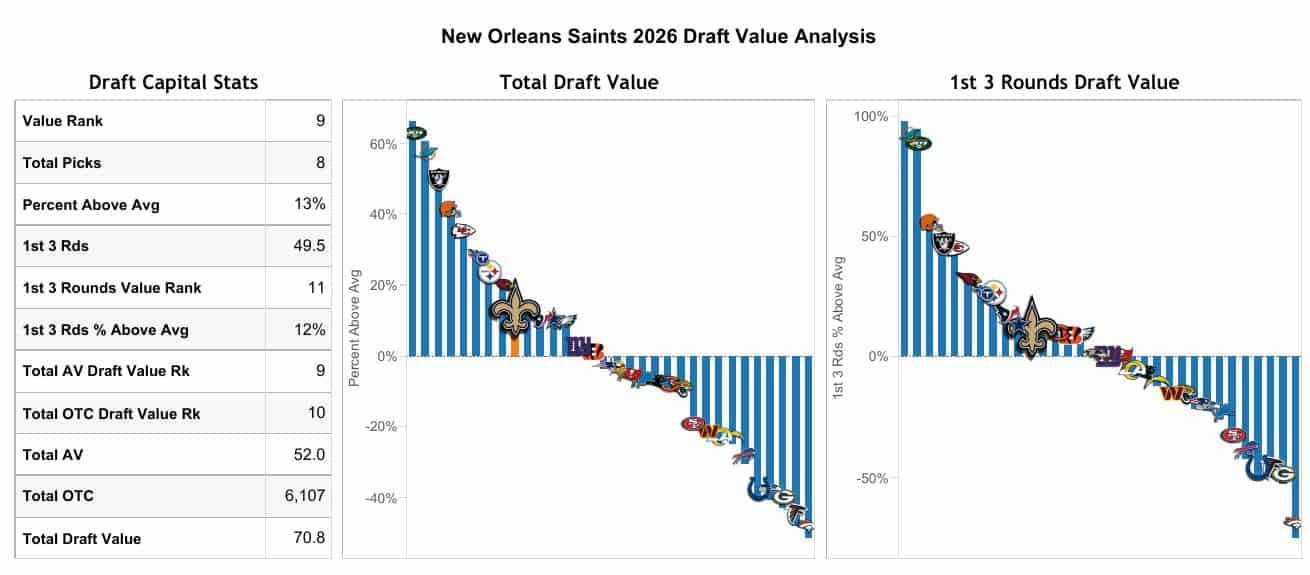
Our Sharp Football Draft Value is a valuation of draft capital based on a combination of average performance delivered and average dollars earned on second contracts.
New Orleans Saints Mock Draft Predictions
Find out who our top-rated experts expect the Saints to draft:
- Brendan Donahue's 2026 NFL Mock Draft – Complete first round breakdown from the #2 most accurate mock drafter over the last five seasons.
- Ryan McCrystal's 2026 NFL Mock Draft – Complete first round breakdown from the #20 most accurate mock drafter over the last five seasons.
New Orleans Saints Offense: Depth Chart, Analysis & Draft Needs
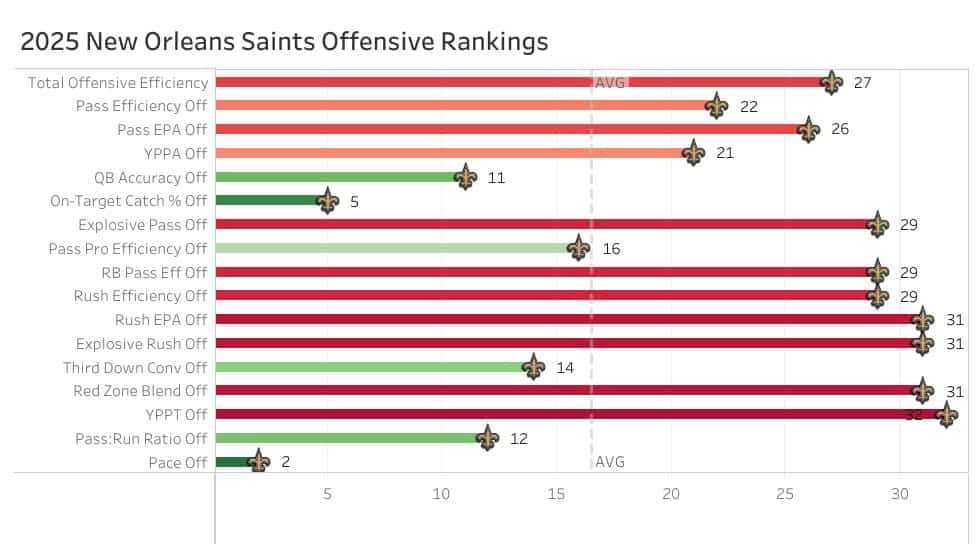
Rich Hribar breaks down the offensive depth chart by position for the New Orleans Saints, identifying areas where the team could improve in the upcoming 2026 NFL Draft.
Quarterback
- Tyler Shough
- Spencer Rattler
- Zach Wilson
Taking over as the starter in Week 8, Tyler Shough completed 68% of his passes through the remainder of the season, which was sixth in the league over that stretch.
During that period, he averaged 7.3 yards per pass attempt (16th) with a 3.1% touchdown rate (32nd), 1.8% interception rate (11th), and an 8.7% sack rate (27th).
Shough’s biggest thorn as a rookie was downfield passing.
He completed 10 of his 38 (26.3%) throws of 20 or more yards downfield over that stretch, which was 27th in the league.
The team went 5-4 with him as the starter after a 1-8 record prior to that point.
Their wins were against Carolina (twice), Tampa Bay, the Jets, and Tennessee, so there is plenty to still look for in terms of punching up in competition.
However, given arguably the worst surrounding core of skill players in the league for that period, paired with a battered offensive line, Shough showed plenty for the Saints to give him a full runway to be their starter in 2026 before making any aggressive changes, big picture.
Especially with Shough on the books for under a $4 million cap hit in each of the next three seasons, the Saints are going to want to give him more surrounding talent to see if they can take advantage of a cost-effective rookie deal.
The Saints went 1-7 in Spencer Rattler’s starts after going 0-6 in his starts as a rookie, but he did play better in his second season, completing 67.7% of his passes with 8 touchdowns (3.1% touchdown rate), 5 interceptions (1.9% rate).
All of those rates were on par with Shough’s, but Shough averaged a full yard more per pass attempt than Rattler’s 6.2 yards per pass attempt.
Shough cleared Rattler in the eye test as well, but to be fair to Rattler, he faced a far more grueling run last year, starting games against the Cardinals and 49ers when they were healthy, as well as Seattle, Buffalo, New England, and Chicago.
Rattler is still on the books for two more years of his rookie contract and showed signs of being a viable reserve.
The team brought in Zach Wilson to compete as the backup.
Running Back
- Travis Etienne
- Alvin Kamara
- Kendre Miller
- Devin Neal
- Audric Estime
- Ty Chandler
- Evan Hull
The Saints made an early move this offseason to shore up this backfield by signing Travis Etienne to a four-year deal worth up to $48 million.
Etienne rebounded from a down 2024 season that featured career lows in several areas, turning 296 touches into 1,399 yards from scrimmage and 13 touchdowns with Jacksonville a year ago.
The counting stats were in place for Etienne, but he was more of a touchdown-based producer for his spike weeks.
He did not rush for 100 yards in a game after Week 4.
After the Jacksonville Week 8 bye, Etienne rushed for 3.6 YPC (24th out of 32 backs with 100-plus attempts) with a 31.9% success rate (30th).
He failed to gain any yardage on a league-high 25.8% of his attempts over that span.
But Etienne had at least 15 touches in 10 straight games to close the year, which is why sustaining a high workload is of the utmost importance.
Etienne has not been the most hyper-efficient back, but he is a clear upgrade on what New Orleans fielded a season ago.
Year one under Kellen Moore provided several positives, but the backfield production was not one of them.
New Orleans running backs combined for:
- 3.7 YPC (29th)
- 34% success rate (30th)
- 6.7% rate of runs for 10+ yards (31st)
- 0.96 yards before contact per rush (28th)
- 2.76 yards after contact per rush (29th)
Alvin Kamara, Kendre Miller, and Devin Neal all picked up injuries that cost them games.
In the final game of the season last year, the Saints handed the ball off 21 times to Audric Estime.
Kamara is coming off a career-low 4.0 yards per touch, turning 164 opportunities into 657 yards and 1 touchdown.
He turns 31 this July with one year remaining on his current contract.
There have been rumors that Kamara might retire, but as of the latest statements from Moore, he expects Kamara to be part of their plans.
That could be coachspeak right now, but given their investment in Etienne and still having a handful of other options on the roster, the Saints are not expected to be aggressively active in this draft at the position.
Wide Receiver
- Chris Olave
- Devaughn Vele
- Kevin Austin
- Mason Tipton
- Ja’Lynn Polk
- Bub Means
- Trey Palmer
- Ronnie Bell
- Samori Toure
- Elijah Cooks
- Damien Alford
After an injury-filled 2024 campaign, Chris Olave rebounded in a big way last year, catching 100 balls for 1,163 yards and 9 touchdowns.
Olave accounted for 27.6% of the team’s targets (WR8) and 39.4% of the team’s air yards (WR4).
He ran a career-high 39% of his routes from the slot after a career-low 21.1% rate in 2024.
Olave is playing 2026 under the fifth-year option, so his spike in production could not have come at a better time for setting up a long-term contract.
Factoring in Olave’s pending extension, the depth chart, and needing to see Shough play alongside some real talent if they are in a position to look at quarterback again in 2027, the Saints should be looking to add multiple pass catchers in this draft.
Devaughn Vele is the only receiver here who has shown signs of being a regular player on this depth chart.
Vele only caught 25 passes for 293 yards and 2 touchdowns last season, but he was playing his best football after the trade of Rashid Shaheed.
Over the four games after the trade, Vele received 20.3% of the team’s targets, posting more receiving yards (232) than Olave (232) in those games.
Vele then missed the final three games of the season with a shoulder injury.
With Vele having two years remaining on his rookie contract, the only other receivers signed beyond 2026 are Damien Alford, Bub Means, and Ja’Lynn Polk.
Tight End
- Juwan Johnson
- Noah Fant
- Moliki Matavao
- Zaire Mitchell-Paden
- Treyton Welch
Signing a three-year extension last offseason, Juwan Johnson set career-highs in targets (102), receptions (77), and receiving yards (889) in 2025 to go along with 3 touchdowns.
Johnson only played 41.5% of his snaps last season in-line at tight end, so the Saints went and added Noah Fant on a one-year contract.
Fant operated in that capacity last season with the Bengals playing alongside Mike Gesicki (a similar asset to Johnson).
Fant played a career-high 71.9% of his snaps in-line last year with the Bengals.
Offensive Line
LT: Kelvin Banks, Barry Wesley
LG: David Edwards, Dillon Radunz, Easton Kilty
C: Erik McCoy, Torricelli Simpkins
RG: Cesar Ruiz, Nick Saldiveri, William Sherman
RT: Taliese Fuaga, Asim Richards, Xavier Truss
New Orleans ranked 29th in ESPN’s pass block win rate (56%) and 20th in pass blocking grade per Pro Football Focus.
The Saints ranked 31st in run blocking grade per Pro Football Focus and ranked 23rd in ESPN’s run block win rate (70%).
The New Orleans offensive line was once again ravaged in 2025.
Their most frequently used offensive line combination was on the field for only 16.9% of their plays in 2025.
Only the Chargers had a lower rate (16.5%).
New Orleans has been snakebit the past few seasons in keeping their best offensive line together.
In 2024, their top unit played 20.3% of the snaps (30th).
In 2023, they played 25.9% of the offensive plays (24th).
No other team has been in the bottom third of the league in each of the past three seasons.
If the Saints can keep their starters on the field, the talent and contractual depth are here.
Every starter is signed for multiple seasons.
Kelvin Banks and Taliese Fuaga are both on rookie contracts.
In an effort to bolster their unit heading into 2026, the Saints also signed guard David Edwards from the Bills.
Between Dillon Radunz, Trevor Penning, and Torricelli Simpkins, New Orleans had some of the worst guard play in the league last season.
Those players combined for an 8.8% pressure rate allowed in pass protection with 19 penalties.
Cesar Ruiz only allowed a 3.5% pressure rate while Edwards was at 4.7%.
Ruiz still has two years on his current contract and is still only turning 27; he just needs to stay on the field.
Missing three more games in 2025, Ruiz has not played a full season since 2021.
Erik McCoy has the same story.
McCoy has only played seven games in each of the past two seasons.
New Orleans Saints Defense: Depth Chart, Analysis & Draft Needs
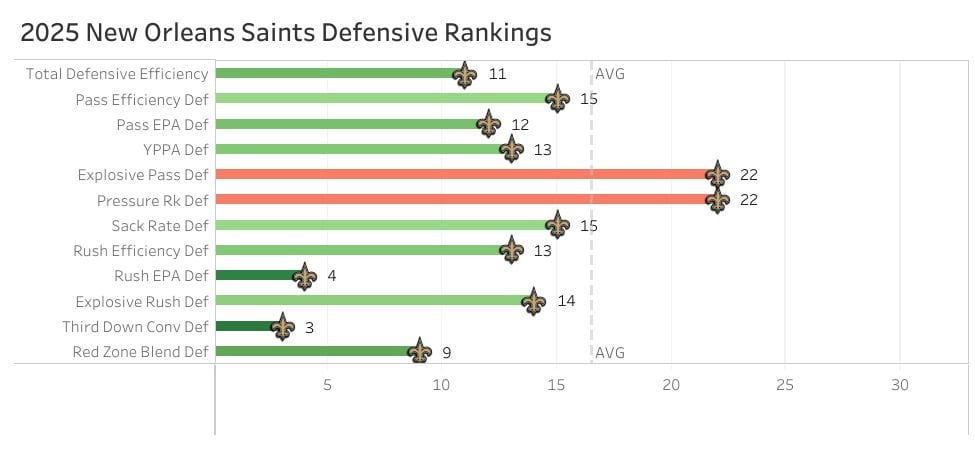
Raymond Summerlin breaks down the defensive depth chart by position for the New Orleans Saints, identifying areas where the team could improve in the upcoming 2026 NFL Draft.
Defensive Line
- Bryan Bresee
- Nathan Shepherd
- Devon Godchaux
- Vernon Broughton
- Khristian Boyd
- John Ridgeway III
- Coziah Izzard
The Saints held up well against the run last season, allowing 4.0 yards per carry to running backs and finishing ninth in explosive run rate allowed to backs.
The defensive line does not deserve a ton of credit for that showing – as evidenced by the team ranking 20th in yards before contact allowed per RB carry – and the departure of long-time linebacker Demario Davis in free agency will put more pressure on that defensive front this year.
A first-round pick in 2023, Bryan Bresee has struggled to make a significant impact through three seasons.
He did get 7.5 sacks in 2024, but that mark fell back to 2.5 last year, which is more in keeping with his career 8.5% pressure rate.
Bresee did make more plays in the backfield in the running game last year (9 run stuffs), but his career 9.4% tackle rate against the run would have ranked 133rd among qualified defensive linemen last season.
Neither Nathan Shepherd nor Davon Godchaux, who also played significant snaps last season, offered much more.
New Orleans does have 2025 third-round pick Vernon Broughton behind those three, but he is still an unknown after suffering a season-ending hip injury in his NFL debut.
Both Shepherd and Godchaux are entering the final years of their deals, and the Saints would have to pick up Bresee’s fifth-year option to get him under contract for 2027.
This is a major need area both in the short and long term.
Edge Defenders
- Chase Young
- Carl Granderson
- Chris Rumph II
- Fadil Diggs
- Myles Cole
The Saints finished 22nd in pressure rate last season, but they did record 45 sacks, which was good for 10th in the league.
As of early April, Cameron Jordan remains a free agent, which leaves the Saints down two long-term starters in their front seven.
New Orleans will have the services of Chase Young, who was limited to 12 games last year but had his best season in the pros.
Young recorded an elite 18.1% pressure rate and 10 sacks over those 12 contests.
He now has a 15.9% pressure rate and 15.5 sacks through 29 games with the Saints.
Carl Granderson is coming off yet another solid season, getting 6 sacks and recording pressure on 12.3% of his pass rush snaps.
Chris Rumph is also back, but he leads a lackluster depth group behind those top two.
Even if New Orleans brings back Jordan, they need to start building better depth and add some youth to the edge group.
If they don’t bring back Jordan, they will need to find a viable rotation rusher either in the draft or late free agency.
Linebacker
- Kaden Elliss
- Pete Werner
- Danny Stutsman
- Isaiah Stalbird
- Jaylan Ford
While the jury remains out on whether Cameron Jordan will return to the Saints, we know Demario Davis’ time in New Orleans is over.
With Davis now playing for the Jets, the Saints needed to add to this linebacker group, and they did that with Kaden Elliss.
It is a homecoming for Elliss, who was drafted by the Saints in 2019 and spent his first four years with the team.
He spent three quality seasons with the Falcons in between, finishing 30th last season among qualified linebackers in yards allowed per coverage snap.
The spot next to him remains a question.
Pete Werner was the primary option a year ago, but he did not stand out as a quality option.
A fourth-round pick last year, Danny Stutsman saw his role in the defense grow late in the season, and he could push for the starting job next to Elliss.
The Saints could also add to this group in the draft, though they do have more pressing needs along the defensive front.
Cornerback
- Kool-Aid McKinstry
- Quincy Riley
- Isaac Yiadom
- Rejzohn Wright
- Dalys Beanum
- Jayden Price
- Beanie Bishop
New Orleans finished 13th in yards per attempt allowed and EPA allowed per pass attempt last season.
Alontae Taylor left in free agency, opening up a big snap hole in the secondary, even if his level of play was not always the best.
Kool-Aid McKinstry took a step back in his second season, allowing 8 touchdowns and finishing 89th in yards allowed per coverage snap among qualified cornerbacks.
He was better as a rookie, though, so the Saints could hope for a bounce-back.
A fourth-round pick last year, Quincy Riley served as the No. 3 option as a rookie.
His per-snap numbers were not great, but he did show a knack for getting to the football, breaking up 10 passes on somewhat limited opportunities.
Isaac Yiadom does have a lot of experience, but he is probably not the answer for the Saints’ glaring hole in the slot.
That answer could come from safety, given New Orleans’ strength there, and the Saints have already talked about transitioning someone over.
Of course, the other option is to add to this group, and that is probably something the Saints should look to do even if they decide to use more big nickel in 2026.
Safety
- Justin Reid
- Jonas Sanker
- Julian Blackmon
- Jordan Howden
- Terrell Burgess
- Elliott Davison
On a defense with question marks throughout, New Orleans’ safety room stands out as a strength.
Justin Reid continued his strong play in his first season with the Saints, allowing just 6.1 yards per target.
A third-round pick last year, Jonas Sanker established himself as an immediate starter, playing 978 snaps on defense.
There were some growing pains, but he looks like a promising young player.
Julian Blackmon entered the year in that starting job, but he suffered a season-ending shoulder injury in Week 1.
He re-signed in free agency, and he is one of the primary options to cover the slot if the Saints decide to use more three-safety looks.
Jordan Howden saw his role on defense shrink with Reid and Sanker added to the mix, but he still represents quality depth.
The Saints are in a very good spot at safety.
2026 Depth Chart Analysis & Team Needs for All 32 NFL Teams
| Team | Top Need | 2nd Need | 3rd Need | READ MORE |
|---|---|---|---|---|
| Arizona Cardinals | QB | DL | OL | Full Article |
| Atlanta Falcons | WR | EDGE | DL | Coming Soon |
| Baltimore Ravens | OL | WR | EDGE | Coming Soon |
| Buffalo Bills | EDGE | LB | WR | Coming Soon |
| Carolina Panthers | TE | OL | DL | Coming Soon |
| Chicago Bears | EDGE | DB | C | Coming Soon |
| Cincinnati Bengals | EDGE | DB | DL | Coming Soon |
| Cleveland Browns | QB | WR | EDGE | Full Article |
| Dallas Cowboys | CB | EDGE | DL | Coming Soon |
| Denver Broncos | DL | TE | LB | Coming Soon |
| Detroit Lions | OL | EDGE | DL | Coming Soon |
| Green Bay Packers | EDGE | CB | OL | Coming Soon |
| Houston Texans | OL | DL | LB | Coming Soon |
| Indianapolis Colts | EDGE | LB | WR | Coming Soon |
| Jacksonville Jaguars | DB | DL | LB | Coming Soon |
| Kansas City Chiefs | EDGE | CB | WR | Coming Soon |
| Las Vegas Raiders | QB | S | OL | Full Article |
| Los Angeles Chargers | OL | EDGE | DL | Coming Soon |
| Los Angeles Rams | WR | RT | TE | Coming Soon |
| Miami Dolphins | WR | CB | EDGE | Coming Soon |
| Minnesota Vikings | DB | DL | OL | Coming Soon |
| New England Patriots | WR | EDGE | OL | Coming Soon |
| New Orleans Saints | WR | CB | DL | Full Article |
| New York Giants | DL | OL | CB | Full Article |
| New York Jets | QB | EDGE | CB | Full Article |
| Philadelphia Eagles | EDGE | TE | OL | Coming Soon |
| Pittsburgh Steelers | QB | OL | DB | Coming Soon |
| San Francisco 49ers | OL | WR | DB | Coming Soon |
| Seattle Seahawks | CB | RB | EDGE | Coming Soon |
| Tampa Bay Buccaneers | EDGE | TE | CB | Coming Soon |
| Tennessee Titans | OL | WR | EDGE | Full Article |
| Washington Commanders | DB | WR | OL | Full Article |