

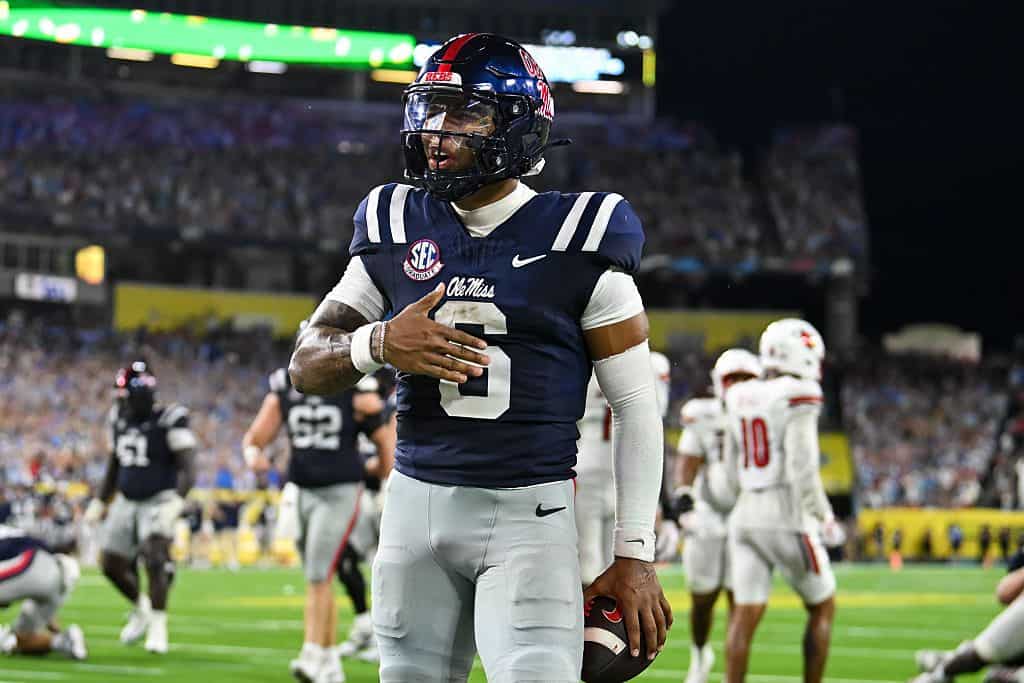
LSU vs. Ole Miss, Current Betting Odds:
- LSU -3 points
Find the odds for the top games every week of the college football season
LSU at Ole Miss Best Bet Prediction:
- LSU -3 points
A hostile environment in Oxford won't be easy to handle, but Lane Kiffin‘s squad appears to hold an edge on both sides of the ball, so let's take LSU against the spread.
When LSU Is on Offense
Lane Kiffin and coordinator Charlie Weis Jr. want to play fast, and he's successfully implemented his offense right out of the gate at LSU.
Check out the difference in pace of play for LSU over the last two seasons:
- 2025: ranked 109th
- 2026: ranked 5th
This matters because the Ole Miss defense doesn't have much experience playing a fast-paced offense — other than against its own in practice, of course.
Last year, Ole Miss played just one team ranked in the top 60 in pace of play: Mississippi State.
And that Bulldogs offense averaged 6.0 yards per play in the Egg Bowl, its highest mark against an SEC opponent all season.
There's no reason to think this Ole Miss defense improved significantly during the offseason, having lost some of its key players who followed Kiffin to LSU and making minimal portal additions on that side of the ball.
Allowing 6.9 yards per play to Louisville in the season opener was a red flag, though Louisville appears to have a legitimately dangerous offense this year.
The more concerning data point was the 5.3 yards per play allowed to Charlotte, a team that went 1-11 last year and lost to an FCS program in the season opener.
The key to slowing down LSU's passing attack will be getting pressure on Sam Leavitt.
Last year at Arizona State, Leavitt took a sack on 19.8% of his dropbacks versus pressure, ranked 118th, per Sports Info Solutions.
Ole Miss ranked 19th in opponent-adjusted pressure rate generated last year, but lost leading pass-rusher Princewill Umanmielen to LSU.
Against Louisville, the pass-rush unit started strong with a 41% pressure rate, but a pitiful 13% pressure rate against Charlotte raises some concern.
Taking a closer look at the Louisville game, it looks like the Ole Miss pass rush primarily created havoc when Lincoln Kienholz failed to get rid of the ball quickly, based on this data from Pro Football Focus:
Dropback Time Comp Rate Yds/Att Pressure Rate Under 2.5 sec 69% 8.6 19% 2.5 sec or more 54% 13.0 56%
So a deciding factor in this matchup could be whether Leavitt can consistently get rid of the ball quickly enough to avoid Ole Miss' pass rush.
That's certainly the plan in Kiffin's offense, but there's already reason to doubt Leavitt.
Last year under Kiffin, Trinidad Chambliss got rid of the ball in under 2.5 seconds 54% of the time.
So far, Leavitt's quick throw rate sits at 45%.
Maybe that's because LSU has played two opponents without a threatening pass rush, but we won't know for certain until this game plays out.
Even if Leavitt struggles against Ole Miss' pass rush, he could still make an impact in the running game, especially with the read option.
Last year at Ole Miss, Kiffin used the read-option on 28% of rushing attempts, and this would be a good matchup to lean heavily on those plays.
A year ago, Ole Miss' defense ranked 124th in yards allowed against the read option.
Pete Golding‘s defense hasn't faced a read-option team yet, but Louisville did run five read-option plays for 53 yards (four of those as keepers by Keinholz).
Leavitt showed off his running ability with 113 yards on 12 carries in the season opener against Clemson (three carries for 36 yards off the read-option), so he's certainly a threat to Ole Miss with his legs.
When Leavitt hands off to lead running back Dilin Jones, LSU's rushing attack may be less of a threat because of early-season struggles by the offensive line.
LSU running backs are averaging just 0.7 yards before contact per attempt on the ground 一 for context, only two teams averaged fewer than 1 yard before contact in 2025.
That's a shocking statistic, even after just two games, given Kiffin's ability to create light boxes for his ball carriers with his spread attack.
It's a small sample size, but the production has been bad enough to believe this is a legitimate weakness of the LSU offense, which could slow the unit down against a competent defense like Ole Miss.

When Ole Miss Is on Offense
Ole Miss no longer has Kiffin and Weis calling the offense, but the scheme appears to have remained relatively unchanged with John David Baker taking over.
Baker spent the past two years calling plays at East Carolina, but previously spent three years under Kiffin at Ole Miss, including two as Weis' co-coordinator.
Under Kiffin, Ole Miss relied on quick dropbacks and getting the ball to receivers in space.
In 2025, 54% of Ole Miss' pass plays qualified as quick dropbacks (zero/one-step dropbacks and RPOs), according to Sports Info Solutions.
Baker's offense at East Carolina used quick dropbacks 47% of the time, so we can probably expect a similar approach this season.
That said, Ole Miss opened the season against Louisville, with Chambliss using quick dropbacks only 31% of the time.
The more traditional approach brought mixed results against Louisville.
Chambliss averaged 14.9 yards per attempt on traditional dropbacks, but also faced pressure 57% of the time on those plays.
There isn't an obvious explanation for why Baker leaned so heavily on traditional dropbacks in that matchup, but a 58% quick-dropback rate in Week 2 against Charlotte suggests it was more matchup-specific than a change in direction for the offense.
The increased quick-dropback rate against Charlotte may have also been used as a tune-up for LSU, as quick-dropbacks will be a way to neutralize the Tigers' pass rush.
Through two games, LSU has generated a 48% pressure rate, per Sports Info Solutions.
The offensive line is a concern for Ole Miss this year, which likely forces Baker to focus on getting the ball out quickly against LSU.
Ole Miss is breaking in new starters at both tackle positions and already lost right tackle Tommy Kinsler IV to an injury in the season opener 一 his status for this game remains in doubt.
If Kinsler can't go, Connor Howes, a redshirt freshman and former three-start prospect, will make his second career start against potentially the best pass-rush unit Ole Miss faces this year.
Even if LSU generates consistent pressure, that doesn't necessarily mean the Tigers will disrupt Ole Miss' offense.
Chambliss took a sack on just 11% of his dropbacks versus pressure last year, ranked 18th in the country.
Through two games this year, that sack rate sits at 5.6%.
Chambliss also has the ability to be effective against the blitz, which is a staple of Blake Baker‘s defense at LSU.
LSU blitzed at the 15th-highest rate last year (36%), but Chambliss averaged 9.3 yards per attempt with a 63% completion rate against the blitz in 2026, per Sports Info Solutions.
For Ole Miss to beat LSU's blitz, it will need its receivers to produce after the catch on those short, quick throws, which was an area in which LSU's defense struggled last year.
On throws five or fewer yards downfield in 2025, LSU allowed 7.0 yards per reception, ranked 79th.
The influx of transfers on the defensive side of the ball seems to have fixed that issue, as that rate has dropped to 5.3 yards per completion this year, ranked 31st.
Although it's still early, the improvement can likely be attributed, in part, to the addition of safety Ty Benefield, Boise State's leading tackler a season ago and arguably the best player at his position to change schools this offseason.
A healthy Whit Weeks at linebacker 一 missed five games last year 一 is also a reason to trust LSU's early-season improvement.
Although Chambliss might be able to overcome a questionable offensive line in the passing game, there's less reason to be optimistic about the rushing attack.
Check out this run game matchup based on opponent-adjusted numbers from the 2025 season:
- Ole Miss: ranked 41st in yards before contact gained
- LSU: ranked 5th in yards before contact allowed
Given the questions about the offensive line, there's little reason to believe Ole Miss will improve upon those numbers while LSU is likely to remain steady, if not get even better at defending the run due to the transfers added.
Through two games, LSU is allowing 0.2 yards before contact per rush attempt and has contacted opposing running backs at or behind the scrimmage on 66% of carries, according to Sports Info Solutions.
Obviously, those numbers are slightly inflated by the lack of serious competition, but even against weaker opponents, those are staggering numbers across two games.
It certainly looks like it could be a tough day for Kewan Lacy, which likely puts more pressure than usual on Chambliss to carry the offense.
Final Thoughts on LSU vs. Ole Miss Best Bets
Despite the hostile road environment, trust the more talented team and take LSU against the spread.
LSU's defensive improvements are the strongest reason to trust the Tigers, especially given the concerns for Ole Miss' offensive line.