
The following is an excerpt from Warren Sharp's 2026 Football Preview. In addition to Warren's deep, detailed write-up on all 32 NFL teams, each chapter features page after page of full-color charts, stats, and heatmaps, as well as draft class analysis from Ryan McCrystal. Click here for a full FREE chapter from the 2026 Football Preview.
Every team is excited about their incoming class of rookies, but how will those new players affect each team in 2026?
Let's look at the Houston Texans, breaking down the most likely instant-impact rookies from their class while also providing some insight into why certain early picks may not see the field.

Houston Texans 2026 Draft Class: Which Rookies Will Make an Impact?
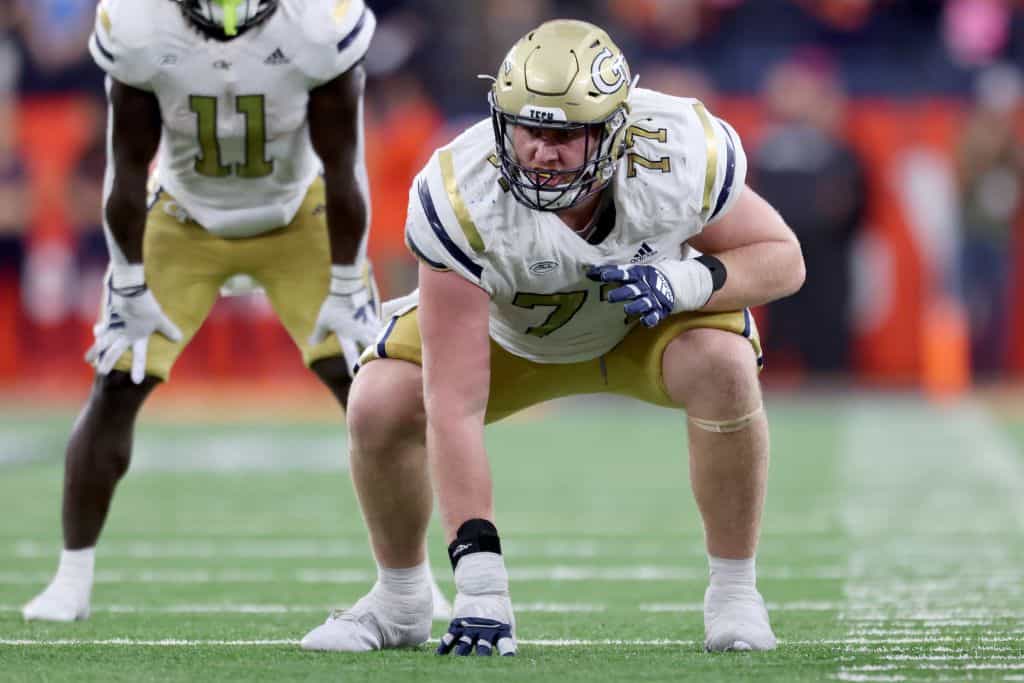
The Texans reached to fill a need when they selected Keylan Rutledge (first round), who is expected to replace Jake Andrews for the starting center job. Although Andrews is still on the roster, this pick doesn’t make sense unless the Texans decided that Rutledge offered an immediate upgrade. Houston wants to get better at running the ball, especially between the tackles, and Rutledge should help the offensive line improve in that area. Georgia Tech ball carriers averaged 3.0 yards before contact per attempt when running to Rutledge’s gap in 2025, the third-best mark among ACC guards.
Rutledge will be joined in the interior offensive line by Febechi Nwaiwu (fourth round), another powerful run blocker. Nwaiwu will compete with Evan Brown to be the primary backup at both guard spots, which is a critical position given Wyatt Teller’s recent injury history. Given Brown’s experience, Nwaiwu likely develops on the bench this year before taking Brown’s backup role in 2027.
Kayden McDonald (second round) was the most run-stuffin nose tackle in the draft, but he’s still a nose tackle, which is a dying position on the defensive side of the ball. When lined up at nose tackle, McDonald made a tackle on 28% of his snaps against the run, the highest rate in the FBS. He’s a disruptive force, will start immediately, and make an impact on early downs. However, McDonald is a non-factor on passing downs, generating a 4.5% pressure rate last season.
Marlin Klein (second round) is a developmental in-line tight end who is unlikely to see much action as a rookie, making it a baffling selection early on Day 2. Klein was born in Germany and didn’t start playing football until high school. Despite the late start, he is still underdeveloped for a 23-year-old who spent four seasons learning the position at Michigan. Klein has the size and athletic traits to develop into a Rob Gronkowski-like pass catcher, but he’s far from reaching that level.
Wade Woodaz (fourth round) wore the green dot at Clemson and has the potential to serve as Azeez Al-Shaair’s backup, but there will be stiff competition from E.J. Speed and others. Since there isn’t an obvious immediate role for Woodaz, his extensive special teams experience was likely a factor in the selection. Joining Woodaz at linebacker will be Aidan Fisher (seventh round), who has an uphill battle to make the roster due to Houston’s depth. Fisher also wore the green dot in college, so Houston clearly values on-field leaders with high football IQ. DeMeco Ryans added yet another green dot player to his defense in Kamari Ramsey (fifth round). Ramsey was at his best as a ball-hawk in the deep secondary in college, but was forced to play the strong safety role in 2025 due to USC’s lack of defensive depth. Houston has starting safeties Calen Bullock and Reed Blankenship under contract for at least two more years, so Ramsey’s versatility makes him valuable in a reserve role, but don’t rule him out pushing the veterans for playing time sooner rather than later.
Lewis Bond (sixth round) is a slot receiver with reliable hands but limited explosive traits. This selection might have been an insurance policy for Tank Dell, who is still recovering from the knee injuries that wiped out his 2025 season. If Dell isn’t ready for Week 1, Houston needs another capable receiver who can compete for reps in the slot with Jaylin Noel. Although Bond’s upside is limited, the fifth-year senior had a route-adjusted catch rate 8% above expected last year and should be serviceable if forced into action as a rookie.
Houston put together an underwhelming class due to its decisions to draft for need at less-than-premium positions while also mixing in a bizarre reach for a 23-year-old developmental tight end. Since Nick Caserio drafted for need early, expect Houston to get some immediate production from the group, but few, if any, teams have less long-term upside in their rookie class.
This analysis continues in the 2026 Football Preview
Order Warren Sharp's 2026 Football Preview to Get Penalty Analysis for All 32 NFL Teams
Warren Sharp’s 600+ page full-color PDF, the 2026 Football Preview, is unlike anything you have read. Stunning visualizations, including new heat maps and stat pages, are built with the reader in mind. Innovative, next-level thought processes abound in every team chapter and article.
Get Warren's Book
Warren Sharp's book shares insights into the players, coaches, teams, and philosophies with one goal: to prepare you for the 2026 NFL season with the smartest information delivered in the fastest, most direct way possible for optimal reviewing and retention.
- Team Chapters previews are in-depth, data-driven & full of actionable info
- Fantasy Football player profiles, predictions, and ranks
- Vegas Odds forecast team wins, division rankings, lines for all 2026 games
- Coaching strategic advice for teams, play-calling analysis & team tendencies
- Front Office Analysis positional spending, roster construction & cap analysis
- Reasons to bet over/under win totals & analysis of futures betting market
- Rookie draft class deep dive into impact for every team
- Rankings for every positional unit on every team with analysis
- Penalty analysis for all 32 NFL teams