

This season, I've been breaking down a few of college football's biggest games each week and giving out at least one bet I like from each matchup.
Let’s break down the Fiesta Bowl matchup between Miami and Ole Miss.
Ole Miss vs. Miami, current line:
Ole Miss vs Miami Best Bet Prediction:
This game is closer to a toss-up than the line indicates, so let’s take Ole Miss against the spread.
- Ole Miss vs. Miami, best line: Ole Miss +3.5
» Bet it now at Novig: Ole Miss +3.5 points

When Ole Miss is on Offense
Ole Miss runs Lane Kiffin’s fast-paced, pass-heavy offense, and not much has changed in Kiffin’s absence.
Coordinator Charlie Weis Jr. was heavily involved in playcalling before Kiffin’s departure and knows the offense well enough to maintain its success without his boss.
Weis’ relationship with Kiffin dates back to his first coaching gig as an offensive assistant when Kiffin was Alabama’s coordinator.
He then joined Kiffin at Florida Atlantic and, after a brief stop at USF, rejoined Kiffin at Ole Miss.
So far, the Ole Miss offense has not missed a beat without Kiffin, but it should be noted that Weis is joining Kiffin at LSU and was in Baton Rouge this week to assist with transfer portal recruiting.
With less time between the quarterfinal and semifinal games, Weis’ lack of attention on Miami could be a factor.
The key to beating Miami is slowing down its pass-rush unit, which generated an impressive 50% pressure rate against Ohio State in the Cotton Bowl.
Based on these opponent-adjusted stats from Sports Info Solutions, it should be a good matchup in the trenches:
- Ole Miss: ranked 4th in pressure rate allowed
- Miami: ranked 2nd in pressure rate generated
Despite similar numbers, the advantage likely goes to Ole Miss due to the offensive scheme.
Kiffin’s offense is built to get the ball out quickly, which naturally limits the amount of pressure even the best pass-rush unit can generate.
Ole Miss uses quick dropbacks (zero/one-step dropbacks and RPOs) 56% of the time, the nation’s sixth-highest rate, while averaging 8.8 yards per attempt on those plays, ranked fifth.
Miami’s pass-rush unit is talented, but even Rueben Bain and Akheem Mesidor can’t consistently generate pressure against that scheme.
When facing quick dropbacks, the Hurricanes have generated a pressure rate of only 23%, ranking 65th.
That doesn’t necessarily mean the edge goes to Ole Miss’ offense, however, because quick dropbacks also mean shorter throws 一 so there’s still time for the defense to make a quick tackle and limit the scheme’s effectiveness.
This was an area where Georgia struggled 一 the Bulldogs ranked 106th in yards per attempt against quick dropbacks 一 and so it was a key reason why we took Ole Miss against the spread last week.
Miami, however, is allowing just 5.7 yards per attempt against quick dropbacks, ranked 24th.
While Miami defends quick dropbacks relatively well, it is worth mentioning that the power conference quarterback who took the most quick dropbacks against Miami this year was Kevin Jennings, who led SMU to an upset win while averaging 8.4 yards per attempt on 24 quick dropbacks.
Jennings threw for 365 yards in that game, the only 300-yard passing performance against the Canes this year.
Another factor in the passing game will be Miami’s tendency to blitz.
Coordinator Corey Hetherman has dialed up a blitz 34% of the time this year, the 22nd-highest rate.
The blitz-heavy approach worked well last week against the less-mobile Julian Sayin, who averaged 10.0 yards per attempt on those plays but also threw an interception and took 3 sacks.
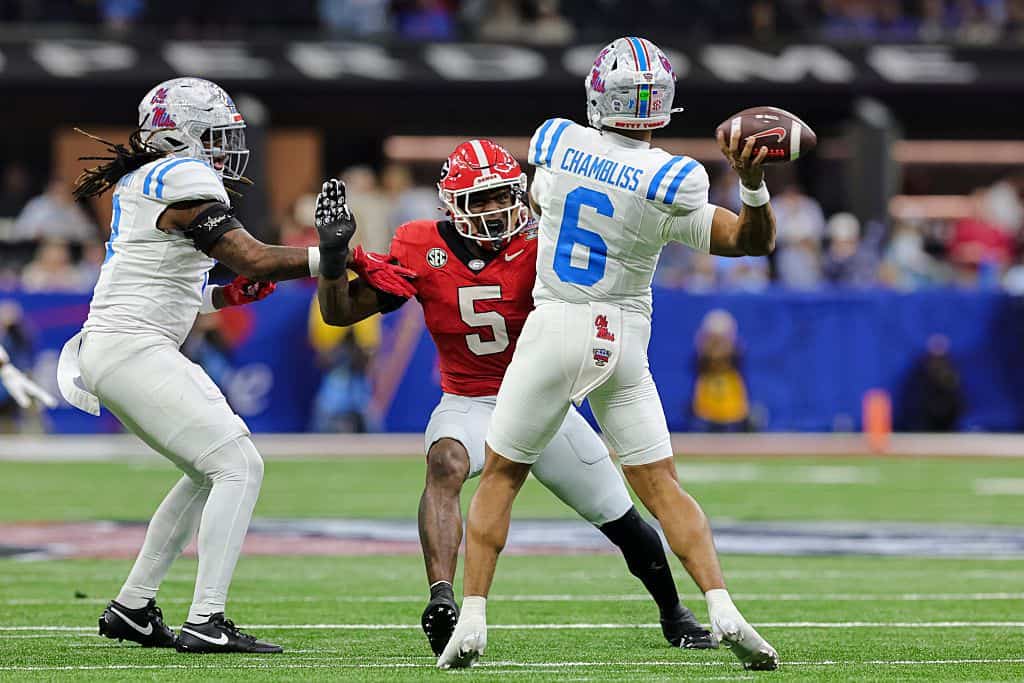
Trinidad Chambliss is more athletic, however, and probably better suited to handle the extra pressure.
According to Sports Info Solutions, Chambliss is averaging 9.4 yards per attempt against blitzes (ranked 6th) while taking a sack 4.4% of the time (ranked 30th).
When Chambliss takes a traditional dropback of three or more steps (which he does 36% of the time), that’s when Miami’s pass rush unit will hold an edge.
Against traditional dropbacks, Miami is generating a 54% pressure rate (ranked 2nd), while Ole Miss’ pressure rate allowed sits at 38% (ranked 30th).
One of the ways for Miami to force Ole Miss into more traditional dropbacks will be to create tough down-and-distance situations.
On third and long, Chambliss’ traditional dropback rate jumps to 65%, so those types of play calls are typically necessary to attack downfield.
Miami’s defense ranks 14th in the nation in third-and-long force rate, but maintaining that level of success against Ole Miss might be challenging.
As previously mentioned, Ole Miss’ quick passing game is a factor in staying ahead of the sticks, but its rushing attack is also tough to contain.
Ole Miss’ spread offense excels at creating light boxes, which has been a relative area of weakness for a Miami defense that doesn’t have as many playmakers at the second level as on the line.
When lined up with a light box, Miami is allowing 4.8 yards per attempt and, perhaps more importantly, 3.1 yards before contact per carry, which ranks 69th in the country.
If Miami struggles to create early contact against the run, it will be harder to force Ole Miss into those third-and-long situations.
Additionally, Ole Miss tends to direct runs outside the tackles, as the theme of the offense is getting playmakers into open space as often as possible.
This is also somewhat problematic for Miami’s defense based on these stats from Sports Info Solutions:
- Between the tackles: 4.0 yards per attempt allowed, ranked 24th
- Outside the tackles: 4.7 yards per attempt allowed, ranked 46th
So while Miami’s defense doesn’t have any glaring flaws, Ole Miss’ scheme does appear to be well-suited to exploit some weaknesses and potentially exceed expectations in this matchup.

When Miami is on Offense
Miami runs a conservative but pass-heavy offense under coordinator Shannon Dawson, relying heavily on Carson Beck’s experience and his ability to distribute the ball like a point guard on underneath routes.
This strategy works well in part due to Miami’s offensive line, which is likely to hold an edge over Ole Miss’ pass-rush unit based on this opponent-adjusted data from Sports Info Solutions:
- Miami: ranked 1st in pressure rate allowed
- Ole Miss: ranked 20th in pressure rate generated
Miami’s dominance in pass protection is particularly impressive since Beck takes traditional dropbacks 56% of the time.
Even in traditional dropbacks, however, Miami leads the nation in pressure rate allowed at just 25%, holding a clear advantage over an Ole Miss defense that ranks 46th by the same metric.
Although Beck takes traditional dropbacks at a high rate, the downfield passing attack is not a huge part of the offense.
Instead, Miami tries to get the ball in the hands of its playmakers quickly on underneath routes, with 57% of throws traveling five or fewer yards downfield, the seventh-highest rate, per Sports Info Solutions.
This strategy likely gives the Miami passing attack a significant edge over Ole Miss based on these numbers on throws five or fewer yards downfield:
- Miami: 6.7 yards per attempt, ranked 7th
- Ole Miss: 5.5 yards per attempt allowed, ranked 77th
One of the reasons for Ole Miss’ struggles on shorter throws is an inability to tackle in open space against the pass.
Ole Miss is allowing a broken/missed tackle once every 4.5 receptions, ranked 109th.
Miami’s receivers rank 18th by the same metric, so we should expect to see some mistakes by the Ole Miss defense lead to extra yardage after the catch.
Although this underneath passing attack has been a winning strategy for Miami, it should be pointed out that part of the motivation for the game plan is a lack of trust in Beck’s downfield passing.
Beck has thrown 22 interceptions over the last two years and routinely puts the ball in harm's way when attacking downfield.
On throws 10 or more yards downfield, opponents have generated a 19% ball-hawk rate against the Canes, ranked 97th 一 evidence that there’s nothing fluky about Beck’s interception total, as defenders are consistently getting their hands on the ball.
Downfield pass defense has been a strength of the Ole Miss defense 一 it ranks sixth in completion rate allowed at 15 or more yards downfield 一 so Miami is unlikely to alter its strategy and get more aggressive.
However, since the Ole Miss offense has the potential to score quickly, there’s a chance Miami gets forced into a shootout.
If the game flow swung that direction, it would undoubtedly favor Ole Miss due to Beck’s issues attacking downfield.
The run game matchup is more difficult to predict because it's not a strength for either team, as evidenced by these opponent-adjusted numbers from Sports Info Solutions:
- Miami: ranked 70th in yards before contact
- Ole Miss: ranked 116th in yards before contact allowed
- Miami: ranked 43rd in yards after contact
- Ole Miss: ranked 51st in yards after contact allowed
Those stats appear to favor Miami slightly, but the Hurricanes tend to invite stacked boxes at a high rate, which plays into Ole Miss’ hands.
Check out Ole Miss’ stats based on box type:
- Light box: 5.5 yards per attempt, ranked 80th
- Stacked box: 3.9 yards per attempt, ranked 40th
This is similar to Ole Miss’ matchup with Georgia, another power-run offense that invited stacked boxes, which allowed Ole Miss to contain the ground game.
A few weaker teams had surprising success running the ball against Ole Miss this year, such as Washington State and Mississippi State, but both teams used spread offenses to create light boxes.
In fact, when Mississippi State ran for 262 yards in the Egg Bowl, its running backs did not face a single stacked box.
That won’t be the case for Mark Fletcher and Miami, so expect to see a relatively modest performance from the Canes' ground game.
Final Thoughts on Miami vs. Ole Miss Best Bets
This should be a tight game, so let’s take the underdog and play Ole Miss against the spread.
This is a tough game to predict because the pace of the game likely determines who has an edge, and one unlucky turnover could swing momentum dramatically.
If Miami can avoid costly errors, run the ball, and slow down the pace, it likely holds an edge and can win a close game 一 but so can Ole Miss.
If Ole Miss can force Miami into a shootout, however, Beck’s limitations as a passer become a significant disadvantage, and Ole Miss likely holds a significant edge.