
Subscribe to the Sharp Football Email Newsletter to receive all our 2026 NFL content:
I have some bad news.
Let’s just get it out of the way before we go any further.
Last year, I made sure to give the NFL its flowers when they reversed a trend of producing unfair schedules by improving on several key factors in 2025.
Unfortunately, it turns out the evil dollar has won in 2026.
The 2026 NFL schedule is the least equitable in NFL history across most key metrics.
Let’s outline five of these metrics right now, from net rest edge to general rest advantage, and note the unfavorably historic nature of the 2026 schedule:
1. Net Rest Edge:
Last year, the largest net rest edge was +13 days.
It was an improvement over 2024 (+16 days) but was still the #5 largest net rest edge since 2000.
I have access to the last 36 years of NFL schedule data (dating back to 1990).
This year, the largest net rest edge is +15 days (Bears).
It ranks as the #2 largest net rest edge since 1990.
2. Net Rest Disadvantage:
Last year, the largest net rest disadvantage was -19 days, which was the #9 largest of the last 26 years (since 2000).
This year, the largest net rest disadvantage is -24 days (Chargers).
It ranks as the #4 largest since 1990, #2 largest since 2000, and #1 largest since 2013.
3. Net Rest Delta:
Last year, there was a 32-day swing in rest edge between the best (+13) and worst (-19) teams, the #7 largest delta for any NFL season since 2000.
This year, the delta is 39 days between the best (+15) and worst (-24) teams.
It ranks as the largest delta for any NFL season since 2000 (27 years).
4. Games with 3+ rest day advantage:
Last year, there were 61 games played where one team had 3+ days of rest advantage, the #4 most in NFL history.
This year, there are 69 such games.
It ranks as the most games in any NFL season in history.
5. Games with any rest advantage:
Last year, there were 101 games played out of 272 (37%) where one team had a rest advantage over its opponent, tied for the most in NFL history.
This year, there will be 110 games played out of 272 (40%) where one team has a rest advantage over its opponent.
It ranks as the most games in any NFL season in history.
The reason the schedule is more unfair in these regards is because the NFL has doubled down on two key beliefs, as expressed in public statements after announcing the schedule:
- The NFL believes that rest disparity does not matter at all.
- The NFL’s priority is to put the games that will get the most viewership in prime windows to sell them for the most money possible.
It is that simple for them.
The desire to produce a balanced schedule that is as fair as possible for all 32 teams, to kick off the ball, and to let the best teams win has been replaced.
If the NFL can tell the story that rest doesn’t matter at all, which is what they’ve pivoted to this offseason, they literally can do almost anything they want with the schedule without repercussion or complaint.
Which is why it’s important to have this checks-and-balances type of analysis.
It is why someone needs to hold the NFL accountable for which teams they are negatively impacting with the schedule.
While I will dig into the data across a large, decade-long sample to show what does or does not matter from a rest disparity standpoint, at some point, there is just common sense that needs to be applied.
If you were given a choice between:
A) +15 net days of rest in a season
B) -24 net days of rest in a season
What schedule are you choosing?
If you were given a choice between:
A) Playing zero teams off a bye in a season
B) Playing four teams off a bye in a season
What schedule are you choosing?
I think EVERYONE chooses to play the A-schedule.
Realistically, if you were given a choice between playing an opponent who has less rest than you or playing an opponent who has more rest than you, what would you choose?
You’re choosing an opponent who has less rest than you 100 out of 100 times.
For a myriad of reasons, including that they might have less time to get healthy from injuries, they might be the more tired team, they will have less time to prepare for you, and so on.
You can’t look at one season of data and claim rest doesn’t matter.
Use a larger sample as well as common sense.
Rest DOES factor into results because common sense says it’s obvious and because longer samples of data show that it does.
Ask any athlete in any sport about rest, from kids playing tournaments with multiple games per day, all the way to Olympians as they try to get their bodies in optimal shape for peak performance.
Rest matters.
This isn’t complicated.
We know a lot goes into wins and losses, making it very challenging to isolate the precise impact of rest in a small-sample sport like the NFL.
But the NFL wants you to believe it’s a nonfactor, and that’s simply not the case.
Before we dig deeper, I do want to ensure I present both sides of the case for the 2026 schedule.
In 2026, the NFL did a GREAT job of eliminating three games in 10 days, reducing four games in 17 days to only one such situation, reducing negated bye weeks, and reducing the number of games played after a road Sunday night or Monday night game.
These are all things that factor into player health and safety as well as rest edges for teams.
So, while there are some significant concerns with the direction of the schedule, there were also some strides taken in certain areas, including player health, which cannot be overlooked and deserves to be commended.
With that said, let’s dig into what the data is for 2026 and why I believe having a fair schedule from a rest perspective is more important in the NFL than in any other sport.

NFL Rest Edge & Disparity in the 2026 Schedule
What is a rest edge in the NFL?
A rest edge in the NFL is the number of extra days a team has to rest and prepare for their game over their opponent.
An example of rest edge: if the Dolphins have a full 7-day bye week ahead of their game vs. the Bills, and the Bills play on Monday Night Football and are on a short week, the Dolphins have a rest edge of +8 days before their game against the Bills. Conversely, the Bills have a rest edge of -8 days.
What is net rest in the NFL?
Net rest is the cumulative sum of individual game rest edges throughout an entire NFL season.
An example of net rest: This year, the Falcons have games with rest edges of +7 days (coming out of their bye week entering Week 12), +3 days (coming off a mini-bye entering Week 4), and +1 day entering Week 7.
But they also have -3 days rest against the Lions when Detroit is off a mini-bye and are -1 day against the Ravens in Week 5, as Atlanta played Monday Night Football in Week 4.
As a result, the Falcons' net rest is 7+3+1-3-1=7, so +7 days net rest for the 2026 season.
As we've seen with previous seasons, rest edges can be a massive benefit to one team or the other.
It’s not always the total nest rest that matters.
It can also be individual games with a rest advantage that matters.
Having a rest edge does not mean you’re easily going to win a game, nor does a rest disadvantage mean you’re going to lose.
But it’s a factor, and it matters to teams.
That is particularly true when we’re talking about a 3+ day rest edge (more on measuring rest edges to follow).
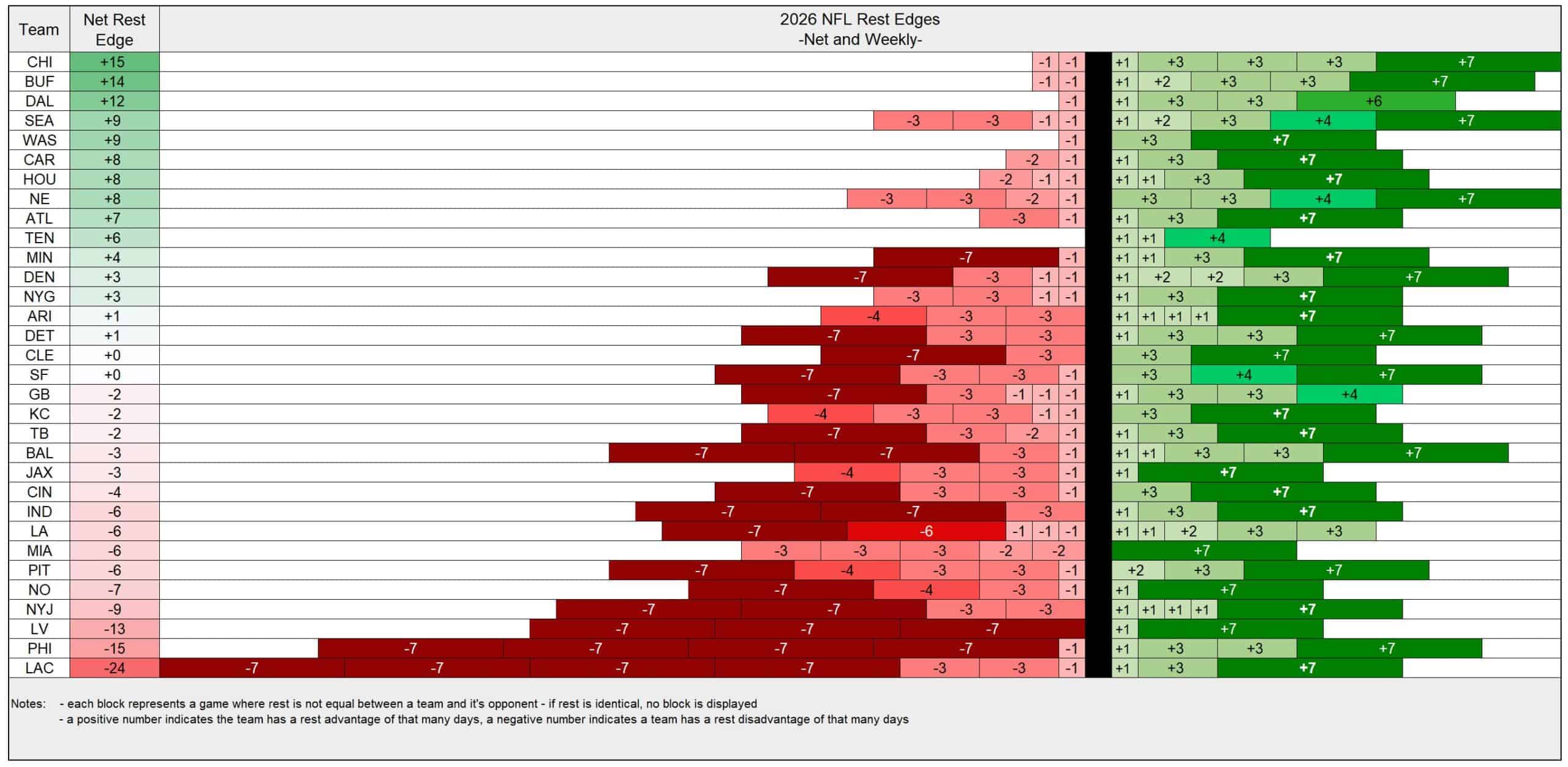
The graphic below shows the net rest edge for each team this season.
Each block is a single game where one team has a rest advantage or disadvantage.
For example, a +1 block for Detroit indicates they have 1 extra day of rest compared to their opponent in one game this season.
Sum up the individual game blocks, and you get the net rest edge for the season.
A team with just three blocks total means they have “even” rest with their opponent in their other 13 games, thus no edge or deficit.
*Click on image to enlarge and download*
There is a 39-day swing in rest edge between the best (+15) and worst (-24) teams in rest edge.
It ranks as the #1 largest delta for any NFL season since 2000 (27 years).
2026: 39 days ◄
2025: 32 days
2024: 37 days
2023: 32 days
2022: 24 days
2021: 27 days
2020: 26 days
2019: 24 days
2018: 24 days
Which NFL team has the best rest edge in 2026?
The Chicago Bears have the best rest edge for the 2026 NFL season.
The Bears have 15 more days of rest than their opponents.
It ranks as the #2 largest net rest edge since 1990.
Which NFL team has the worst rest edge in 2026?
The Los Angeles Chargers have the worst rest edge for the 2026 NFL season.
The Chargers have 24 fewer days of rest than their opponents.
It ranks as the #4 largest since 1990, #2 largest since 2000, and #1 largest since 2013.
Why is Rest Edge Important?
Why is it important to check for these issues (and others) to ensure the schedule is as fair as possible?
For two key reasons:
- By nature, with only 17 games per team, the NFL schedule is the least “equitable” to all 32 teams of any major American professional sports league.
- The NFL does not prioritize making the schedule equitable.
Let’s expand on each reason.
First, compare the NFL season to other professional sports:
MLB: 30 teams, 162 games played per team
NBA: 30 teams, 82 games played per team
NHL: 32 teams, 82 games played per team
NFL: 32 teams, 17 games played per team
More teams than most leagues, but substantially fewer games.
As a result of such few games, the strength of schedule between NFL teams skews massively each season between the easiest and toughest.
This doesn’t have anything to do with rest at all.
This year, for example:
- The Arizona Cardinals play 12 games against teams expected to have a winning record this season, and they play 10 games against teams expected to have 10+ wins this season.
- The Detroit Lions play just six games against teams expected to have a winning record this season, and they play three games against teams expected to have 10+ wins this season.
Even if the Cardinals and Lions were mirror images of one another in talent and coaching, they wouldn’t have the same record in 2026 purely due to how massive that difference is in their schedule of opponents faced in 2026.
In MLB, NBA, and NHL, just before the season starts, every team’s schedule alone grants them a much more similar opportunity to win their championship.
But not in the NFL. Not with so many fewer games and such a wider range of schedules of opponents.
There aren’t enough games played to distribute all the opponents evenly (think 31 games played each year, one against every other team in the NFL).
More than any other professional league, WHO you play matters more in the NFL, and the schedules of opponents are not going to be balanced.
So, since we know the opponents each team plays are not going to be balanced, the VERY LEAST the NFL could do is to attempt to spread out the disadvantages from a game timing perspective as evenly as possible around the NFL.
Teams don’t want to play on short rest.
Teams don’t want to play opponents who have more rest than they do.
Considering all teams feel the same in this regard, the NFL might think to prioritize its schedule to balance the inequalities that inevitably will present themselves when you’re trying to schedule 272 games throughout a four-month season.
Which leads us to the second point.
The NFL does not prioritize making the schedule equitable.
There are guardrails to ensure the schedule they choose does not get too inequitable, but making a fair schedule is not a top priority, and who is to say the NFL’s opinion of what is “acceptable unfairness” is appropriate?
If this surprises you, you need to hear from the NFL’s VP of Broadcast Planning, Mike North, who said this last year about the schedule:
“You’ve got these 272 games and they are their assets…they are all worth a little something different. So we want to make sure that the ones that are worth the most are available to as many fans as possible.
Put them in national television windows to get maximum value out of them.
We’re trying to drive engagement, drive viewership, and obviously it’s a business, so drive revenue”
When asked on the Ross Tucker Show last year why the team decided to put the Chiefs against the Cowboys on Thanksgiving, when the Cowboys game on Thanksgiving is already one of the most-watched NFL games every year, North said they wanted to go as big as possible.
“Maybe we can get Taylor (Swift) to sing the National Anthem to get people involved beyond avid football fans. Let’s see if we can set a record that day. Let’s push for 48, 49, 50 million.”
This is their prime focus. It’s setting records for viewership to get more lucrative media deals in the future.
Period. End of story.
North also added about the guardrails analogy I mentioned before:
“There’s a line that we shouldn’t cross when it comes to things like competitive fairness and player health and safety, travel, whatever it is. Push the engagement, push the viewership, and maybe walk right up to that competitive inequities line, but don’t cross over it.”
North and his team know there is a give-and-take.
They could make a perfectly fair schedule from a rest and prep perspective, but the schedule may not have as many great teams playing in prime time in a given week.
So, to place those “assets” where they are most likely to create spikes in viewership and ratings, the byproduct will be an increase in inequality.
The NFL would rather not discuss that.
They would rather no one check their work, like I do each year.
They would rather answer privately to a few teams, play the games, and have no one question how much intentional inequality exists in their schedule and how much is too much.
But for years, that’s what I’ve done.
I’ll share the positive and the negative in hopes that the NFL produces future schedules that give as many teams as possible as even a shot as possible at the Super Bowl each season.
So let’s begin the process of walking through the 2026 NFL schedule and evaluating the work the NFL did.
In doing so, we will answer the following questions for all 272 games:
- Is a team at a rest disadvantage in a game compared to their opponent?
- How many days do they have to prepare for their game?
- How many does their opponent have?
- Are they coming off a road game on a short week?
- Is their bye week edge negated?
To evaluate the aspect of NFL strength of schedule that deals with the timing of the games, we need to look at several variables related to rest and prep, including:
- Net rest edges
- More or less rest than the opponent
- Opponent’s days to prepare for the game
- Short-week road games
- Off road games on Sunday night or Monday night
- Negated bye weeks
- Three Games in 10 Days
- Four Games in 17 Days

Rest Factors in the 2026 NFL Schedule
Before we dig into what rest matters, let’s first discuss what rest does NOT matter as much.
Surprisingly, it’s the most original form of rest the NFL handed out decades ago: the bye week.
Do Bye Weeks Still Matter?
The simple answer is that NFL bye weeks do not provide nearly the benefit they once did.
In 2011, the NFL and the Players Association signed a new Collective Bargaining Agreement (CBA).
Before this CBA, teams were able to practice as often as they wanted during the team’s bye week.
Some coaches gave their players a week off. Other coaches gave their players just a couple of days off and came back to practice much earlier.
But the 2011 CBA put an end to the arbitrary nature of the bye week and guaranteed players would receive four days off.
From division realignment in 2002 to 2010, teams after a bye week won 55.7% of their games as an average half-point favorite and covered the spread in 56.3% of games (7.6% return on investment).
But since the 2011 CBA, teams after a bye week have won just 52.4% of their games as an average half-point favorite and covered the spread in 48.9% of games (-6.6% ROI).
In part due to bettors attempting to “chase” the value of teams off bye weeks, the point spreads of teams off bye weeks have increased, and performance has decreased in more recent years.
Over the last decade (since 2016): average favorite of -1.0 points, 48.2% against the spread (-7.9% ROI)
Indeed, with the new CBA, bye weeks are less valuable with the forced time off.
But with every single team receiving a bye week, there is no inequality to be argued.
What Rest Advantages Provide an Edge?
While bye weeks no longer offer an edge, there are rest spots that provide advantages for teams both straight up and against the spread over the last decade.
Rest later in the season holds value, as well as rest edge over your opponent of the three to six day variety, rather than a full 13 to 14 days off that comes with a bye week.
The same positive results are true when looking to fade teams who are playing on short rest while on the road, or teams who are playing the final game of three games in 10 days.
A few examples to illustrate some of these points before breaking down the 2026 NFL schedule:
- Over the last decade, teams with a three to six day rest edge and not off a full bye have covered 54.6% of games with a 4.2% ROI over 233 games from Week 6 onward.
- If these teams play on the road with this rest edge, the cover rate jumps to 56.1% with a 7.0% ROI over 134 games.
These rest edges matter and are useful to identify.
Another quick analysis for which we will exclude the 2020 season (due to the advantage to road teams without home crowds):
- In the last decade, teams playing short-week (less than six days rest) road games after Week 6 have won just 43.9% of games and covered just 47.4% (-9.4% ROI).
- Meanwhile, when those same road teams play with extra rest (over 6 days) instead of short rest (literally just flip one variable), they have won 46.9% of games and have covered a whopping 53.3% (+1.8% ROI).
That’s a swing of 11.2% ROI and 5.9 percentage points in cover rate, shifting from burning money at -9.4% ROI to actually making money by blindly tailing.
While rest results on an annual basis can vary, looking at a larger decade-long sample is telling.
Rest is a real factor, and it makes sense.
It doesn’t take a rocket scientist to choose to have more rest than your opponent has before a game.
Let’s just use common sense here.
Which 17-game schedule would you rather play:
A) 8 games featuring more rest than your opponent and 1 game with less rest than them
B) 1 game featuring more rest than your opponent and 6 games with less rest than them
I wouldn’t trust many people who claim they would prefer to play the second schedule.
But guess what?
Those two schedules were issued to teams in the SAME SEASON in a league that should be looking to give as many teams a chance to win as possible before each season.
Having extra rest is a factor. It’s not the 100% end-all, be-all, but it’s important.
But the NFL doesn’t see that to be the case.
When asked on the Ross Tucker Show about what is the goal behind producing the schedule, I want you to read what Max St. John, NFL Manager of Schedule Planning, had to say:
“It’s really trying to predict how many people are going to watch games, what teams are going to be good next year, and what teams are going to struggle. At the start of the season, we have a ton of storylines to tell across all of our windows. But as you get later into the season, we want games with playoff implications in our biggest window. [We’re] trying to be as predictive as we can about who we think is going be in a tight division race competing for the No. 1 seed. Making sure we really rely on those teams late in the season that’s where it comes in a lot.”
He made sure not to say the quiet part out loud.
Notice there is no mention of trying to create a fair schedule? An even or balanced schedule between all 32 teams?
It’s moved beyond that now. It’s about viewership, viewership, viewership.
You get viewership with good teams in important viewing windows, and if that has to come at the expense of a fair schedule, then the fair schedule loses out.
Based on the way the NFL has talked after the 2026 schedule release, I now believe they have created a model that predicts total viewership based on opponents and broadcast time.
They take the results and sell the “A-tier” games to networks simply by telling them how many eyeballs they expect on each game.
According to North:
“You take the 272 games, you bucket them, you tier them, and then I think you see us putting A-tier games in holiday windows. You’re starting to see better quality in the international broadcasts. The fans vote with their remotes. They tell us what they care about. They tell us what they want to watch. And when there’s an audience for a window, we’re not doing our jobs if we’re putting anything other than the very best games in those windows. So you see us keeping our foot on the gas.”
I believe the schedule the NFL ultimately decides to go with for their 272 games is one that has the highest total predicted viewership according to their model.
Once they settle on that schedule based on viewership, they sell the games to networks as they were doing the last couple of weeks, which we heard on the news.
While the 2025 schedule was an improvement over the historically inequitable 2024 schedule, the 2026 schedule was a massive step in the wrong direction for the most part.
How Net Rest Impacted Teams in 2025
Last year, there were five teams with over seven days of positive net rest (+8 or better).
- Seahawks won 14 games
- Rams won 12 games
- 49ers won 12 games
- Lions won 9 games
- Dolphins won 7 games
We had two Conference Champions and the Super Bowl Champion receiving the best net rest in the NFL last year, and those three teams averaged 10.8 wins.
Last year, there were three teams with over seven days of negative net rest (-8 or worse).
- Raiders won 3 games
- Commanders won 5 games
- Saints won 6 games
That’s an average of 4.7 wins per team.
Obviously, net rest does not explain all of the successes or failures for these teams.
But it certainly has an impact.
Last year, in general, teams playing on worse rest did better than they usually do, but that was more an anomaly than the norm, as the data below will show.
Over the larger 10-year sample, rest certainly plays a role in performance.
More Rest Than Opponent
Since 1990, only nine teams have played 6+ games with a rest advantage in a season.
While rare, it happened three times last year.
This year, fortunately, it does not happen once.
The largest total number of games for any team with more rest than their opponent this year is five games.
However, there are eight total teams with five games of rest advantage over their opponent:
- Bears
- Seahawks
- Bills
- Ravens
- Broncos
- Cardinals
- Rams
- Jets
Last year, there were only five teams with five games featuring rest edge.
That total has climbed to eight teams this year.
Eight teams with at least five games with more rest than their opponent is the highest total in NFL history.
Before 2023, the highest total in NFL history was three teams to have 5+ games with more rest than their opponent in a season.
This total has spiraled out of control over the last four years, jumping to:
- 7 teams in 2023
- 5 teams in 2024
- 5 teams in 2025
- 8 teams in 2026
On the opposite end of the spectrum, the Dolphins play just one game with more rest than their opponent all season.
And eight teams play two or fewer games with more rest than their opponent:
- Jaguars
- Bengals
- Browns
- Saints
- Chiefs
- Commanders
- Raiders
- Dolphins
Less Rest Than Opponent
Last year, only three teams played 5+ games with a rest disadvantage.
This year, that number more than doubled.
This year, SEVEN teams play 5+ games with a rest disadvantage:
7 – Chargers
5 – Eagles, Rams, Packers, Chiefs, Steelers, Dolphins
Seven teams with 5+ games of less rest than their opponent in a season is the #2 most in NFL history.
Meanwhile, one team plays ZERO games with a rest disadvantage.
And we have three total teams playing one or fewer games with a rest disadvantage all season:
1 – Commanders, Cowboys
0 – Titans
To have both the Commanders and Cowboys competing against the Eagles in the NFC East, while the Eagles have five games with a rest disadvantage, and both the Commanders and Cowboys have just one such game?
That seems unfair.
Opponent’s Days to Prepare for Your Game
If the standard is a game every seven days with six days of rest, how often does an opponent have more than standard rest to prepare to face their opponent?
In 2026, two teams have to play 6+ games in which their opponent will have extra time to prepare for them.
The game count recently:
2022: 1 team played 6+ games against opponents on extra rest
2023: 4 teams
2024: 6 teams
2025: 1 team
2026: 2 teams
Last year, the Raiders were the lone such team, and their season was an obvious disaster, but for more reasons than just rest alone.
The two teams in 2026 that play 6+ games against opponents on extra rest are the Eagles and the Chargers.
The Chargers have been getting screwed by the NFL for years for this particular metric, and it is confusing why this treatment persists.
2023: 2 games vs. “short rest” opponents, 6 games vs. “extra rest” opponents, net -4
2024: 0 games vs. “short rest” opponents, 6 games vs. “extra rest” opponents, net -6
2025: 2 games vs. “short rest” opponents, 3 games vs. “extra rest” opponents, net -1
2026: 2 games vs. “short rest” opponents, 6 games vs. “extra rest” opponents, net -4
This is the worst situation across the NFL for any team.
Consider this:
In the last four years (2023-2026), the Chargers will have played 21 games vs. opponents who have extra rest.
Meanwhile, a team like the Ravens will have played only 10 such games, fewer than half that total.
Both are competing to win the AFC.
That seems unfair.
Short-Week Road Games in the NFL
Short-week road games are the worst type of games to play.
Less time for coaches to prep, less time for players to heal and get healthy, and less time to install a game plan.
Less of all of that than your opponent, because you also have to travel to the game.
Teams hate playing these games, and it’s for good reason, especially as the season progresses.
Over the last decade, teams playing in short-week road games have won just 46% of these games and covered the spread in 49% (-6.0% ROI) after Week 6.
The mark is even worse if you exclude 2020, when road teams excelled without home-field advantage.
In the last decade, teams playing short-week (less than six days rest) road games after Week 6 have won just 43.9% of games and covered just 47.4% (-9.4% ROI).
Meanwhile, when those same road teams play with extra rest (over 6 days) instead of short rest (literally just flip one variable), they have won 46.9% of games and have covered a whopping 53.3% (+1.8% ROI).
That swing over hundreds of games in each sample is massive.
Because the NFL is trying to schedule more games in prime-time viewing situations, short-week road games are inevitable.
But the key is to distribute them as fairly as possible AND limit them by using other schedule tricks, such as allowing teams off a bye to play on the road the next Thursday.
This year, there are 36 short-week road games.
That number is nearly identical to the 37 short-week road games scheduled last year, although due to flex scheduling, that total increased to 41 games by the end of the 2025 season.
The NFL often implements flex scheduling and adjusts games later in the season, which could increase the number of short-week road games from the 36 currently scheduled.
As recently as 2021, there were just 31 short-week road games, and that number was 29 in 2019.
Due to flex scheduling and the NFL prioritizing TV schedules over equity, we’ve seen 41+ total short-week road games played every season the last four (since 2022).
This year, the Bills bear the brunt of this scheduling disadvantage.
Buffalo is the only team to play three short-week road games this year:
- Week 6, they play in Las Vegas after a Monday Night Football road game in Los Angeles vs. the Rams. Buffalo should ideally stay on the West Coast before traveling to Las Vegas to prevent travel and help reduce the impact of this spot.
- Week 10, they play in New York after a Monday Night Football road game in Minnesota against the Vikings.
- Week 16, they play in Denver on a Friday (Christmas) after playing the Bears the prior Saturday.
No other team plays more than two short-week road games, at least as of right now.
But from an equality perspective, 10 teams don’t play any short-week road games this year, including a team like the Bengals, who will be competing with the Bills for the AFC Championship.
Other AFC favorites, such as the Chiefs and Broncos, play only one short-week road game.
So, for teams like the Bengals, Chiefs, and Broncos to play zero or one short-week road game, while the Bills play three, makes the season more challenging for Buffalo in this regard.
Games After Playing on the Road Sunday Night or Monday Night
Teams hate when they have to travel home and arrive in the wee hours of Monday or Tuesday morning.
It throws a wrench in their week of prep.
This year, there are currently only 30 games in which teams will have to play after a road Sunday Night Football or Monday Night Football game.
This number increases due to flex scheduling each season, but has been 38 games each year for the last three seasons when flex scheduling gets involved.
The NFL reducing these games should be viewed as a positive, as the long-term trend is less than ideal for these teams.
Teams have covered just 49.0% of spreads since 2013 after playing a road Sunday Night Football or Monday Night Football game.
Negated Bye Weeks in the NFL Schedule
Every team gets one bye week.
Most often, that gives the team an extra week of rest compared to the opponent they face coming out of the bye.
But sometimes, their opponent out of the bye is also off a bye or mini-bye, and thus, the first team doesn’t get the full “advantage” of the bye.
It doesn’t “hurt” the team, because they still get their rest and prep.
But it doesn’t “help” the team, as they don’t have a rest or prep advantage over their opponent.
In the recent past, this number was double-digit teams:
2025: 10 teams with negated byes
2024: 6 teams with negated byes
2023: 11 teams with negated byes
One look at the 2026 Net Rest Edges graphic and you’ll see the great news.
In 2026, only three teams have negated byes!
Only the Rams, Packers, and Titans have negated byes.
One note on the first two teams mentioned.
The Rams play the Packers on the inaugural Thanksgiving Eve game, which is a Wednesday in Week 12.
So the NFL gave them both a Week 11 bye to prepare.
Thus, neither gains any advantage from that bye over their opponent.
The Titans' bye is Week 9, and they play the Jaguars in Week 10.
But the Jaguars play a Thursday night game in Week 9, so they are coming off a mini-bye with extra prep and rest when they face the Titans in Week 10.
Three Games in 10 Days
For years, when I did this post-schedule-release rest analysis, I did not have to worry about detailing instances where teams played three games 10 days apart.
2019: 0 times
2020: 0 times
2021: 0 times
2022: 0 times
2023: 0 times
But then there was the 2024 schedule.
The NFL played games on Christmas that year, which was on a Wednesday, so they re-inserted three games in 10 days.
But instead of it only happening to the four teams that played on Christmas, the NFL slipped in six other teams.
So there were 10 teams scheduled in 2024, but only nine ultimately hit that mark due to flex scheduling.
Last year, the NFL reduced it to just one team.
And fortunately, I’m happy to share that zero teams will be playing three games in 10 days in 2026.
In fact, Mike North made a specific reference to that in his interview this year, saying they told the computer to eliminate three games in 10 days.
The NFL is playing two games on Wednesday this year, but one is Week 1, so that alleviates the concern, and the other is Week 12, with both teams (Rams, Packers) having bye weeks before that game, alleviating the concern (while negating their bye week).
The NFL's elimination of this stretch for teams is a great move by them.
Four Games in 17 Days
Several years ago, the NFL removed the need for teams to occasionally be forced into playing four games in 17 days.
I thought it was gone for good, so I didn’t even mention it in my 2023 schedule analysis review and was happy to exclude it.
But in 2024, they brought it back seven times, the most in NFL history.
It occurred three times last year.
2025: 3 times
2024: 7 times
2023: 0 times
2022: 0 times
2021: 1 time
Fortunately, it’s only occurring once in 2026.
And the team that must deal with it is the Buffalo Bills.
Buffalo's four games in 17 days:
- Monday Night Football, Week 10, in Minnesota
- Sunday, Week 11, in New York against the Jets
- Sunday, Week 12, home against the Dolphins
- Thursday, Week 13, home against the Chiefs
That sequence of Monday-Sunday-Sunday-Thursday crams in those four games into the shortest possible period over four weeks.
Making matters worse for the Bills is that not only are they the only team in the NFL with this quirk, but this stretch also comes late in the season, when they are more likely to be tired.
AND it ends with a pivotal game against the Chiefs, which may decide playoff seeding in the AFC.
At least the game is at home, but it does somewhat reduce the “home-field edge.”
NFL Rest & Prep Rankings in the 2026 Schedule
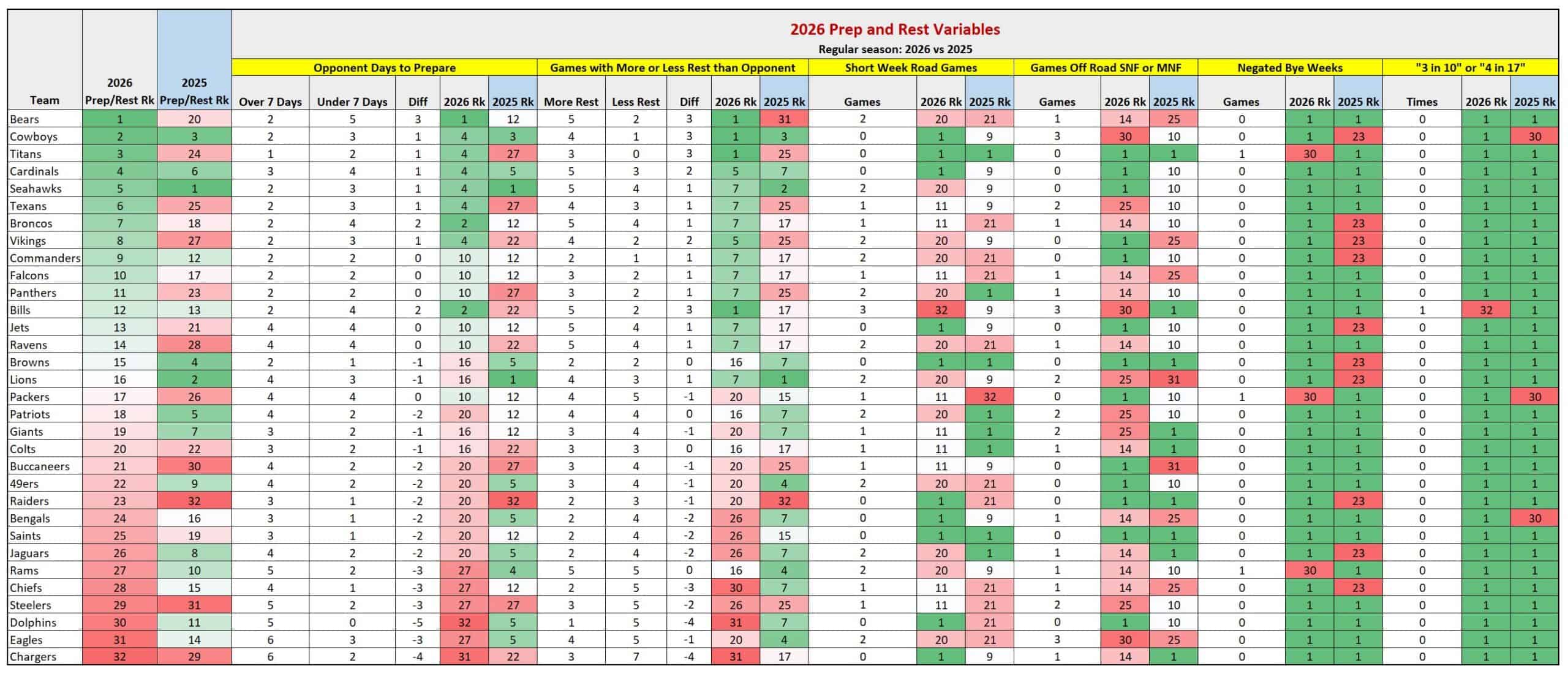
The teams most hurt by the NFL schedule makers in 2026:
- Los Angeles Chargers
- Philadelphia Eagles
- Miami Dolphins
- Pittsburgh Steelers
- Kansas City Chiefs
The teams most helped by the NFL schedule makers in 2026:
- Chicago Bears
- Dallas Cowboys
- Tennessee Titans
- Arizona Cardinals
- Seattle Seahawks
One element of setting expectations for the season is understanding the advantages certain teams have.
Last year, the #1 team in my Prep and Rest ranks was the Seattle Seahawks.
They went 14-3, posted the best record in the NFC by far, earned a #1 seed, secured a first-round bye, and won the Super Bowl.
As much as we would like it if there were a completely level playing field, that is simply not the case, particularly when a key desire is getting compelling matchups on national TV.
Thus, understanding which teams have advantages when it comes to rest and prep elements is extremely useful and certainly should be one part of the process when predicting how the 2026 season will unfold, both on a seasonal basis as well as a weekly basis throughout the season.
Let's finish up by diving into the schedule quirks for individual teams.
2026 NFL Schedule Team Notes & Analysis
Chicago Bears 2026 Schedule Notes & Analysis
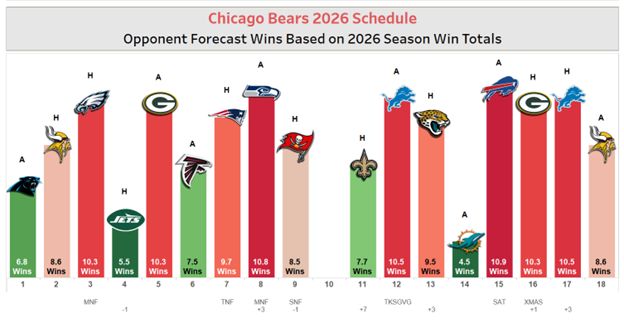
After ranking #29 in my prep and rest rankings last year and having a net rest edge of -4, the Chicago Bears rank #1 in both metrics this year.
#1 in prep and rest ranking and #1 in net rest with +15 days.
The +15 days of net rest for the Bears is the #2 largest net rest edge for any team in the NFL since 1990.
The Bears' +15 days of net rest is the most in franchise history.
They've had over eight days just one other time, and that was in 2023 at +12.
In the last five years (2021-2025), the Bears averaged +1.4 days of net rest edge.
The Bears play five games in 2026 with a rest edge over their opponent.
That is tied for the most in the NFL.
But it’s not just a lot of games with one day of rest edge.
Chicago plays four games with +3 days of net rest.
Most of these are games against critical opponents:
+3 days vs. the Seahawks in Week 8 after hosting Thursday Night Football
+3 days vs. the Lions in Week 17 after playing on Christmas
+3 days vs. the Jaguars in Week 13 after playing on Thanksgiving
+7 days vs. the Saints after their Week 10 bye
Last year, the Bears had just one game with +3 or more days of rest.
It was after their bye, and they won outright as an underdog.
It is also noteworthy that late in the season, from Week 11 on, the Bears have rest edges in four of their seven games, with a rest disadvantage in zero games.
They are the only team in the NFL with that benefit.
In critical divisional games late in the season, the Bears have rest edges in home games against the Packers and Lions.
Notably, none of the other NFC North teams rank in the top 10 of net rest differential, while the Bears sit at #1.
While the Bears face the #6 toughest overall schedule of opponents, they have excellent rest edges.
Why this matters even more for the Bears is that since 2020, the Bears are 0-9 straight up and 1-8 against the spread when playing a game with a rest deficit of at least three days.
Their return on investment if you bet on them in these games was -78.8%.
Both marks are the worst in the NFL.
However, over that same span since 2020, the Bears are 37-45 SU and 42-35-5 ATS (55%) when not playing with a rest disadvantage.
Their ROI is +4.1%.
That 55% ATS mark ranks #4 best in the NFL.
So the Bears shift from worst to #4 best in exceeding pre-game expectations when having extra rest.
That includes 2025 with Ben Johnson at the helm.
Chicago went 11-2 SU and 11-1-1 ATS with no rest disadvantage.
That’s +75% ROI made when betting on them and was, by far, the best mark in the NFL.
But the Bears went 0-2 SU and ATS when playing with a rest deficit of at least three days last year.
Los Angeles Chargers 2026 Schedule Notes & Analysis
On the opposite end of the spectrum is the Chargers.
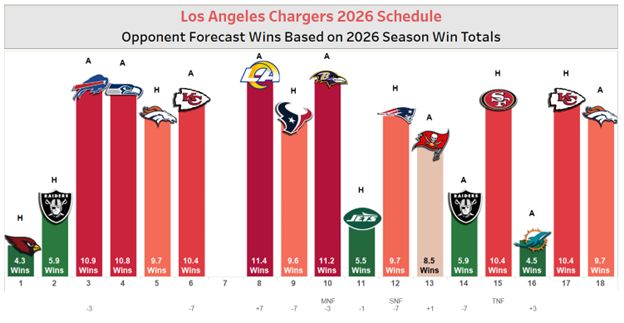
Los Angeles faces -24 days of net rest, ranking #32 of 32 teams.
It is also historically bad.
That net rest deficit ranks as the #4 largest since 1990, #2 largest since 2000, and #1 largest since 2013.
Overall, the Chargers also rank #32 in my prep and rest rankings.
The tough schedule comes despite not being favored with rest by the NFL in years past.
In fact, in the now seven seasons since 2020, they’ve had positive net rest only one time.
The Chargers have a whopping SEVEN games with rest disadvantages.
That is the most games for the Chargers with a rest disadvantage in team history.
Only one other time since 1998 has a team received at least seven games with a rest disadvantage.
The Chargers play four teams coming off a bye:
Week 6 vs. the Chiefs
Week 9 vs. the Texans
Week 12 vs. the Patriots
Week 14 vs. the Raiders
The Chargers also play two opponents coming off mini-byes: the Bills in Week 3 and the Ravens in Week 10.
Mini-byes have proven to be even more valuable than full byes recently, and both of those games are road games for the Chargers against key AFC foes.
In total, the Chargers play six games against opponents who have over seven days to prepare for them, more than any other team in the NFL.
For an incredible eight straight games, from Week 6 through Week 13, the Chargers will play with a rest disparity against their opponent, either positive or negative.
From Week 3 on, the Chargers play the NFL’s #2 toughest schedule, as the graphic below indicates, and will do so playing with a very difficult rest schedule.
Philadelphia Eagles 2026 Schedule Notes & Analysis
Unlike the Chargers, while the Eagles' schedule of rest is challenging, at least they face an easy schedule of opponents.
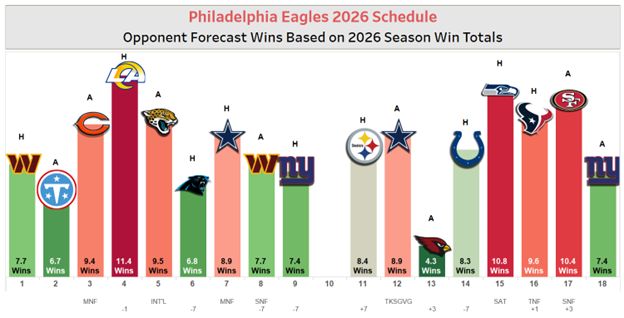
Philadelphia plays the #7 easiest schedule of opponents in 2026, but their rest is the #2 most difficult in both net rest (-15) and prep and rest rankings.
The Eagles' net rest of -15 days is the worst for the team since 2012.
The Eagles play six games against opponents who have over seven days to prepare for them, which is tied with the Chargers for the most in the NFL.
The Eagles play five total games with less rest than their opponent, #2 most in the NFL.
But if there is any silver lining to that number, the good news is that most of those games are early in the season.
From Week 1 to Week 9, the Eagles play four games with a rest disadvantage and zero with a rest advantage.
This includes a very tricky spot in Week 6, where the Eagles come back from playing the Jaguars in London, do not have a bye, and take on the Panthers, who are off a Week 5 bye.
From Week 1 to Week 9, the Eagles have a rest differential of -22, easily the worst in the NFL by a substantial margin.
However, they benefit later in the season.
They have a +7 days net rest edge from Week 11 on and play four total games with a rest advantage to only one game with a rest disadvantage.
One interesting note as it relates to divisional competition:
The Cowboys and Commanders both rank in the top four in net rest, and both rank in the top 10 in my prep and rest rankings.
Both Dallas and Washington play only one game with less rest than their opponent.
The only team with fewer games is the Titans (0).
The Cowboys and Commanders have great rest schedules, while the Eagles have to play five games with less rest than their opponent and the #31 overall schedule of net rest.
This will be one obstacle for the Eagles to overcome in 2026, and Philly has historically struggled when receiving less rest than their opponent.
Since 2015, when playing at 3+ days of rest disadvantage, the Eagles are 7-14-1 SU and ATS, recording -36.4% ROI.
They are 3-5 SU and 2-6-1 ATS since 2020, with -52.3% ROI.
That ranks as the #3 worst mark in the NFL over that span.
Buffalo Bills 2026 Schedule Notes & Analysis
The Bills' +14 net rest differential ranks #2 in the NFL.
It is also #1 for the Bills in franchise history.
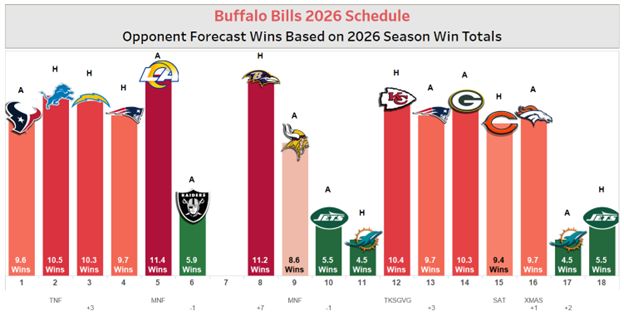
Buffalo plays five games with more rest than their opponent, tied for the most of any team in the NFL this year.
That ties a franchise record (2003 and 2022).
Because the Bills play only two games with less rest than their opponent, Buffalo’s +3 net games with more rest is tied for #1 in the NFL.
Making matters even better for the Bills is that their two games with a rest disadvantage are both only -1 day of rest difference, and both are against two of their worst opponents on the schedule: the Raiders and the Jets.
Buffalo plays their biggest competition in the AFC with a rest or schedule edge of some type (ordered by win total projection):
11.2-win Ravens: Buffalo has +7 days of rest out of their bye
10.4-win Chiefs: rest is identical, but this is a short-week home game on Thursday
10.3-win Chargers: Buffalo is +3 days of rest off a mini-bye, which also comes with the benefit of being a home-to-home mini-bye, so no travel
9.7-win Patriots: the Bills' first game sees no rest edge, but the second game sees the Bills with a +3 day rest edge after Thanksgiving
9.7-win Broncos: the Bills have a +1 day rest advantage for the Christmas game
Those are the five toughest games the Bills will play in the AFC this year.
Rest seems to matter more for the Bills.
Since 2020, they are 62-18 (78%) when not playing with a rest disadvantage, #1 best in the NFL.
They are 44-33-3 ATS (57.1%), which is #2 in the NFL and has resulted in +9.1% ROI.
However, over that same span, they are just 15-13 (54%) when playing with a rest disadvantage.
They are 12-16 ATS (42.9%) with a -18.2% ROI.
With a rest disadvantage last year, they went 2-4 (33%) and 1-5 ATS (17%) for -68% ROI.
Overall, Buffalo was -7 in net rest edge last year (#29).
Improving to +14 this year is massive.
However, while there are multiple scheduling advantages, the Bills are the only team to face two difficult scheduling disadvantages: three short-week road games and playing four games in 17 days.
Buffalo is the only team to play three short-week road games this year:
- Week 6, they play in Las Vegas after a Monday Night Football road game in Los Angeles vs. the Rams. Buffalo should ideally stay on the West Coast before traveling to Las Vegas to prevent travel and help reduce the impact of this spot.
- Week 10, they play in New York after a Monday Night Football road game in Minnesota against the Vikings.
- Week 16, they play in Denver on a Friday (Christmas) after playing the Bears the prior Saturday.
No other team plays more than two short-week road games, at least as of right now.
But from an equality perspective, 10 teams don’t play any short-week road games this year, including a team like the Bengals, who will be competing with the Bills for the AFC Championship.
Other AFC favorites, such as the Chiefs and Broncos, play only one short-week road game.
So, for teams like the Bengals, Chiefs, and Broncos to play zero or one short-week road game, while the Bills play three, makes the season more challenging for Buffalo in this regard.
In terms of the four games in 17 days, Buffalo is the only team to undergo that type of stretch:
- Monday Night Football, Week 10, in Minnesota
- Sunday, Week 11, in New York against the Jets
- Sunday, Week 12, home against the Dolphins
- Thursday, Week 13, home against the Chiefs
That sequence of Monday-Sunday-Sunday-Thursday crams in those four games into the shortest possible period over four weeks.
Making matters worse for the Bills is that not only are they the only team in the NFL with this quirk, but this stretch also comes late in the season, when they are more likely to be tired.
AND it ends with a pivotal game against the Chiefs, which may decide playoff seeding in the AFC.
At least the game is at home, but it does somewhat reduce the “home-field edge.”
Denver Broncos 2026 Schedule Notes & Analysis
We should spend time discussing the Broncos, not necessarily because they rank high in net rest, but because the other three teams in the AFC West have such a terrible rest schedule overall.
Denver ranks #7 this year in my prep and rest analysis.
Their +3 net rest ranks #12.
But they do play five games with more rest than their opponent, tied for #1 most in the NFL.
This is partially offset by four games with less rest than their opponent (#8 most).
They play four teams with less than a week to prepare for them, as well.
The Broncos' schedule is a tale of two seasons.
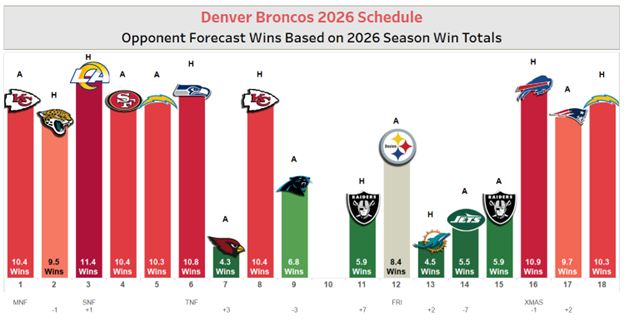
Week 1 through Week 6, it is the #1 toughest schedule in the NFL based on opponents played, and rest isn’t really an issue.
Denver plays six straight games against teams expected to make the playoffs this year: the Chiefs, Jaguars, Rams, 49ers, Chargers, and Seahawks.
To play all three NFC West opponents during the first six weeks of the season is insane.
However, from Week 7 on, it’s the #1 easiest schedule in the NFL based on opponents played.
In those 11 games, the Broncos play six teams expected to win seven or fewer games.
They play just four difficult teams, and three of them are at home in Denver (Chiefs, Bills, and Chargers).
The real story, however, is the schedule the rest of the AFC West plays from a rest perspective.
The Chargers rank #32 in my prep and rest metric, with a net rest of -24 (#32).
The Chiefs rank #28 in my prep and rest metric, with a net rest of -2 (#18).
The Raiders rank #23 in my prep and rest metric, with a net rest of -13 (#30).
Miami Dolphins 2026 Schedule Notes & Analysis
Miami ranks #30 per my prep and rest rankings.
They also rank #24 in net rest this year at -6 days.
This is a sharp change from the 2025 Dolphins, who ranked #2 in net rest at +11 days.
The Dolphins have positive net rest in three of the last four years, so 2026 will be an adjustment.
But what is unique about the Dolphins' schedule is that they have just one game with a rest advantage.
One game is the fewest of any team in the NFL.
And with five games featuring less rest than their opponent (#2 most), the Dolphins play a net of -4 games with more rest than their opponent.
They play five games where their opponent has extra time to prepare for them and zero games where their opponent has less than a week to prepare for them.
The net of -5 games when their opponent has less than a week to prepare is the worst in the NFL.
That total (5) is tied for the #4 most in NFL history.
Only 3 teams since 1990 have had to play more than five games with less net rest than their opponent.
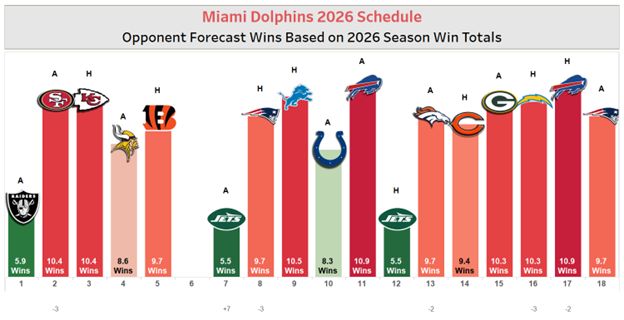
The other challenge for the Dolphins is that, not only do they play a tough rest schedule, but they also play the #2 toughest overall schedule in 2026.
Compare both of these to what the rest of the AFC East faces:
Bills: #12 prep and rest, #2 net rest, #14 strength of schedule
Patriots: #18 prep and rest, #6 net rest, #12 strength of schedule
Jets: #13 prep and rest, #29 net rest, #5 strength of schedule
—-
Dolphins: #30 prep and rest, #24 net rest, #31 strength of schedule
To suggest the 2026 Dolphins schedule, with zero games of extra rest aside from a bye week and five games at a rest deficit, will be challenging is a massive understatement.
Los Angeles Rams 2026 Schedule Notes & Analysis
With the sheer number of primetime games the Rams have, it was inevitable for them not to have some type of disruption from a rest perspective.
After ranking #3 in rest edge in 2025 with +10 days of net rest, the Rams rank #24 this year with -6 days of net rest.
Overall, they rank #27 in the prep and rest rankings.
The Rams' schedule really can be split into thirds.
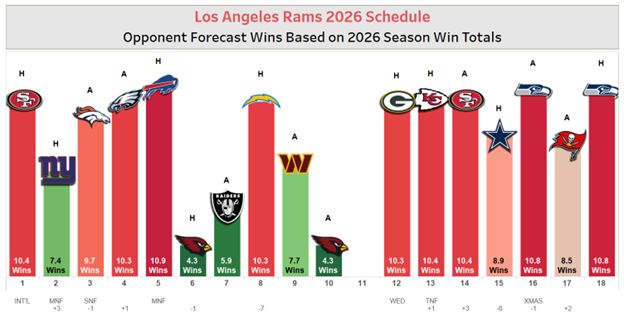
Weeks 1 through 5, they play the NFL’s #4 toughest schedule, facing four playoff teams in five weeks.
Weeks 6 through 11, they play the NFL’s #1 easiest schedule, facing only one playoff team in those five weeks.
But after their bye, from Week 12 on, they play the NFL’s #1 toughest schedule, with playoff team after playoff team littering the schedule.
The fortunate part for the Rams is that they have rest edges during their toughest stretches.
Jacksonville Jaguars 2026 Schedule Notes & Analysis
ESPN Analytics has a metric called “pain index,” which combines all the undesirable schedule effects, such as “rest differentials, back-to-back road trips, short weeks, and travel.”
Not only does Jacksonville rank #32 in 2026, but it is the worst “pain index” since 2002.
So it is good to look at the Jaguars' schedule a little closer.
Jacksonville has a net rest of only -3 days, which is #21, but they rank #26 in my prep and rest rankings.
They play four games with less rest than their opponents (#8 most).
From Week 10 on, they play four of nine games with less rest than their opponent.
The good news for Jacksonville during this stretch is they play the #7 easiest schedule of opponents, facing six of nine opponents who are not expected to make the playoffs.
What likely adds to ESPN’s “pain” is that Jacksonville has given up two home games to play in London this year, so they have a ton of unexpected travel.
They never play back-to-back games in Jacksonville and have a three-game road trip from Week 9 to Week 11 (BAL-TEN-NYG).
That trip begins with a short week road game on Thursday in Baltimore, and they also have back-to-back road games in Texas (HOU-DAL) in Week 15 and Week 16.
Playing in Jacksonville early in the season or late in the season can be a benefit, but in Weeks 1, 2, and 13 through 18, Jacksonville plays just two home games during the heat of the day.
The rest of the games are on the road, with one of them being a home night game to diminish the impact of the heat (Monday Night Football against the Steelers in Week 14).
Additionally, Jacksonville must play at elevation in Denver in Week 2 of the season, which is an adjustment for teams, particularly early in the season.