

Exiting the NFL Combine, we are digging into the 2026 fantasy rookie class for Dynasty rookie drafts, startups, and seasonal formats.
Even before the NFL Draft in April, rookies are available in Best Ball formats across all platforms.
That information gets applied to athletic models and layered alongside production profiles to shape each prospect's complete portfolio.
Let's look at the pre-draft profile for Ohio State WR Carnell Tate, including his strengths, weaknesses, and fantasy outlook for both redraft and Dynasty formats.
Don't Miss Out on The Best Fantasy Football Coverage in the Business
Like the NFL, fantasy football never sleeps.
From rankings to the best draft strategies, Sharp Football has everything you need to get ready for the fantasy season in our Fantasy Football Draft Kit, powered by premier fantasy football analyst Rich Hribar.
Save more by bundling the Draft Kit with our in-season fantasy package that features Rich's comprehensive “Worksheet” preview of every game, every week of the NFL season.
Click here for more information about our fantasy coverage!
Carnell Tate Pre-Draft Fantasy Profile
Rookie Age*: 21.6
*Age on 9/1/26
Tate is the latest projected first-round pick from an extended line of Ohio State receivers.
Tate improved his receiving yardage and touchdowns each season in college while playing alongside Marvin Harrison Jr, Emeka Egbuka, and Jeremiah Smith.
He closed this season catching 51 passes for 875 yards and 9 touchdowns over 11 games.
Tate had 2.14 yards per team pass attempt (WR11 in this class) while his 3.02 yards per route run were third.
The types of targets he earned helped anchor that yardage as he posted 17.2 yards per catch this past season.
53% of his targets resulted in a first down or touchdown (2nd in this class) while 17.7% of his receptions were scores (5th).
Tate was one of the best boundary receivers in the country last season, catching 12 of 14 contested targets (85.7%) while collecting 11 of 17 (64.7%) targets on throws 20 or more yards downfield.
Six of those resulted in touchdowns, tied for the most in this class.
His lack of forced missed tackles (only 11.8% of his receptions) was tied to usage.
Tate’s 14.6 air yards per target were the seventh-highest in this class.
Tate is the same weight as Makai Lemon (192 pounds) but has a size advantage (6-foot-2) with longer arms (31.75) and huge hands (10.25) that show up as he wins in tight coverage.
He was not credited with a drop on his 66 targets.
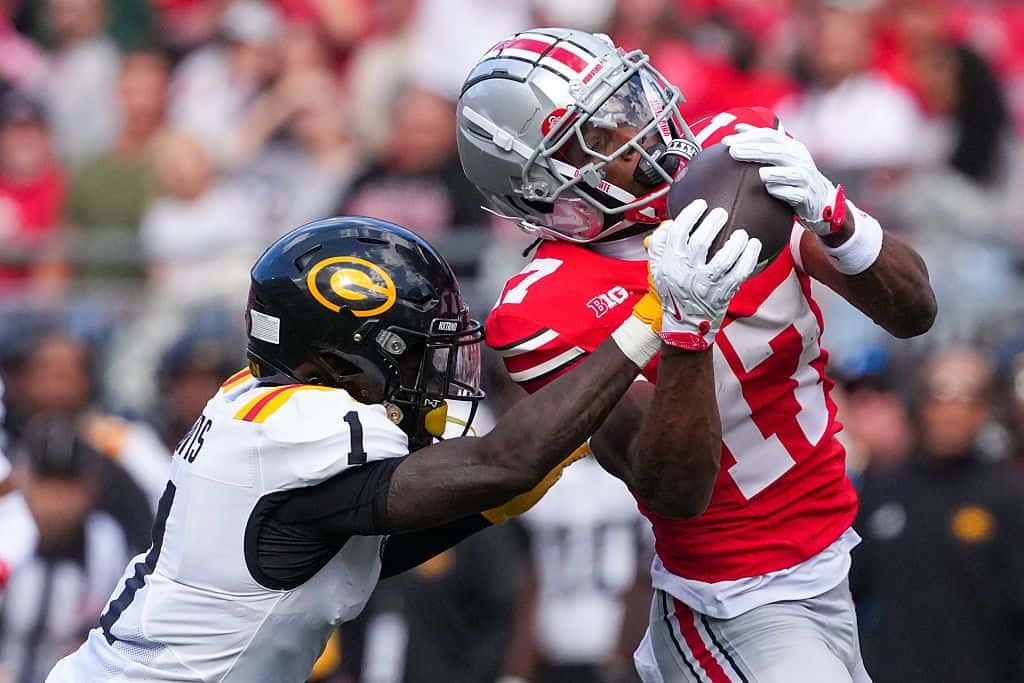
You can make a strong case that Tate has the best hands in this class, and he makes tough catches for many receivers look routine.
Ironically, Tate has the inverse question marks about his versatility than we covered with Lemon.
Ohio State used Tate as their lid lifter.
He played 86.8% of his career snaps out wide and received next to no manufactured production.
That limited his production after the catch.
10.6% of his targets were screens.
We only have a small sample (only 30 routes), but when Tate did play from the slot last year, he posted a robust 5.0 yards per route run.
He may not be a player in the ilk we covered with Lemon getting peppered with zone looks, but Tate can win as a vertical slot.
While playing outside, Tate was also an asset in the run game, something teams will notice.
Pro Football Focus gave Tate the fourth-highest run blocking grade in this class.
The under-the-hood metrics for Tate look solid for a player next to a talent like Jeremiah Smith.
The biggest nit to pick with Tate in setting ceiling expectations is that he was never a truly dominant target earner playing alongside front-end receivers.
Would he have had the same type of target volume as Lemon or Jordyn Tyson in those situations?
We don’t know, but even for the recent run of Ohio State receivers, Tate has a lighter profile of counting production entering the NFL.
He never hit 1,000 yards in a season and averaged 3.1 receptions per game over his career.
In 14 career games against ranked opponents, Tate averaged 2.9 receptions for 37.5 yards per game.
To provide some context to that, here are all of the first-round receivers who averaged fewer than 4.0 receptions per game over their college careers and their subsequent WR3 or better scoring seasons per game to date.
| Player | Year | Draft | Career Rec/Gm | WR3+ | WR2+ | WR1 |
|---|---|---|---|---|---|---|
| Xavier Legette | 2024 | 32 | 2.1 | 0 | 0 | 0 |
| Henry Ruggs | 2020 | 12 | 2.4 | 0 | 0 | 0 |
| Anthony Gonzalez | 2007 | 32 | 2.6 | 0 | 0 | 0 |
| Troy Williamson | 2005 | 7 | 2.7 | 0 | 0 | 0 |
| Jameson Williams | 2022 | 12 | 2.7 | 2 | 2 | 0 |
| Phillip Dorsett | 2015 | 29 | 2.8 | 0 | 0 | 0 |
| John Ross | 2017 | 9 | 2.9 | 0 | 0 | 0 |
| Ricky Pearsall | 2024 | 31 | 2.9 | 0 | 0 | 0 |
| Breshad Perriman | 2015 | 26 | 2.9 | 0 | 0 | 0 |
| Kelvin Benjamin | 2014 | 28 | 3.0 | 2 | 1 | 0 |
| Demaryius Thomas | 2010 | 22 | 3.1 | 6 | 6 | 4 |
| Carnell Tate | 2026 | TBD | 3.1 | TBD | TBD | TBD |
| Jaylen Waddle | 2021 | 6 | 3.1 | 4 | 2 | 1 |
| Kadarius Toney | 2021 | 20 | 3.2 | 0 | 0 | 0 |
| Freddie Mitchell | 2001 | 25 | 3.2 | 0 | 0 | 0 |
| Javon Walker | 2002 | 20 | 3.3 | 3 | 3 | 2 |
| Jon Baldwin | 2011 | 26 | 3.3 | 0 | 0 | 0 |
| Brian Thomas Jr. | 2024 | 23 | 3.3 | 1 | 1 | 1 |
| Dwayne Bowe | 2007 | 23 | 3.4 | 4 | 4 | 1 |
| Craig Davis | 2007 | 30 | 3.4 | 0 | 0 | 0 |
| Robert Meachem | 2007 | 27 | 3.4 | 1 | 0 | 0 |
| Odell Beckham | 2014 | 12 | 3.5 | 5 | 5 | 3 |
| Quentin Johnston | 2023 | 21 | 3.6 | 1 | 0 | 0 |
| Roddy White | 2005 | 27 | 3.6 | 7 | 7 | 5 |
| A.J. Jenkins | 2012 | 30 | 3.6 | 0 | 0 | 0 |
| Darrius Heyward-Bey | 2009 | 7 | 3.6 | 1 | 0 | 0 |
| Ted Ginn | 2007 | 9 | 3.6 | 3 | 0 | 0 |
| Devante Parker | 2015 | 14 | 3.7 | 1 | 1 | 1 |
| Matthew Golden | 2025 | 23 | 3.7 | 0 | 0 | 0 |
| Jalen Reagor | 2020 | 21 | 3.8 | 0 | 0 | 0 |
| Cordarrelle Patterson | 2013 | 29 | 3.8 | 0 | 0 | 0 |
| Santonio Holmes | 2006 | 25 | 3.9 | 3 | 2 | 0 |
| Brandon Aiyuk | 2020 | 25 | 3.9 | 4 | 2 | 0 |
| D.J. Moore | 2018 | 24 | 3.9 | 7 | 5 | 1 |
| Lee Evans | 2004 | 13 | 4.0 | 5 | 1 | 1 |
Now, to be clear, I do not believe this is a make-or-break data point (thresholds are never a be-all, end-all) for Tate, and I am more than into his potential to get a chance to grow as a feature receiver in the NFL.
Just some added perspective on how rare we have seen front-end picks have this type of limited production.
The first thing that stands out here is another mark of how much the league has overvalued speed entering the league.
There are so many fast guys who were only one-dimensional at the college level and struggled to develop in the NFL.
Especially in the same projected draft range as Tate, who is expected to be a top-10 pick.
Tate does win vertically, but he wins with nuance and route running rather than by blowing past defensive backs.
His 4.53 forty was brought up as a negative at the NFL Combine, but it is not a detriment because he tracks balls as well as anyone in this class and has great body control and a large catch radius.
If he were just fast with his profile, it would be more concerning.
I believe that fresh out of the packaging, Lemon and Tyson have an edge in earning full-field targets.
The 34-player sample above has a 29.4% rate of delivering at least one WR1 scoring season, but 47.1% also failed to turn in at least one WR3-or-better campaign, and 58.8% failed to turn in a WR2-or-better season so far.
I do not believe Tate has the after-the-catch athleticism to be on the Demaryius Thomas or Odell Beckham spectrum here, leaving Roddy White as the apex range of outcomes.
Dating myself, Javon Walker feels like an appropriate ceiling comparison.