

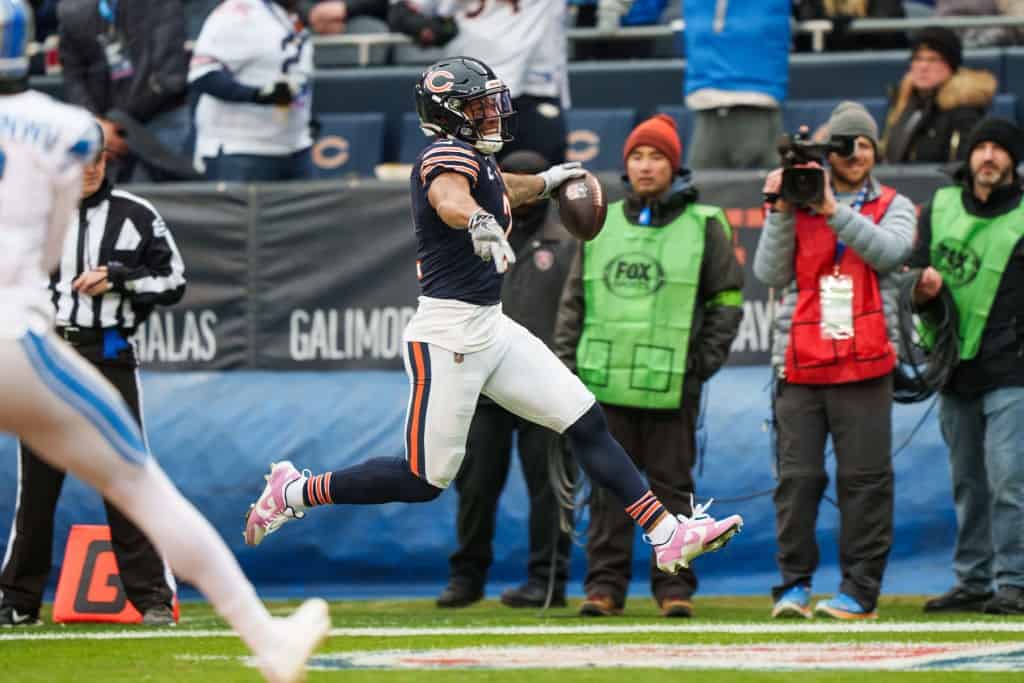
In an early move that is expected to be made official when the league rolls over next week, the Chicago Bears and Buffalo Bills have agreed to a trade that sends D.J. Moore to Buffalo.
Done deal: The Bills are sending a 2026 second-round pick to the Bears for WR D.J. Moore and a 2026 fifth-round pick, per sources.
A pick swap that gives Chicago extra draft ammo and Buffalo a new top receiver. pic.twitter.com/OQ8fZCbLTr
— Tom Pelissero (@TomPelissero) March 5, 2026
Let's examine the fantasy football implications of this move for all sides involved, starting with Moore.
For full contract details and more of a “real football” look at the biggest moves, see our NFL Free Agency Signing Tracker.
Explore more 2026 NFL Free Agency content:
| 2026 NFL Free Agency Content |
|---|
| 2026 NFL Free Agency Tracker: Best Available Free Agents |
| NFL Free Agency 2026: Analyzing Every Major Signing (Updated Daily) |
| 2026 NFL Franchise Tag Tracker: Every Tagged Player & Values |
| NFL Free Agency Fantasy Impact 2026: Every Big Signing |
| NFL Free Agency Betting Implications: Which Signings Move the Needle Most? (Coming soon) |
| NFL Free Agency Fantasy Winners and Losers 2026 (Coming soon) |
D.J. Moore Fantasy Value With Buffalo Bills
D.J. Moore Career Stats
| Year | Age | Team | Games | Tgt | Rec | ReYd | ReTD | PPR/Game | Rank |
|---|---|---|---|---|---|---|---|---|---|
| 2018 | 21 | CAR | 16 | 82 | 55 | 788 | 2 | 9.8 | WR54 |
| 2019 | 22 | CAR | 15 | 135 | 87 | 1175 | 4 | 15.4 | WR17 |
| 2020 | 23 | CAR | 15 | 118 | 66 | 1193 | 4 | 14.1 | WR28 |
| 2021 | 24 | CAR | 17 | 163 | 93 | 1157 | 4 | 14 | WR27 |
| 2022 | 25 | CAR | 17 | 118 | 63 | 888 | 7 | 11.7 | WR35 |
| 2023 | 26 | CHI | 17 | 136 | 96 | 1364 | 8 | 16.9 | WR9 |
| 2024 | 27 | CHI | 17 | 140 | 98 | 966 | 6 | 14 | WR29 |
| 2025 | 28 | CHI | 17 | 85 | 50 | 682 | 6 | 10 | WR46 |
Moore has always been a bit of a fantasy conundrum, often failing to live up to high-end expectations, but he has reliably been on the field and delivered floor-based production.
The question we will immediately ask here is if Buffalo is attempting to catch a falling knife?
Moore is coming off a down season with the Bears, and his mercurial behavior has come up in each of the past two seasons.
In 2025, Moore posted career lows in receptions and receiving yards.
He was targeted on a career-low 15.3% of his routes.
His previous career low was 19.1% as a rookie in 2018.
Moore only had one game last season with more than 73 yards receiving to go along with 11 games below 50 yards.

D.J. Moore Advanced Stats
| Year | Team | Yards/Route | aDOT | YAC/Rec | Tar/Route |
|---|---|---|---|---|---|
| 2018 | CAR | 1.84 | 9.0 | 7.7 | 19.1% |
| 2019 | CAR | 2.03 | 11.0 | 4.5 | 23.3% |
| 2020 | CAR | 2.23 | 13.1 | 5.8 | 22.1% |
| 2021 | CAR | 1.86 | 10.6 | 4.5 | 26.2% |
| 2022 | CAR | 1.78 | 12.9 | 3.0 | 23.6% |
| 2023 | CHI | 2.31 | 10.9 | 5.6 | 23.0% |
| 2024 | CHI | 1.45 | 7.5 | 6.0 | 21.1% |
| 2025 | CHI | 1.23 | 11.6 | 4.1 | 15.3% |
If lighting a candle for Moore here, he did play better to close the year.
Moore scored 5 touchdowns over the final six games last season.
That said, we are eight years into his career, and he has one WR1 scoring season under his belt.
2025 saw Moore set career lows in just about every category you can find, but if you are looking at his career production, his overlap playing under Joe Brady in 2020 and 2021 with Carolina was strong.
The hope is that a reunion with Brady, while playing alongside Josh Allen, keeps Moore engaged.
Moore is at the crossroads of his career, and this change of scenery is a boost for his opportunity to lead a passing game again.
Buffalo was one of the neediest teams for a wide receiver, while Allen is the best quarterback that Moore has played with over his career to this point.
In 2025, Buffalo's wide receivers averaged 10.6 receptions (18th) for 125.8 yards per game (22nd) and 11 touchdowns (23rd) in the regular season.
Collectively, Buffalo wideouts were targeted on 21.4% of their routes, which was 27th in the league.
Allen averaged 7.9 yards per pass attempt when targeting his wide receivers last season, which was 15th in the league.
Throwing to his tight ends, Allen averaged a league-high 10.0 yards per pass attempt and 6.8 yards per attempt throwing to his backfield (7th).
2025 Bills Wide Receiver Room
| WR | Yards/Route | aDOT | Tar/Route | Route/DB% |
|---|---|---|---|---|
| Khalil Shakir | 1.81 | 3.4 | 24.0% | 71.8% |
| Keon Coleman | 1.27 | 11.56 | 17.8% | 52.6% |
| Brandin Cooks | 1.66 | 24.91 | 19.0% | 41.9% |
| Josh Palmer | 1.28 | 11.46 | 15.7% | 35.1% |
| Tyrell Shavers | 1.17 | 12.8 | 11.3% | 33.0% |
| Elijah Moore | 1.04 | 8.35 | 15.7% | 25.5% |
| Gabe Davis | 0.96 | 8.71 | 14.1% | 22.1% |
| Curtis Samuel | 0.74 | 15.42 | 10.7% | 16.6% |
| Mecole Hardman | 0.31 | 23 | 23.1% | 3.7% |
Buffalo may not be done adding here, but given what they used to acquire Moore, paired with his remaining salary over the next two seasons, Moore immediately steps in as the leading candidate for targets in this room.
In early drafts this offseason, Moore was being selected as WR43, so this is a major win for his stock.
This move should vault him into the WR2/WR3 cusp, at minimum.
How much higher he can max out is what we care about.
Allen has not had a feature WR1 since Buffalo moved on from Stefon Diggs.
Diggs ended his run with Allen and Brady on a sour note.
In the games where Diggs played under Brady in 2023, he was the WR18 in expected points per game and even worse in results, ranking WR38 in actual points scored per game.
That gives us some ballpark for having back-end WR2 aspirations for Moore while pricing in some volatility should he settle in the WR20 to WR30 range.
If everything comes together, then Moore has added upside.
Brady has called conservative game plans since taking over as the play caller in Buffalo.
Over the final nine games in 2023, Buffalo was 31st in the NFL dropback rate (52.4%) and 27th in the rate of yardage gained via passing (60.7%).
Before that, they were seventh in the NFL in dropback rate (63.2%), and 68.5% of their yardage came through the air (13th).
In 2024, Buffalo had a 56.3% dropback rate (25th) with 63.5% of their yardage through the air (22nd).
This past season, the Bills posted a 54.3% dropback rate (30th) with 57.6% of their yardage via passing (30th).
Buffalo’s strengths have been the offensive line and running game, which have made them a successful team on the scoreboard and limited their passing volume.
However, Brady has leaned into their run game more than the base rate, even with a talented WR1.
What will be interesting to see is how much that was by Brady’s own design or top-down influence from Sean McDermott.
Now that Brady is running the entire show, will Buffalo cut it loose more often?
The defense could also be worse without McDermott as an added variable in driving up Buffalo's passing volume.
Even if you are keeping one foot out on Moore as we await where his price settles and what other moves Buffalo has in store, this is an upgrade for him in terms of opportunity and increased efficiency through quarterback play.
From a Dynasty perspective, this gives Moore added nuance.
He is a player now that will have price rebound before playing a down this season.
If you are holding Moore on a mid-range roster, this is a time to push him more aggressively into the market to contending rosters.
If you are a contending roster (meaning you likely have lower-end draft picks), Moore is the type of asset that you should target with those picks for immediate production in conjunction with a weaker class this spring.
I would be willing to move late firsts more Moore on those rosters for the short-term spike, and any Round 2 rookie picks that can be used to acquire Moore as moves I am making every time this offseason.
Khalil Shakir & Dalton Kincaid Fantasy Value Following D.J. Moore Trade
Moore's addition casts a negative outlook on every other Buffalo pass catcher.
Both Khalil Shakir and Dalton Kincaid are effective players, but both have had niche roles that have restricted their playing time, even with Buffalo starving for pass catchers.
Through four NFL seasons, Shakir has run 73 total pass routes in one and two WR sets,
Last year, with that aforementioned roster, he was on the field for 25 routes in one and two WR sets, which was 18.8% of those play calls.
Kincaid was hyper-efficient last season with 2.73 yards per route run, but his limitations as an in-line player and his role in the run game on a run-heavy team have limited his opportunities.
Kincaid only played 33.4% of his snaps in-line last season.
The Bills ran the ball only 28.5% of the time when he was on the field, compared to 57.1% when he was off.
That has capped Kincaid’s overall participation in the offense and limited his routes run.
Over his three seasons in the league, Kincaid has been on the field for 64.1% of the team's dropbacks in his games played.
Adding target competition to a player already seeing limited passing snaps forces Kincaid to live on efficiency over volume.
Dawson Knox can still be released to free up some heavy-personnel work, but Buffalo pre-emptively planned for that by selecting Jackson Hawes a year ago.
Bears Fantasy Value Following D.J. Moore Trade
While we have covered Moore and the Buffalo pass catchers, the real sizzle here is what Moore’s departure from Chicago opens up for a trio of young pass catchers in Rome Odunze, Luther Burden, and Colston Loveland.
Even with Moore getting a bump in cost, I would expect at least Burden and Loveland to be selected over him in drafts, while Odunze won’t be far behind, even if Moore holds a higher ADP.
The Bears were already an offense to buy on after the way they closed 2025.
Moore was on the field for 86.2% of Chicago's dropbacks last season, including the postseason.
The next-closest player on the team (Odunze) was at 65.6%, while Loveland was at 62% and Burden at 41.1%.
We are going to see significantly higher rates from all of them in 2026.
Moore also leaves a team-high 15 end zone targets (28.8%) behind.
We only have a small sample of Moore missing time last year, but Odunze was targeted on 28.3% of his routes with Moore absent (46 routes), Loveland 24.2% (62 routes), and Burden 20.3% (64 routes).
Those are all reasonable proxies heading into this offseason.
Burden (3.20 yards per route run on those plays) and Loveland (2.56 yards per route) will have efficiency dips on larger sample sizes, but both are extremely talented assets on whom gamers should be bullish to buy in.
Colston Loveland 2026 Fantasy Value
Loveland was already being drafted as TE3 before the trade news, so he has less room to climb since he is unlikely to clear Trey McBride and Brock Bowers, but he is my favorite bet among the three without factoring in any cost.
Loveland closed the year on high notes.
Over the final five games of the season, Loveland was on the field for 80.9% of the team's dropbacks, receiving a target on 30.5% of his routes with 2.34 yards per route run.
He caught 31 passes for 408 yards and 2 touchdowns over that span.
Luther Burden 2026 Fantasy Value
Burden closed the season quietly (6 catches for 66 yards in the postseason), but he flashed on his limited opportunities, drawing a target on a team-high 24.3% of his routes with a team-high 2.36 yards per route run.
Those totals are influenced by a sample size impacted by entering games for designed play calls when the team was at full strength.
Still, when Odunze missed the final five games of the regular season, Burden led the team with 324 receiving yards despite missing a game himself over that span.
In the four games he played without Odunze over that stretch, Burden had 21.1% of the team targets and posted 3.52 yards per route run.
Burden closed those weeks as the WR24, WR23, WR1, and WR40 despite only scoring 1 touchdown.
Going back to his rookie profile, I always considered Burden to be misrepresented as a slot-only player because of his college quarterback play (remember Brady Cook this season?), which played out as a rookie.
He played 57.4% of his snaps out wide and 40.7% from the slot.
Burden should slide right into the vacated role of Moore, while Chicago looks to add a player to fill the role Olamide Zaccheaus had in the offense (which Loveland’s ascension cuts into).
The one area where gamers might get too aggressive with Burden is that he only had 2 targets in the end zone as a rookie.
Those will definitely go up since Moore is leaving some on the table, but Loveland and Odunze are thorns in that area for first-read scoring opportunities that make Burden a better PPR selection than in formats that are more touchdown-driven.
There is some irony here, but Burden looks a lot like a DJ Moore-type of fantasy asset on the surface.
Where the production looks good and you are never mad at having him, but you could be left wanting more if the touchdowns do not come along for the ride.
While being in on Burden as an upside WR2/WR3, his price tag is surely going to go up the most because Odunze has had steam in each of the past two seasons and ultimately fell short of expectations.
Gamers will price that in compared to the allure of the upside from Burden.
Rome Odunze 2026 Fantasy Value
I am keeping the lights on for Odunze in year three, but there are some red flags here.
Odunze opened last season hot, scoring 5 touchdowns over the opening four games.
He had over 60 yards receiving in three of those four games.
Then the wheels came off.
Odunze was a WR3 or better in weekly scoring in two of his eight games after the bye.
He scored 1 touchdown the rest of the season and then missed the final five games with a foot injury.
Before his injury, Odunze led the team with 23.7% of the targets and 38.2% of the air yards.
He was still the WR24 in expected points per game over that period, but the WR46 in actual points per game.
While Caleb Williams still had accuracy issues despite growth in 2025, Odunze took the brunt of that again because his route tree came with higher-variance target opportunities.
Over those final eight games, 27.3% of Odunze’s targets were inaccurate.
No player with as many targets had a higher rate of off-target opportunities.
As a rookie in 2024, 26.7% of Odunze’s targets were inaccurate.
No player had a higher rate with as many targets.
What we are left with is nearly a two-year sample of Williams and Odunze being disconnected, a sample size that spans two different schemes.
Loveland had a 15.9% inaccurate target rate last year, while Burden was at 9.5%.
Given top-down concerns about the quality of targets and the emergence of the younger pass catchers in the offense, Odunze does look more like a boom-or-bust WR3 weekly option (he can finish higher in cumulative scoring) who will be driven by scoring and efficiency bursts when those high-variance targets are connecting.
Where Odunze still has upside is the types of targets he gets and his continued profiling as a vertical and red zone option.
Despite missing time, Odunze had 13 targets in the end zone, which was only two fewer than Moore.
Odunze had 39.3% of the end zone targets before his injury, which was WR9 at the time.
TL;DR
- D.J. Moore goes from WR4/FLEX to WR2/WR3
- Khalil Shakir not on my draft radar
- Dalton Kincaid boom-or-bust, back-end TE1
- Colston Loveland doesn’t move up since he was already TE3, but he is my favorite Chicago pass catcher
- Luther Burden upside WR2/WR3
- Rome Odunze upside WR3
- Keep drafting both quarterbacks at cost