

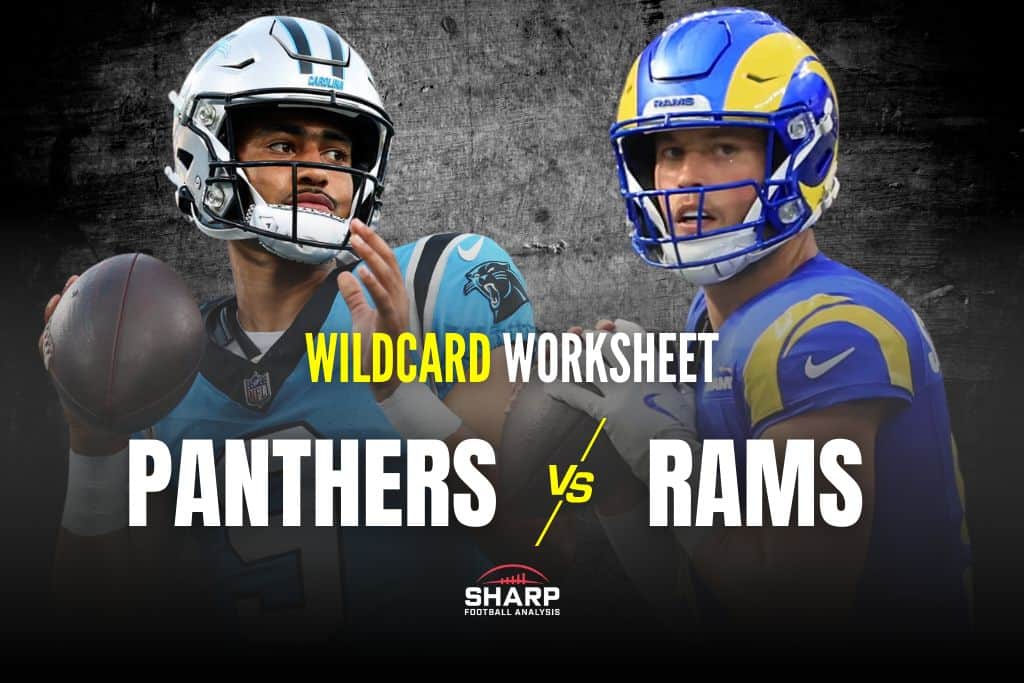
The Worksheet, a comprehensive fantasy football preview by Rich Hribar, breaks down everything you need to know about the Wild Card Round matchup between the Panthers and Rams.
Find a breakdown of every Wild Card Round NFL game in our Worksheet Hub.
| LA Rams | Rank | @ | Carolina | Rank |
|---|---|---|---|---|
| -10.0 | Spread | 10.0 | ||
| 28.25 | Implied Total | 18.25 | ||
| 30.5 | 1 | Points/Gm | 18.3 | 27 |
| 20.4 | 10 | Points All./Gm | 22.4 | 15 |
| 63.9 | 7 | Plays/Gm | 59.5 | 22 |
| 63.1 | 24 | Opp. Plays/Gm | 59.8 | 9 |
| 6.2 | 1 | Off. Yards/Play | 5.0 | 26 |
| 5.2 | 14 | Def. Yards/Play | 5.5 | 20 |
| 42.82% | 20 | Rush% | 45.60% | 10 |
| 57.18% | 13 | Pass% | 54.40% | 23 |
| 40.67% | 9 | Opp. Rush % | 47.15% | 27 |
| 59.33% | 24 | Opp. Pass % | 52.85% | 6 |
- Rams ATS: 12-5
- Panthers ATS: 10-7
- Panthers ATS Home: 5-3
- Rams ATS Away: 5-3
- Rams ATS as Favorite: 11-4
- Panthers ATS as Underdog: 9-5
Game Overview
The playoffs kick off with a rematch.
These teams played in Carolina in Week 13, with the Panthers pulling off a 31-28 upset as 10-point home underdogs, the same layout as this weekend.
Carolina led the league with 8 outright wins as an underdog this year.
There are reasons that we will cover here in greater detail that will make it hard for Carolina to run back the same result.
Still, the short story is that Carolina pulled off that upset thanks to timely turnovers and ball control, winning the high-variance plays.
The Rams averaged 7.4 yards per play in that matchup (their fourth-highest of the season).
The Rams only faced 5 third downs all game.
The Rams had only 1 penalty.
The Rams scored a touchdown on four of their five possessions without a turnover.
But the Panthers won the turnover battle 3-0.
Turnovers are always massive, but those three were significant swings in the game.
Carolina had a pick-6 for a score, a deflected interception in their own end zone, and a strip sack with the Rams in position to attempt a potential game-tying field goal.
Those three plays resulted in an EPA of -16.1 for the Rams, the most significant turnover swing for the Panthers in a game this season and the worst for the Rams this season.
Carolina was 7 of 15 on third downs (46.7%), the second-most conversions for them in a game this season.
Carolina was also 3 of 3 on fourth downs, two of which were touchdowns from outside of the red zone.
The Carolina offensive touchdowns in that game were from 35, 33, and 43 yards out.
Despite the long scoring plays, Carolina had the ball for 35:16 of the clock, and their most significant time of possession margin (10:32) in a game this season.
That is the top-down recipe for pulling off a huge upset.
Despite that upset already on the board, this game is lined up the same way for a reason.
The Rams enter the playoffs as the league's highest-scoring offense and with the second-highest point differential (+172).
Carolina is 23rd in point differential (-69), the only team in the postseason this year with a negative scoring margin.
The only other teams to ever have a worse point differential and make the postseason were the 2004 Rams (-73), 2011 Broncos (-81), and 2010 Seahawks (-97).
The silver lining is that all three of those teams won in the Wild Card Round, with the Tim Tebow-to-Demaryius Thomas overtime touchdown and the Beast Quake run among the most infamous plays in modern playoff history.
To give Carolina some credit, they are at least battle-tested.
Carolina has a slight rest advantage, and although this is not a 10 a.m. PT kickoff, it is a west coast team coming across country, which could be a variable in another attempt to pull off an upset.
If the Rams have another area of concern, it is special teams.
The Rams are 31st in EPA on special teams this season (-50.0).
Even since the release of Joshua Karty, they are 29th (-18.1).
Quarterback
Matthew Stafford: Stafford enters the postseason leading the NFL in passing yardage (4,707) and passing touchdowns (46).
Sean McVay altered his offense this season to adjust to the current defensive climate.
Stafford played a career-high 59.6% of his snaps under center this year, which led the league.
Stafford took 250 dropbacks under center.
The next closest quarterback was at 189.
As a byproduct of playing more under center, Stafford used play action on a career-high 36.7% of his pass attempts, which also led the league.
On his under-center dropbacks, Stafford used play action 86.1% of the time.
Stafford threw 20 touchdowns to 1 interception on those dropbacks.
Keep a pin in that, because this is an area where we could see McVay calibrate for the rematch.
When these teams met in Week 13, Stafford was efficient.
He still threw for 8.7 yards per pass attempt and a pair of touchdowns.
The Panthers are a unique defense in that they do not generate much pressure or have a wealth of stars, yet they did limit passing production.
Carolina allowed 11.6 passing points per game this season, which was eighth in the league.
Carolina only pressured Stafford on 13.3% of his dropbacks, his second-lowest pressure rate in a game this season.
The Panthers were 31st in pressure rate (29.6%) and 27th in sack rate (5.6%) during the regular season.
Stafford averaged 9.2 yards per pass attempt without pressure in the first matchup.
The Rams moved the ball all game as noted, but 3 turnovers were his undoing, all of which cost the Rams significantly.
Credit Ejiro Evero (who coached under McVay) for getting enough disruptive plays in a game where Carolina was down multiple defensive starters in the secondary.
We also saw this offense struggle against Raheem Morris a few weeks ago, another coach who was with McVay and understands this offense and Stafford.
Carolina was without Jaycee Horn and Tre’Von Moehrig in that game.
Where Evero and this Carolina defense found their success was by limiting that production on those play-action and under-center passes, something we have covered this season.
Carolina is a defense that disguises their coverages from pre-snap to post-snap at a high rate, which changes the picture for passers turning their back to the defense.
Carolina has done a good job against these meta-breaking offenses.
They limited Sam Darnold to 5.4 yards per pass attempt.
They held Borck Purdy to 6.0 Y/A with 3 interceptions.
Jordan Love had 7.4 yards per attempt, but 0 touchdowns and an interception.
This season, Carolina allowed a league-low 5.6 yards per pass attempt on play-action passes.
On non-play-action passes, they allowed 7.8 Y/A, which was 29th.
That was the same story in this game in Week 13.
Stafford had a 57.1% play-action rate in the first matchup, his highest rate of the season.
Using play action that week, Stafford was 10 of 16 (62.5%), but for only 83 yards (5.2 Y/A).
On his non-play-action passes, Stafford was 8 of 12 (66.7%) for 160 yards (13.3 Y/A).
Will this be an area where McVay adjusts in the rematch and plays more of a traditional dropback game?
The flipside of that first game plan was that the Rams also did not play much heavy personnel, which has been their bread and butter this season.
In that first game, the Rams were in 13 personnel 17.6% of the time, their second-lowest rate in a game over their final 11.
Their average rate of 13 personnel over that span was 44.9%.
Stafford was only 3 of 4 for 20 yards (5.0 Y/A) out of 13 personnel in that game.
The Rams were in 11 personnel for 80.4% of their snaps in the Week 13 matchup.
The next-highest rate of 11 personnel for the Rams over that 11-game span was 70.9%.
Stafford threw his 2 interceptions out of 11 personnel that game, but he also averaged 9.3 yards per pass attempt.
Bryce Young: Young did not stuff the stat sheet this season, completing 63.2% of his passes (22nd) for 6.2 yards per pass attempt (29th), 9.8 yards per completion (30th), and a 4.7% touchdown rate.
He threw for 200 yards in only four games this season.
Carolina ran an ultra-conservative game plan this season, throwing the ball 4% below expectations.
That was 29th in the league.
When these teams played in Week 13, Carolina threw the ball 20.4% below expectations, their lowest rate of the season.
Young was hyper-efficient against the Rams, completing 15 of 20 passes (75%) for 206 yards (10.3 Y/A) and 3 touchdowns.
That was the highest yards per pass attempt of his career.
Young only threw the ball 4 times on first down plays.
He was 7 of 10 for 44 yards (4.4 Y/A) on first and second down plays as 8 of 10 of 162 yards (16.2 Y/A) with 3 touchdowns on third and fourth down.
His 3 touchdowns were a 35-yard pass to Chuba Hubbard on 3rd and 8, a 33-yard touchdown to Jalen Coker on a 4th and 3, and a 43-yard touchdown to Tetairoa McMillan on a 4th and 2.
Carolina has struggled to run the football, and that is a tough recipe to replicate since much of the passing production allowed by the Rams has come via volume versus efficiency.
The Rams have been a good pass defense overall, allowing 6.7 yards per pass attempt (10th) and 10.5 yards per completion (9th) along with a 4.3% touchdown rate.
Opponents were able to get their fantasy points against the Rams via volume since they faced 34.8 pass attempts per game (6th most).
Where Carolina did have success in the first matchup was when the Rams failed to get home with pressure.
From a clean pocket in Week 13, Young was 14 of 17 (82.4%) for 198 yards (11.6 Y/A) with 3 touchdowns.
Under pressure, Young was 1 of 3 for 8 yards with 2 sacks.

Running Back
To continue reading this article
and gain access to The Worksheet as well as all of our postseason betting recommendations, click below to learn more about our Postseason Package.
Learn More
More Wild Card Round Fantasy Breakdowns From The Worksheet:
| Matchup | Time |
|---|---|
| Rams @ Panthers | Saturday -- 4:30 p.m. ET |
| Packers @ Bears | Saturday -- 8:00 p.m. ET |
| Bills @ Jaguars | Sunday -- 1 p.m. ET |
| 49ers @ Eagles | Sunday -- 4:30 p.m. ET |
| Chargers @ Patriots | Sunday Night Football |
| Texans @ Steelers | Monday Night Football |