
The following is an excerpt from Warren Sharp's 2026 Football Preview. In addition to Warren's deep, detailed write-up on all 32 NFL teams, each chapter features page after page of full-color charts, stats, and heatmaps, as well as draft class analysis from Ryan McCrystal. Click here for a full FREE chapter from the 2026 Football Preview.
Every team is excited about their incoming class of rookies, but how will those new players affect each team in 2026?
Let's look at the New York Jets, breaking down the most likely instant-impact rookies from their class while also providing some insight into why certain early picks may not see the field.

New York Jets 2026 Draft Class: Which Rookies Will Make an Impact?
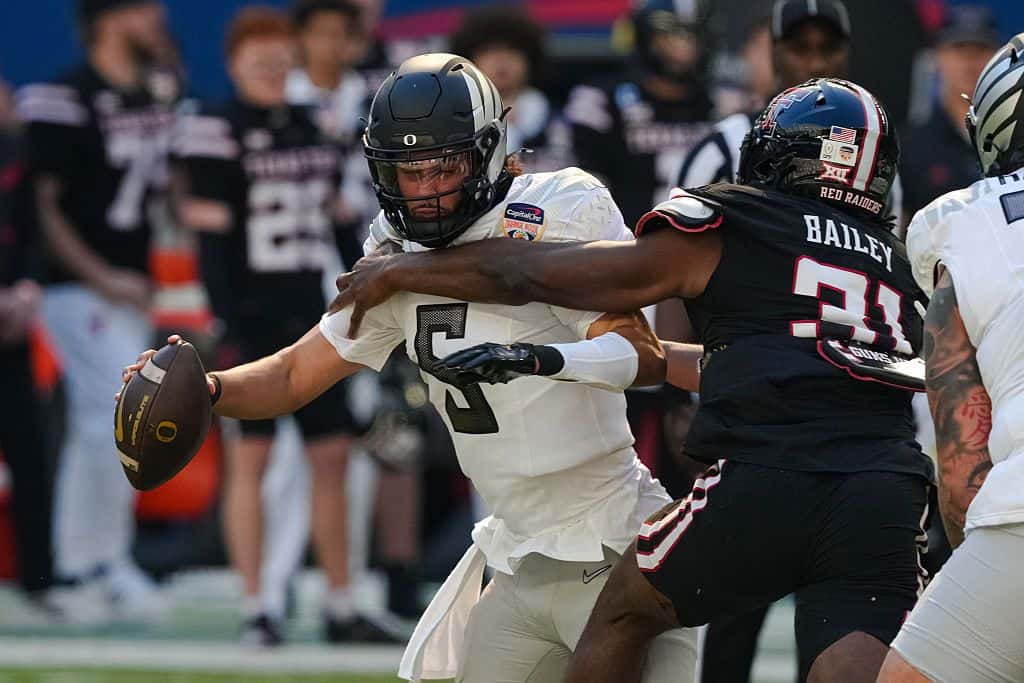
The Jets made a safe choice with the selection of David Bailey (first round) based on his proven production and fit in Aaron Glenn’s defense. Although there are concerns about Bailey having the physicality to be an asset against the run, it’s worth the gamble due to his elite explosive traits as a pass rusher. Bailey generated a 33.6% pressure rate against traditional dropbacks last year, the highest rate of any player over the last two seasons. The next best was Bailey’s own mark from the 2024 season at Stanford (28.6%). Players with Bailey’s explosive traits and arsenal of pass-rush moves don’t come around often, and it should allow him to make an immediate impact in Glenn’s defense.
Kenyon Sadiq (first round) was a surprising pick given the Jets’ selection of tight end Mason Taylor in the early second round last year. That’s an awful lot of recent draft capital invested into one of the least valuable and most easily replaceable positions on the field. That said, Sadiq brings significantly more explosive traits to the offense than Taylor, and the two complement each other well. The Jets will presumably use two-tight-end formations at a high rate, with Sadiq frequently lining up in the slot.
The Jets will also use Omar Cooper Jr. (first round) in the slot, which makes this selection feel like a less-than-ideal use of draft capital. It will be hard to create enough opportunities for Taylor, Cooper, and Sadiq behind Garrett Wilson before trying to justify spending three top-42 picks on that group over the last two seasons. To put a positive spin on it, however, the Jets now have a ton of flexibility in their offensive formations given Sadiq’s athleticism and the slot/outside flexibility of both Cooper and Wilson.
D’Angelo Ponds (second round) is only 5-foot-9 but played on the outside at Indiana and might get a chance to stay there in New York. Glenn is only 5-foot-9 himself, so if anyone might be willing to overlook Ponds’ physical limitations, it will be Glenn. However, Ponds’ lack of size showed up in college, and he struggled to defend downfield against some of his tougher competition. Based on route-adjusted data, Ponds allowed a catch rate 0.9% above expected against explosive routes.
Darrell Jackson Jr. (fourth round) will serve as T’Vondre Sweat’s backup at nose tackle. Jackson has never made an impact as a pass rusher, but he has the size/length combination to eat up space and take on double teams in the middle of the defensive line.
Cade Klubnik (fourth round) will probably be a career backup, but gambling on a quarterback early on Day 3 was a smart approach for the Jets since they didn’t have access to any viable future starter in the early rounds. The Jets will probably give Klubnik a look at some point this season just to see what they have, but don’t expect much. Ideally, Klubnik plays in an RPO-heavy offense that focuses on getting the ball out quickly and takes advantage of his athleticism, none of which describes Frank Reich’s style.
Anez Cooper (sixth round) is a physical run-blocking guard who will probably be the Jets' primary backup as a rookie. He’s not much of an athlete, but if Glenn is hoping to see the Jets build the type of physical offensive line he witnessed during his time in Detroit, Cooper fits perfectly. VJ Payne (seventh round) might have a hard time finding a role due to the Jets' depth in the secondary, but he was expected to be off the board much earlier and could turn into a steal in the long run.
The Jets likely added four players who will contribute immediately, which helps set a high ceiling for this draft class. Cooper and Sadiq will likely have a minimal impact on wins and losses in the short term, but their depth at the skill positions will make New York a favorable landing spot for a rookie in 2027.
This analysis continues in the 2026 Football Preview
Order Warren Sharp's 2026 Football Preview to Get Penalty Analysis for All 32 NFL Teams
Warren Sharp’s 600+ page full-color PDF, the 2026 Football Preview, is unlike anything you have read. Stunning visualizations, including new heat maps and stat pages, are built with the reader in mind. Innovative, next-level thought processes abound in every team chapter and article.
Get Warren's Book
Warren Sharp's book shares insights into the players, coaches, teams, and philosophies with one goal: to prepare you for the 2026 NFL season with the smartest information delivered in the fastest, most direct way possible for optimal reviewing and retention.
- Team Chapters previews are in-depth, data-driven & full of actionable info
- Fantasy Football player profiles, predictions, and ranks
- Vegas Odds forecast team wins, division rankings, lines for all 2026 games
- Coaching strategic advice for teams, play-calling analysis & team tendencies
- Front Office Analysis positional spending, roster construction & cap analysis
- Reasons to bet over/under win totals & analysis of futures betting market
- Rookie draft class deep dive into impact for every team
- Rankings for every positional unit on every team with analysis
- Penalty analysis for all 32 NFL teams