
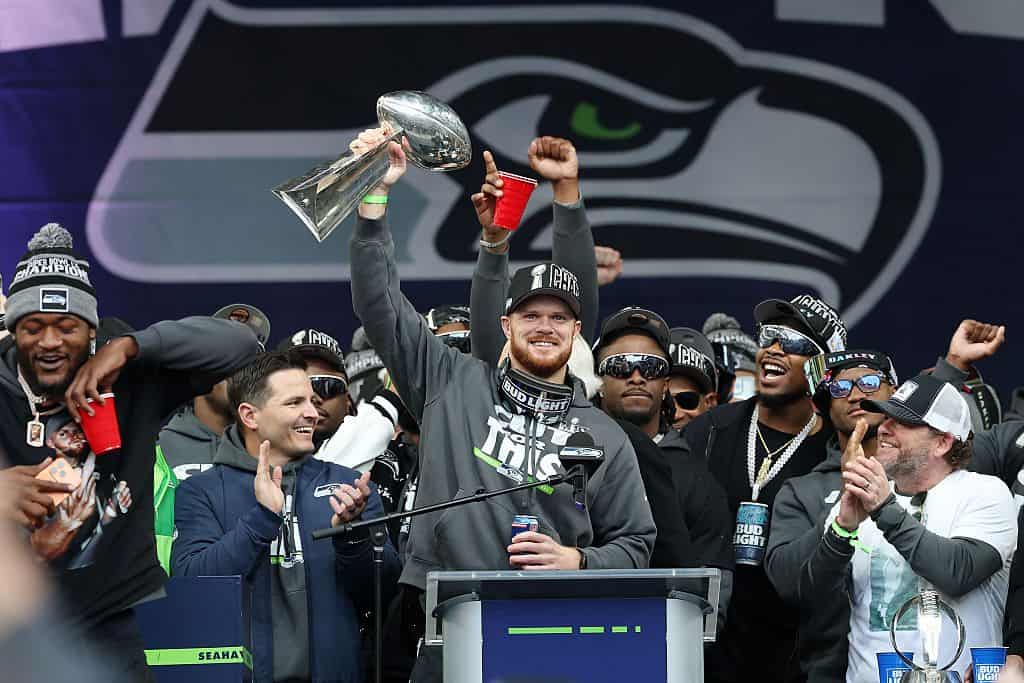
The Seattle Seahawks have been chosen to star in the HBO docuseries Hard Knocks for the upcoming 2026 NFL season.
At over 600 pages, Warren Sharp's new book 2026 Football Preview features dedicated chapters for all 32 NFL teams, fantasy football predictions, Vegas odds with forecasted wins, plus hundreds of visuals and infographics breaking down the upcoming 2026 NFL season.
In honor of Hard Knocks episode, we're sharing Warren's team chapter for the Seattle Seahawks in its entirety, absolutely free, to get you prepared for the upcoming series by delivering the smartest information & analysis in the fastest, most direct way possible.
Get Warren's Book for $34.99
Seattle Seahawks 2026 Season Preview
What if I were to tell you before the 2025 season, the Seattle Seahawks were favored in seven of 17 games, predicted to win 7.5, and predicted to finish in fourth place in the NFC West?
And their new quarterback was retread Sam Darnold, with a career 35-38 record after washing out of every prior stop on his journey?
And that in 2025, Darnold would lead the league in turnovers, with:
The #2 most interceptions of any player…
The #1 most fumbles of any player…
The #2 most fumbles lost of any player…
His total of 20 turnovers:
#1 most turnovers of any player in 2025 (20)
#1 most EPA lost of any player in 2025 (-100.2)
Would you expect that team to go 14-3 and win the Super Bowl?
I sure as hell would not, but that’s exactly what happened in the magical 2025 season for the Seattle Seahawks.
Coaching accounted for a ton of success in Seattle, more than probably most successful teams that have won a Super Bowl in recent memory.
Last May, when we finalized our “positional unit rankings” you can find here in these pages, we pegged Seattle #22 QB room, #30 OL, and #19 receivers. The only units that ranked in the top 10 were the RB room (barely top 10 at exactly 10) and on defense.
Last July, PFF came out with their rankings. An #22 overall roster with an identical #30 for the OL, #20 for receivers, #5 for RBs, with a net of #18 for the offense and #18 for the defense (#23 DL, #24 LB, #12 secondary).
Last September, Mike Clay (ESPN) had the Seahawks with the #25-ranked offense and #8-ranked defense for a total rank of #21 right before the season began.
We know how offense contributes more to winning than does defense.
On offense, passing contributes more to winning than running.
When passing, quarterbacks contribute more to winning than receivers.
And yet across the NFL space, every reputable authority believed Seattle’s offense was well below average, with the offensive line and quarterback being the two biggest impediments to success.
I don’t believe everyone was dead wrong about the offensive line and quarterback. I believe coaching really solved a lot of the problems before they could even become an issue.
And naturally, for a team without a great roster, it never hurts when the talent they do have stays healthy. And Seattle ranked #3 in overall roster health in 2025, including #3 on the offense. They had the #5 healthiest offensive line and #1 healthiest quarterback, the two most questionable areas of this roster.
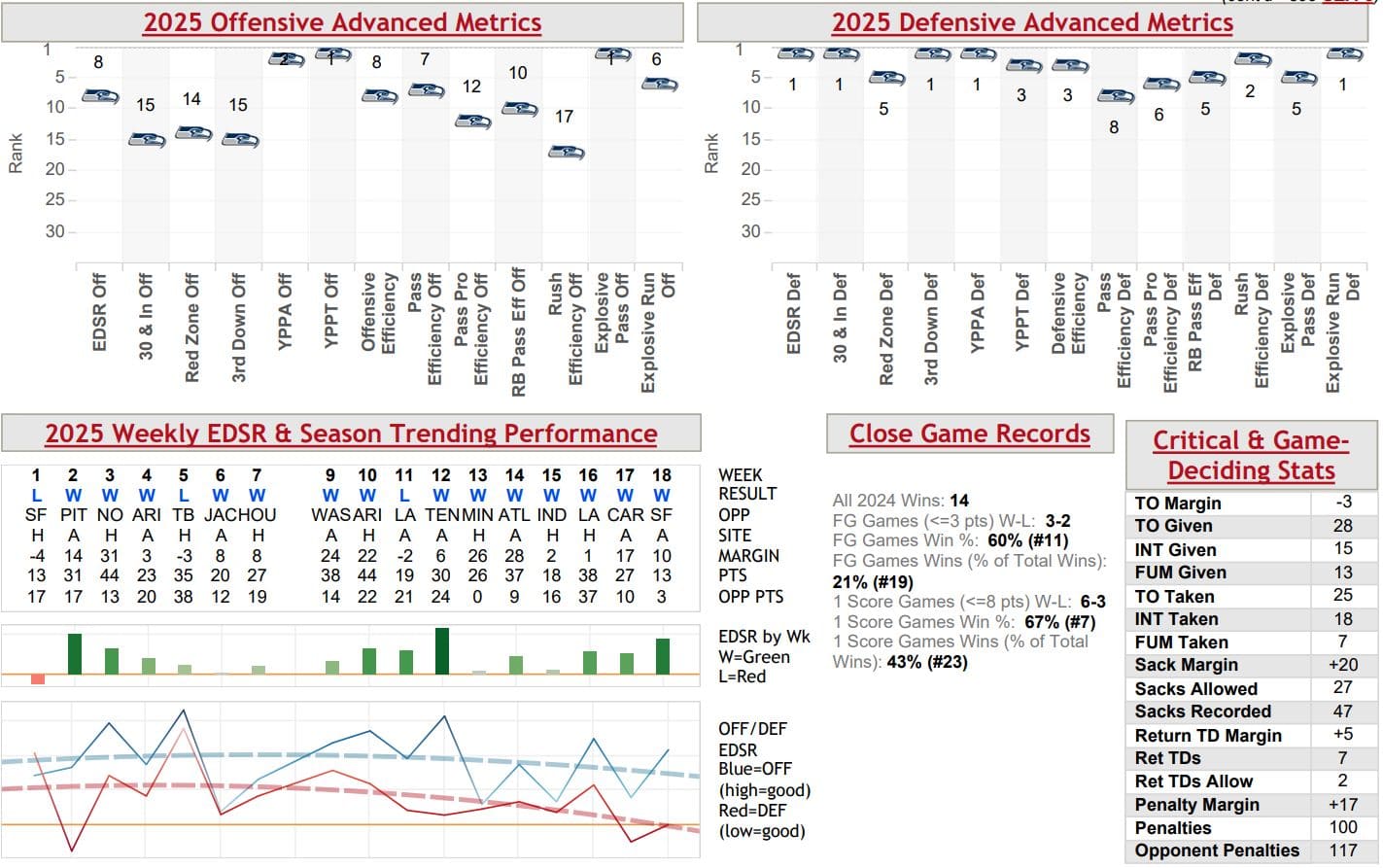
If we’re being honest, the defense clearly carried the offense to the Super Bowl and won it for Seattle. The Patriots had 78 TOTAL YARDS through three quarters with 0 points and one total drive (out of 10) that even crossed midfield. That drive ended on the Seahawks 44-yard line. Seattle allowed the third-lowest EPA per play of any Super Bowl defense in the modern era.
And while we’ll break down Mike Macdonald’s outstanding job on his side of the ball, let’s start with the offense, because that is where most of the magic needed to happen to elevate a below-average roster.
First, let’s take a step back to the spring of 2025. After three straight winning seasons, the Seahawks did something close to unthinkable. They blew up the offense.
DK Metcalf, the franchise's most explosive receiver and the holder of its single-season receiving yardage record, was traded to the Pittsburgh Steelers. Geno Smith, a Pro Bowl quarterback who had resurrected his career in Seattle, was shipped to the Las Vegas Raiders. Tyler Lockett, a beloved decade-long fixture, was let go and signed with Tennessee.
In their place came Sam Darnold, a former No. 3 overall pick on his fourth team, signed off a Minnesota season that ended with a brutal playoff performance, and Cooper Kupp, a 32-year-old coming off three injury-marred years that had convinced the Rams to move on.
General manager John Schneider also hired Klint Kubiak to run the offense and used a first-round pick, the 18th overall selection, on guard Grey Zabel, the highest-drafted offensive lineman ever out of an FCS school.
It was a teardown that, on paper, made the offense older, less explosive, and quarterbacked by a player whose career had been a seven-year argument for caution.
Out of the ashes emerged Jaxon Smith-Njigba, who did not just take over as the No. 1 receiver job. He authored one of the great individual seasons in the history of the position.
He caught 119 passes for 1,793 yards and 10 touchdowns, leading the NFL in receiving yards and setting a franchise record that obliterated the old mark. To put 1,793 in perspective, it stands as the eighth-most receiving yards in a single season in NFL history. He commanded a 36.2% target share, the highest in the league, meaning more than one in three Seattle pass attempts went his way. He was not merely a volume merchant, either. Smith-Njigba led the NFL in deep receiving yards with 542 and in deep receptions with 13, a remarkable transformation for a player who had been pigeonholed as a short-area slot operator over his first two seasons.
He gained at least 72 receiving yards in 15 of his 17 games. He was named a unanimous first-team All-Pro and won Offensive Player of the Year, becoming just the sixth wide receiver ever to claim the award.
I could spend this entire chapter talking about what Kubiak did from a coaching perspective to improve Seattle’s offense in 2025.
There were too many levers he pulled and dials he turned to mention, but I’ll share the four specific changes that made a world of difference and that I enjoyed the most.
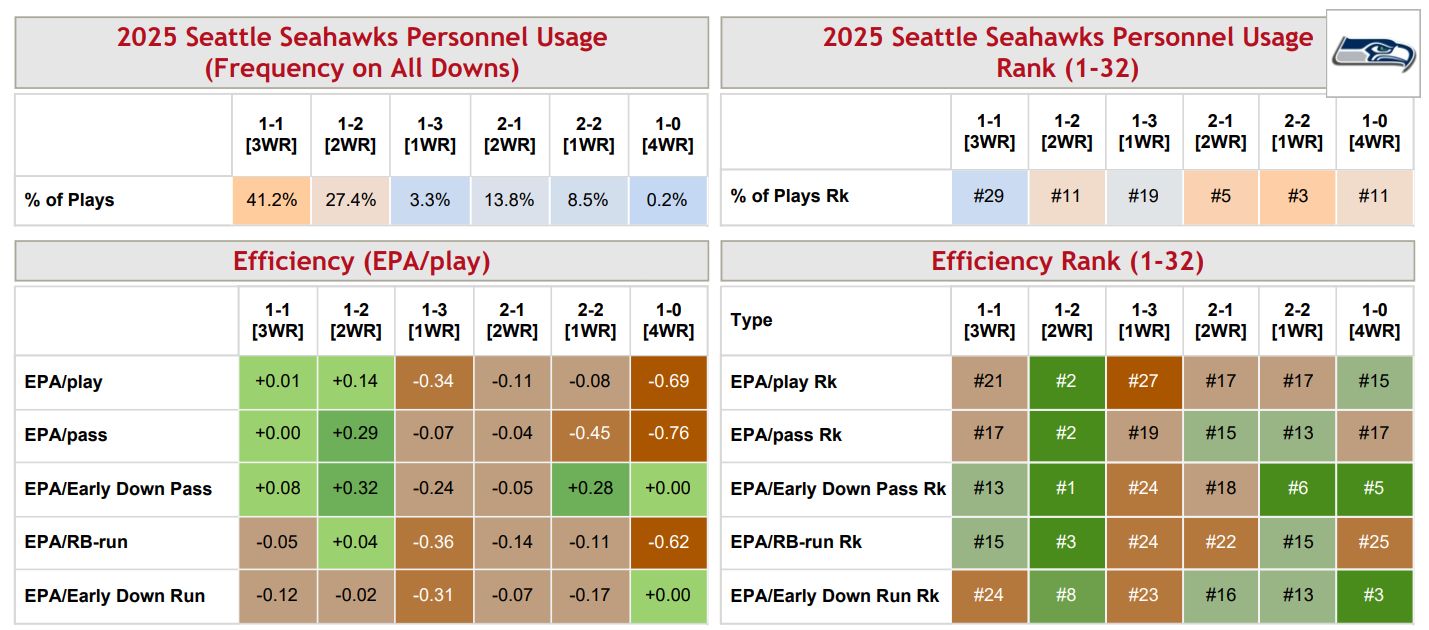
The first was a personnel change.
In 2024, the Seahawks were an 11-personnel-heavy team.
78% of their snaps came with 3+ WRs on the field, #3 most of any team.
21% of their snaps came with 2+ TEs on the field, #25.
And they were terrible out of multiple TE sets.
12 personnel:
#30 EPA per play (-0.20)
#30 yards per play (4.2)
#30 success rate (35%)
They utilized almost no 2-back sets (1.7%, #25) even though these plays were highly successful when they used them.
In 2025, Kubiak came in and flipped that ratio on its head:
44% of their snaps came with 3+ WRs on the field, #28 most of any team.
43% of their snaps came with 2+ TEs on the field, #7.
And they were outstanding out of multiple TE sets.
12 personnel:
#2 EPA per play (+0.14)
#1 yards per play (7.5)
#3 success rate (47%)
They also used a top-10 rate of 2-back sets (24%, #6) and delivered good efficiency out of those plays.
It was the exact inverse of the 2024 season.
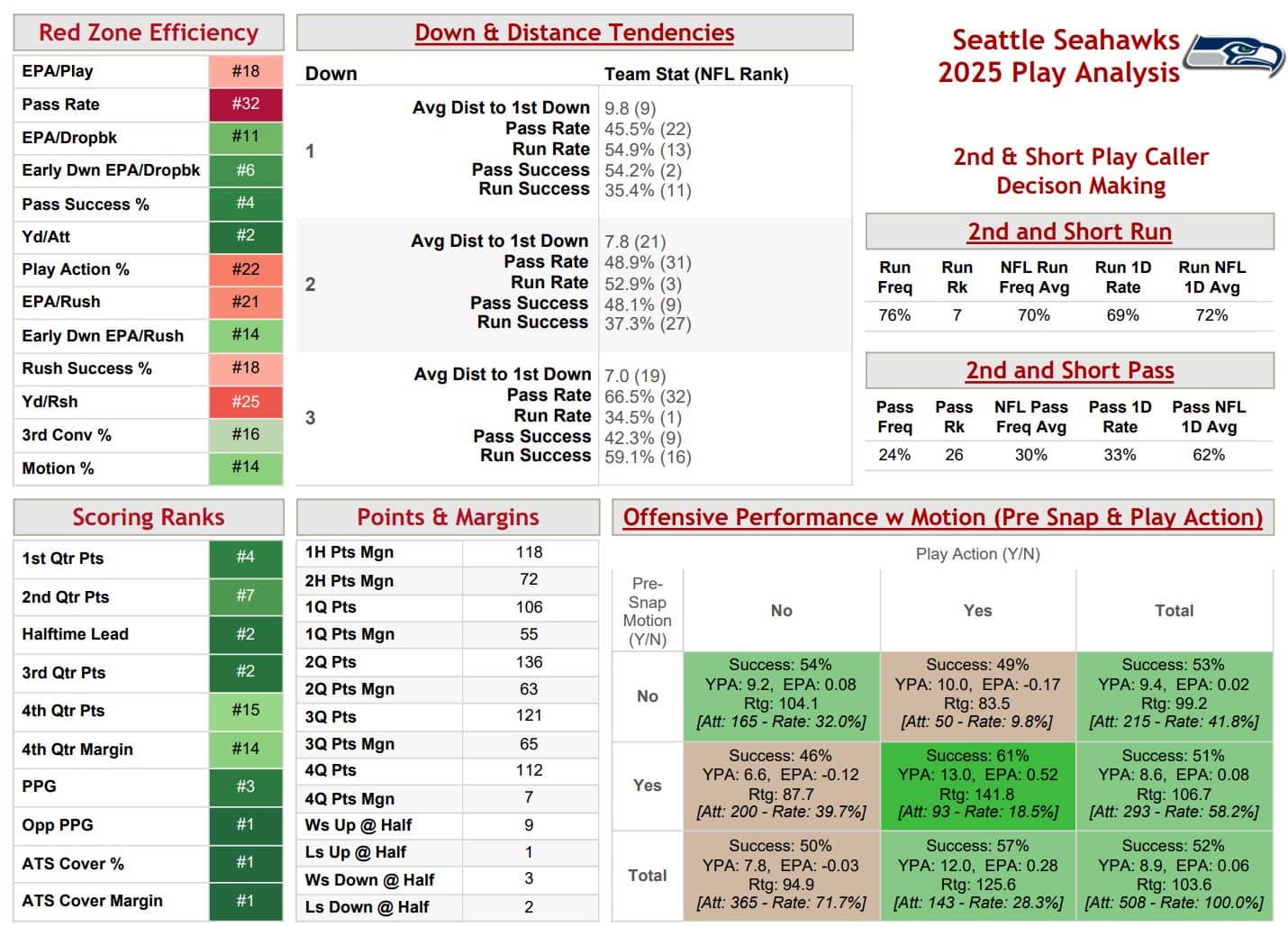
Another change from Kubiak was in the play-action game.
In 2024, Seattle used the #28 rate of play action of any team (19%).
When they used play action, the results were terrible:
#31 EPA per attempt (-0.15)
#26 success rate (42%)
#31 yards per attempt (6.4)
In 2025, Kubiak used the #8 rate of play action of any team (28%).
When they used play action, the results were excellent:
#6 EPA per attempt (+0.28)
#8 success rate (52%)
#1 yards per attempt (11.3)
Once again, it was the exact inverse of 2024, flipping the ratio right on its head.
Taking something the team was bad at and did infrequently to something the team would do extremely frequently at the best efficiency in the NFL.
A third thing was an increased usage of pre-snap motion.
In 2024, Seattle used the #25 rate of pre-snap motion (42%).
When they used motion, the results were terrible, especially ahead of passes:
Passes:
#29 EPA per attempt (-0.20)
#23 success (39%)
#23 yards per attempt (6.6)
All plays:
#31 EPA per play (-0.31)
#28 success rate (36%)
#26 yards per play (4.8)
In 2025, Kubiak used the #14 rate of pre-snap motion (54%).
When they used motion, the results were outstanding, especially ahead of passes:
Passes:
#10 EPA per play (+0.08)
#10 success rate (47%)
#2 yards per play (8.2)
All plays:
#17 EPA per play (+0.01)
#18 success rate (41%)
#6 yards per play (6.1)
Along with the shift to heavy personnel and the massive spikes in usage of play action and pre-snap motion, the final impactful change was simply how great Seattle was on first downs.
In 2024, Seattle was not a good team on first down:
#23 in EPA per play (-0.06)
#21 in EPA per pass (+0.09)
#29 in EPA per rush (-0.16)
They also ranked #18 in yards per play (5.3).
In 2025, Seattle was outstanding on first down:
#7 in EPA per play (+0.06)
#6 in EPA per pass (+0.21)
#15 in EPA per rush (-0.04)
They also ranked #3 in yards per play (6.4).
The emphasis on winning on early downs, with aggressive play calling and drilled execution, was massively important for the Seahawks in 2025.

These four offensive improvements, led by coaching, can not go unappreciated.
And the changes they brought about had a cascading impact. They ranked #4 in first-quarter points, #7 in second-quarter points, and #2 in third-quarter points.
Seattle outscored opponents by 55 points in the first quarter, #1 in the NFL, and by 118 points in the first half, #2. Through three quarters, their cumulative point margin was +183, the best in football.
When an offense takes scoring as seriously as the Seahawks and routinely puts its foot on your throat for three quarters, it is hard to come from behind to win, especially against a defense like the one Macdonald built.
When Macdonald ran the Baltimore Ravens defense, his unit finished third in points allowed in 2022 before jumping to first in 2023, the year his Ravens also led the NFL in takeaways and turnover margin. The same pattern happened in Seattle.
His defense that first year finished 11th in points allowed. In 2025, his second year, the same unit finished #1 in points allowed at 17.2 per game, the first time the Seahawks led the league in scoring defense since 2015.
Seattle’s 2025 defense finished the season ranked #1 in EPA per play (-0.12), #2 in yards per play (4.6), and #3 in success rate (37%).
The peak was almost absurd. From Week 7 through Week 14, an eight-game stretch, Seattle allowed -0.34 expected points added per play. That -0.34 figure was the best eight-week stretch any defense has produced in the last 25 years.
The 2013 Legion of Boom, the Seahawks unit that suffocated the Denver Broncos in Super Bowl XLVIII and remains the gold standard in franchise memory, peaked at -0.23 over its best eight-game run. The 2002 Tampa Bay Buccaneers and the 2003 Baltimore Ravens, two other historically great defenses, topped out around -0.24.
How they did it is the most impressive part. Conventional wisdom says you generate pressure by sending extra rushers. Macdonald did the opposite.
Seattle finished with the #11 lowest blitz rate in the NFL while posting the #5 best pressure rate, getting after the quarterback on 39% of dropbacks. They recorded 111 hits (#3) and 47 sacks (#7).
They were able to do this while using the #2 highest rate of simulated pressure in the NFL. Showing an aggressive blitz pre-snap but ultimately dropping standard rushers into coverage while bringing a non-traditional fourth rusher became the defining cornerstone of a historically efficient unit. Seattle was one of four defenses to finish the year with over 50% success when using simulated pressure.
By walking up defensive backs like Devon Witherspoon or Nick Emmanwori to the line of scrimmage pre-snap, offensive lines were forced to slide their protection to account for them. At the snap, the blitzing defensive back would drop back into coverage, and an interior defensive lineman like Leonard Williams would drop into a shallow throwing lane, frequently leading to erratic throws and turnovers.
The front four did the heavy lifting, which meant Macdonald could keep seven defenders in coverage and still make quarterbacks miserable. Williams earned second-team All-Pro honors on the interior. DeMarcus Lawrence, who signed in free agency and openly admitted he knew he would never win a title in Dallas, brought edge juice. Byron Murphy II, the 2024 first-round pick, grew into a disruptive interior force. Uchenna Nwosu rounded out an elite rotation.
While the pass defense confused and pressured, the run defense smothered. Against opposing running backs, Seattle ranked:
#1 in YPC (3.5)
#1 in EPA per rush (-0.22)
#2 in success rate (31%)
Seattle’s -0.22 EPA per rush was the lowest for any defense over the last five years.
And here’s the kicker:
Seattle did this while using the #5 highest rate of light boxes. Light boxes are supposed to get gashed on the ground. Instead, the Seahawks proved that Witherspoon, a three-time Pro Bowl corner, and rookie safety Emmanwori, the 35th overall pick who emerged as a force near the line, were good enough tacklers to hold up against the run from defensive back alignments. Ernest Jones anchored the second level and earned second-team All-Pro recognition, with a legitimate case for top-10 Defensive Player of the Year support. What made the unit truly frightening was its depth.
Injuries hit the back end and the linebacker corps at various points, and Seattle's defensive player health ranked just #13 in the league, yet the role players slotted in and performed close to the level of the starters, a sign of outstanding coaching.
One note on rushing for the offense that could be overlooked if not using the right context: There was a massive difference between rushing efficiency to build leads compared to rushing efficiency to end games.
Looking at Seahawks RB runs based on quarter:
Quarters 1-3:
#13 EPA per rush (-0.05)
#6 success rate (41%)
#13 YPC (4.5)
#8 explosive-run rate (8.4%)
Quarter 4:
#24 EPA per rush (-0.10)
#29 success rate (29%)
#22 YPC (3.9)
#15 explosive-run rate (6.6%)
Seattle had built such leads, as mentioned above, that they were predictable in the fourth quarter, and defenses stuffed the runs far more frequently, with 7+ man boxes on 85% of runs and 8 man boxes on 56% of runs (compared to 47% in the first three quarters).
The offensive line, ranked #30 entering the year, improved considerably and allowed just 27 sacks, the fifth-fewest in the league. That is a real credit to Charles Cross, Abraham Lucas, Zabel, center Jalen Sundell, and guard Anthony Bradford. This was one of the healthiest units in the NFL, and it ranked #8 in run block win rate and #12 in pass block win rate.
Seattle wasn’t really a lucky team in 2025, aside from health. They ranked #16 in fumble luck and #8 in field goal luck. Seattle went 6-2 against teams that made the playoffs, the best record of any team. They went 6-2 against teams that finished with a winning record, again the best in the NFL. Their combined opponent winning percentage of .523 was the #8 toughest schedule in the league. This was not a record fattened on the carcasses of bad teams, or delivered with beneficial bounces.
But now, the task is achieving similar results with the loss of significant contributors from last year.
I assigned the majority of Seattle’s outstanding 2025 campaign to coaching. Half of that duo returns, as Mike Macdonald is going nowhere.
But the most significant departure is not a player. It is Klint Kubiak, who parlayed his lone season in Seattle into the Las Vegas Raiders head coaching job, taking quarterbacks coach Andrew Janocko and run game coordinator Rick Dennison with him.
Macdonald replaced him with Brian Fleury, a long-time San Francisco assistant with a tight ends background. For Darnold, it means yet another new system. He has now had a different play-caller in essentially every season of his career, and the continuity that helped unlock him in Minnesota and Seattle is gone again the moment he finally won a ring.
So much of what helped the undertalented Seahawks offense reach outstanding levels of performance related to strategy and scheme. Whether Fleury can preserve what worked, or whether the offense takes a step back as it relearns a new voice, is a massive question.
The roster losses are significant, and in many cases, replacements have not been appropriately assigned.
Kenneth Walker III, the Super Bowl MVP who delivered 161 scrimmage yards against New England, signed with the Kansas City Chiefs in free agency. Zach Charbonnet tore his ACL in the Divisional Round and is expected to miss much of 2026.
That gutted the backfield, and GM John Schneider responded by spending his first-round pick, the 32nd overall selection, on Notre Dame running back Jadarian Price, the first running back Seattle has taken in the first round since Rashaad Penny in 2018. Price is a dynamic talent who averaged 6.0 yards per carry behind No. 3 overall pick Jeremiyah Love and led the nation with 37.5 yards per kickoff return, though he will need to refine his pass protection to handle a full three-down role. Emanuel Wilson arrived from Green Bay as a veteran complement.
While there is certainly a ton of opportunity in Seattle for Price, he had the lowest grade for any Round 1 running back selected since 2000, per our Rich Hribar’s running back model. He is the only Round 1 running back with fewer than 125 touches in every season.
He forced missed tackles on 26.9% of runs, best in this RB class, and averaged 36.1 yards per kickoff return. However, he had 4 fumbles despite the light workload. His fumble rate ranked #3 highest in this class. He recorded the #2 worst pass protection grade of any RB in this class, and earned just a 9.9% target rate on routes, the #2 lowest in this class. He had just 15 total receptions in college.
Until Charbonnet returns (and even after to a degree), this RB room has massive question marks.
On defense, edge rusher Boye Mafe left for Cincinnati, and cornerback Riq Woolen signed with Philadelphia. Safety Coby Bryant also departed.
Losing the RB1 and three key defenders is considerable. The replacements were not.
As of publication, Seattle hasn’t signed a single free agent to a contract of more than one year. Their three most expensive expenditures were EDGE Dante Fowler ($2.5M), CB Noah Igbinoghene ($1.8M), and RB Emanuel Wilson ($1.5M).
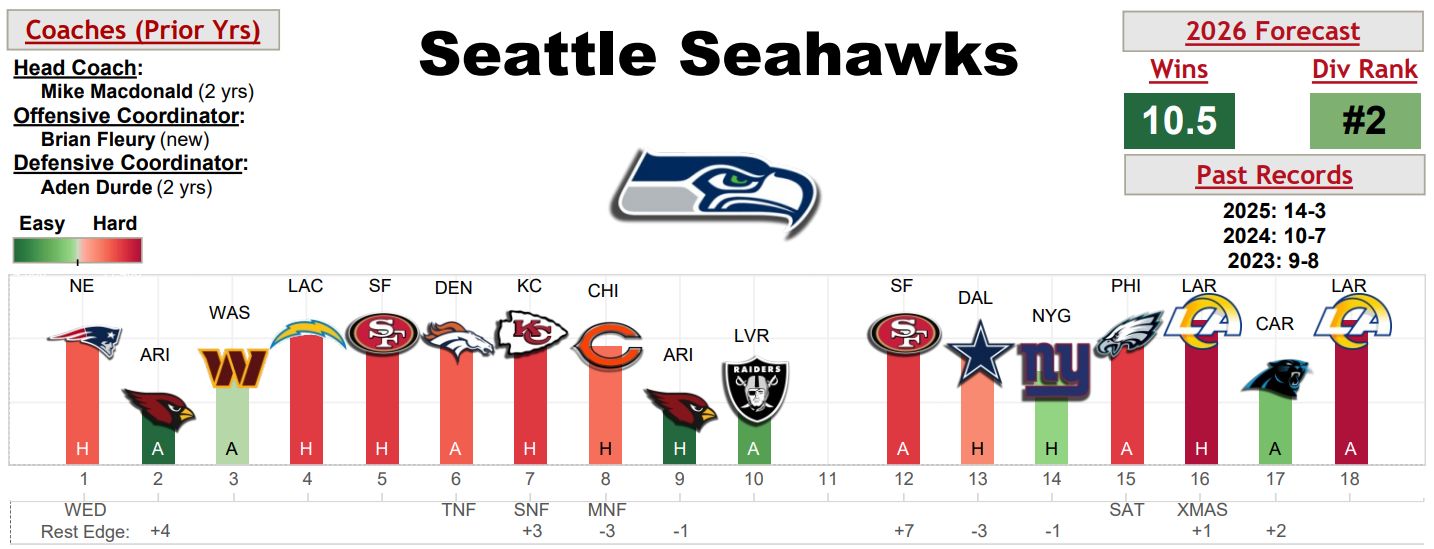
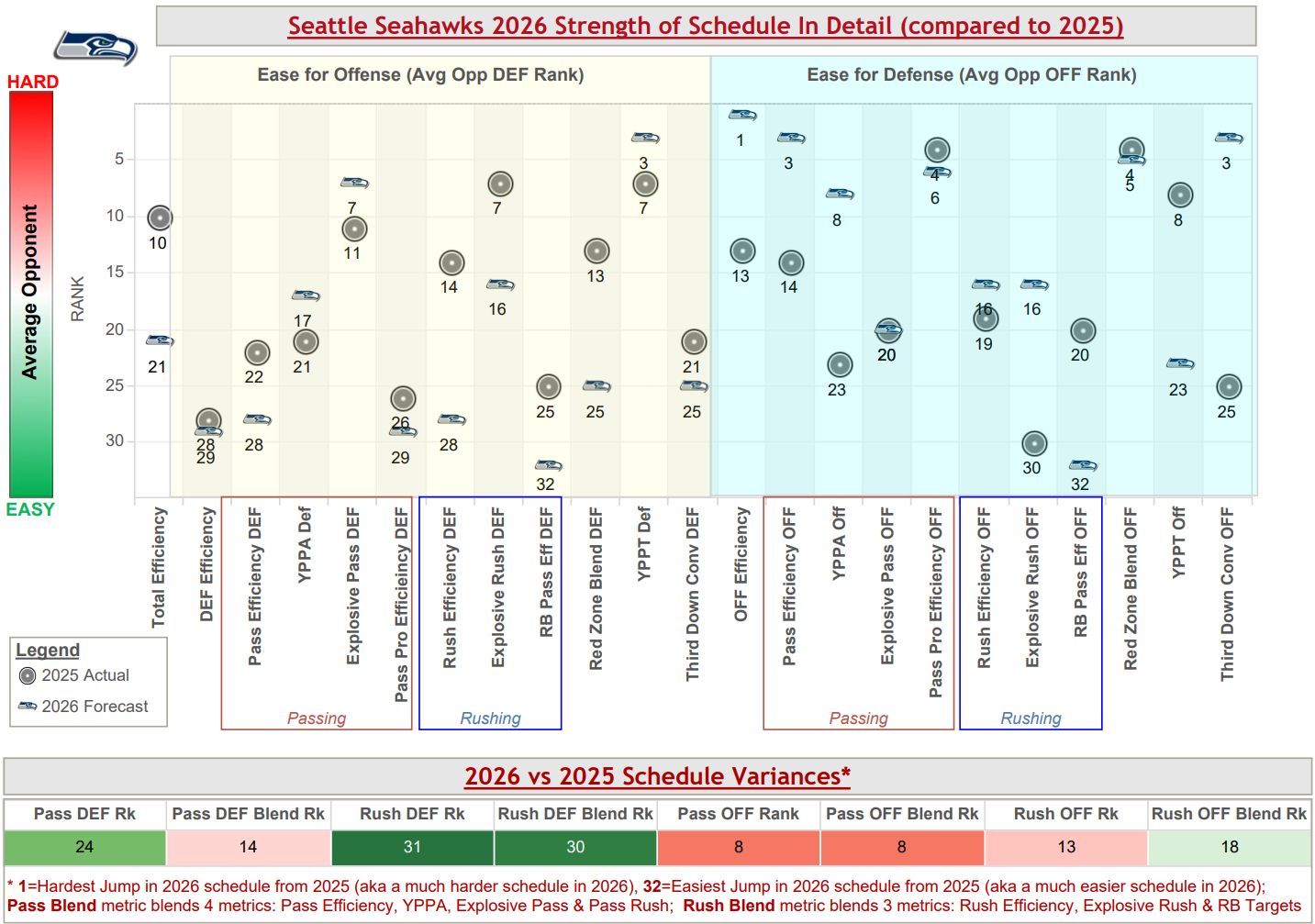
The schedule is difficult, particularly in the NFC West. In 2025, it became the first division in NFL history to feature three teams that won at least 12 games, with Seattle at 14-3 and both the Rams and 49ers at 12-5. The Rams just added EDGE Myles Garrett. The 49ers can’t be any less healthy than they’ve been and always deliver when Kyle Shanahan has a healthy roster.
The NFL scheduled the season opener as a Super Bowl LX rematch, sending the Patriots back to Lumen Field on a Wednesday night, with Seattle tasked with proving the February result was no fluke. The revenge games stack up from there. Seattle drew Kenneth Walker III and the Chiefs in prime-time, Coby Bryant and the Bears on a Monday night, Riq Woolen and the Eagles on a Saturday in Week 15, and Klint Kubiak's Raiders in Week 10 in Las Vegas.
The Seahawks were not supposed to win a Super Bowl this way, which is what made 2025 so fascinating. Sam Darnold led the NFL in turnovers. The offense entered the year with major questions at quarterback, offensive line, and receiver. The roster was not viewed as anything close to championship-caliber.
Then, Klint Kubiak and Mike Macdonald coached around every weakness so well that Seattle became the rare team where the system elevated the personnel before the flaws could fully sink them. Kubiak turned the offense into a heavy-personnel, play-action, motion-driven machine, Jaxon Smith-Njigba became one of the best receivers in football, and Macdonald built a defense that played like a historic unit.
But repeating that formula is the real challenge. Brian Fleury has to preserve the pieces that worked while adjusting to a backfield that lost Kenneth Walker III, may not have Zach Charbonnet for much of the year, and is leaning heavily on rookie Jadarian Price despite major questions in pass protection, ball security, and receiving usage.
The defense gives Seattle the right to believe it can remain near the top of the NFC. Macdonald’s pressure design, simulated looks, light-box run defense, and secondary tackling were all elite, and the Seahawks proved last year was not built on a soft schedule or lucky bounces. The Seahawks are still dangerous. They just may have to work a lot harder to look magical again.
Order Warren Sharp's 2026 Football Preview to get in-depth breakdowns for all 32 NFL Teams!
Warren Sharp’s 600+ page full-color PDF, the 2026 Football Preview, is unlike anything you have previously read. Stunning visualizations, including new heat maps, are built with the reader in mind. Innovative, next-level thought process abounds in every team chapter and article.
Get Warren's Book for $34.99
Warren Sharp's book shares insights into the players, coaches, teams, and philosophies with one goal: to prepare you for the 2026 NFL season with the smartest information delivered in the fastest, most direct way possible for optimal reviewing and retention.
- Team Chapters previews are in-depth, data-driven & full of actionable info
- Fantasy Football player profiles, predictions, and ranks
- Vegas Odds forecast team wins, division rankings, lines for all 2026 games
- Coaching strategic advice for teams, play calling analysis & team tendencies
- Front Office Analysis: positional spending, roster construction & cap analysis
- Reasons to bet over/under win totals & analysis of futures betting market
- Rookie draft class deep dive into impact for every team
- Rankings for every positional unit on every team with analysis