
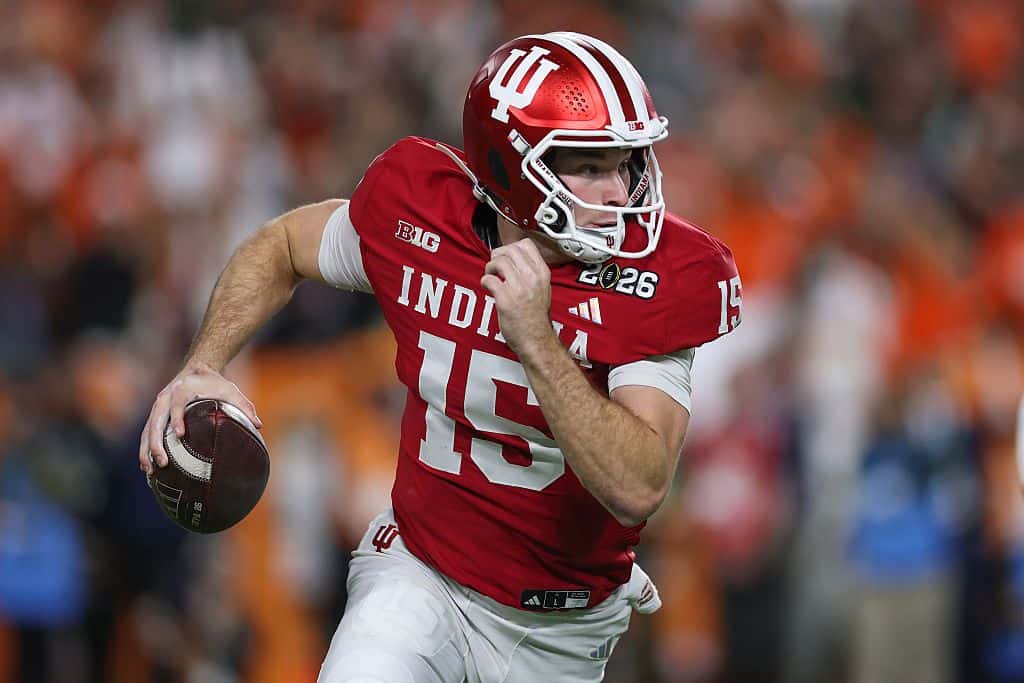
No surprises as Fernando Mendoza, the 2025 Heisman Trophy winner, is the starting point of the 2026 NFL Draft.

The Raiders have not selected a quarterback in Round 1 since JaMarcus Russell in 2007 and have been chasing quarterback production since moving on from Derek Carr following the 2022 season.

In 2025, their passers combined to rank 28th in the league in rating (81.5).

They threw for 6.4 yards per pass attempt (27th), 9.8 yards per completion (30th), a 3.9% touchdown rate (26th), and a 3.7% interception rate (30th).

The team immediately moved on from Geno Smith following last season.

Find the pre-draft profile for every notable fantasy prospect in our 2026 Fantasy Football Draft Kit!

Don't Miss Out on The Best Fantasy Football Coverage in the Business

Like the NFL, fantasy football never sleeps.

From rankings to the best draft strategies, Sharp Football has everything you need to get ready for the fantasy season in our Fantasy Football Draft Kit, powered by premier fantasy football analyst Rich Hribar.

Save more by bundling the Draft Kit with our in-season fantasy package that features Rich's comprehensive “Worksheet” preview of every game, every week of the NFL season.

Click here for more information about our fantasy coverage!

Fernando Mendoza Fantasy Value With the Las Vegas Raiders

After two seasons at Cal, Mendoza transferred to Indiana, where he and the team reeled off a 16-0 season and a National Championship.

After throwing 30 passing touchdowns over his two seasons at Cal, Mendoza threw 41 passing touchdowns last season.

The former 3-star recruit improved his completion percentage and yards per pass attempt in all three seasons in college.

His final season completion percentage (72%) ranks 94th percentile, while his touchdown to interception rate (41 to 6) ranks 92nd percentile, and his 9.3 yards per pass attempt sits 84th percentile among all prospects since 2000.

Mendoza’s calling cards are that he has prototypical size (6-foot-5 and 236 pounds) and plays on schedule with accuracy.

A class-high 79% of his throws were on target in 2025.

The seasoning for Mendoza is that he played his best in high-leverage situations.

Mendoza threw only 1 interception while taking 7 sacks on 139 career dropbacks in the red zone.

This past season at Indiana, Mendoza took 69 dropbacks in the red zone, throwing 26 passing touchdowns with 0 interceptions and taking 2 sacks.

On third and fourth downs, Mendoza had a class-high 75.3% on-target throw rate and a class-high 14.7% touchdown rate.

Mendoza was ripping the ball downfield in those spots, too, averaging 10.9 yards per throw downfield on third and fourth downs, which was second in this class.

The nits to pick with Mendoza entering the NFL are how he will perform in a more challenging environment and how he will adapt his game to the current NFL.

There will be some who ask about how his offensive environment at the college level was perfectly in tune with his strengths.

Mendoza had the lowest drop rate in this class (2.2%).

He benefited from a heavy RPO offense predicated on a high rate of throws outside the numbers and into traffic.

23.4% of his dropbacks and 25.4% of his pass attempts last season were on RPO calls, by far the highest rates of this class.

The next-closest quarterback in both departments was Mark Gronowski of Iowa, who had a 16.3% RPO dropback rate and 16.4% of his pass attempts on those play calls.

Mendoza only threw 55.2% of his passes over the middle of the field (12th in this class).

If you look at the current state of the NFL, we have seen a spike in more condensed formations and a continued spike in playing under center, turning your back to the defense, and using traditional play action.

That has increased relevancy here with the Raiders, who just hired Klint Kubiak as their head coach.

In the past two seasons with the Seahawks and Saints, Kubiak’s passers have had under-center rates of 54.8% (2nd in the league) and 42.5% (5th).

Over his three collegiate seasons, Mendoza has had only six dropbacks under center.

While that does take a step of faith in transitioning to the NFL, Kubiak has elevated both Derek Carr and Sam Darnold, players who offer a manageable bar of expectations.

Despite playing in a heavy RPO scheme, Mendoza did make big-time throws, however.

Only 13.9% of his passes were at or behind the line of scrimmage (third-lowest rate in the class).

Only 14.4% of his throws were 20 or more yards downfield (10th), but he had the highest on-target throw rate (54.5%) on those passes.

Even if you are factoring in that his infrastructure of systems and surrounding talent accentuated those characteristics, Mendoza did everything he was asked to a high degree.

Mendoza was also battle-tested due to his conference and postseason run.

On 303 dropbacks against Power Conference opponents, Mendoza led this class in completion rate (71.9%), yards per pass attempt (9.3 Y/A), and touchdown rate (10.6%).

He had five games against top 10 defenses last season (Oregon twice, Iowa, Ohio State, and Miami).

Ohio State and Miami both made Mendoza work, but overall, he completed 65.3% of his passes, averaging 8.3 Y/A, with 9 touchdowns and 3 interceptions.

That quality schedule did give us a sample of Mendoza playing under pressure, which showcased some of the limitations we could see at the next level when the pass rush ramps up.

Under pressure against Ohio State and Miami, Mendoza was 9 of 16 (56.3%) for 93 yards (5.8 Y/A) with 0 touchdowns.

Kept clean in those games, he was 22 of 34 (64.7%) for 316 yards (9.3 Y/A).

At the end of the day, we are fully aware that Mendoza can have a high floor.

The question (particularly for fantasy) comes down to what type of ceiling he can tap into.

From a modeling perspective, the closest comparison I have for Mendoza is Sam Bradford.

The one thing Mendoza does have in his back pocket compared to the QB2 pocket passer group for fantasy is that he is not a complete zero in the running game.

Mendoza is not a run-first passer, but he is the 53rd percentile in career rushing output.

He had a 7.7% scramble rate last season, which was seventh in this class.

I don’t believe Mendoza has the full creativity of a Brock Purdy when things are out of structure, but the top-down fantasy archetype for him is in the same ballpark as Purdy.

Mendoza has the profile as a weekly QB2 for fantasy who can moonlight as a QB1 during spike weeks and finish as a back-end QB1 in cumulative scoring.

For 2026, Mendoza could start the year on the bench as Kirk Cousins bridges the gap to when he takes the field, but we should bet on Mendoza finding the field sooner rather than later.

Cousins has not played well the past two seasons, and the Raiders would have to stack wins to prevent Mendoza from getting on the field early.

The pass catching room is not complete.

Mendoza does get Brock Bowers, but we should expect the Raiders to add wide receiver(s) over the remainder of this draft.

In 2025, Las Vegas wide receivers combined for:

  • 148 receptions (28th)
  • 1,696 receiving yards (30th)
  • 55 yards per route run (28th)
  • 11.5 yards per reception (29th)
  • 7 touchdowns (31st)

Tre Tucker has flashed at times on his rookie contract — in Week 3 last year, he had 8 catches for 145 yards and 3 touchdowns — but he has struggled with consistency attached to poor quarterback play.

Over the past two seasons, Tucker has run the fourth-most pass routes in the NFL (1,219), but his 1.01 yards per route rank 84th out of 96 wide receivers to run 500-plus routes.

Tucker has the vertical ability to make an impact in Kubiak’s scheme, but he is not a true No. 1 receiver and is in the final year of his rookie contract.

Kubiak will look to get more out of second-year receivers Jack Bech and Dont’e Thornton.

Bech was selected in the second round last season (58th overall), but he only played 37% of the offensive snaps, catching 20 passes for 224 yards and 0 touchdowns.

Thornton was selected in the fourth round (108th overall).

He played 45% of the snaps, catching only 10 of 30 targets for 135 yards and 0 touchdowns.

The team added Jalen Nailor on a three-year deal in free agency to add more experience and to push their younger receivers.

Nailor had 69 receptions for 1,066 yards and 11 touchdowns over his rookie contract with the Vikings.

The Raiders do have some luxury in having a great pass catcher at tight end, but that is one of the softer WR1-WR4 units in the league, and the depth beyond those four is inherently weak if those are the guys at the front of the position.

Brock Bowers Fantasy Outlook With Fernando Mendoza

While Bowers is an elite talent, playing with a rookie quarterback does put the brakes on him just a touch.

At least potentially from completely going wild in 2026.

You can make the argument that Mendonza is an upgrade on the quarterback play Bowers has had thus far, and I would not push back given that bar, but it is just another layer of variance here to factor in, which means the door is open for him to end up priced near his ceiling for the second straight season.

When Bowers led the position in scoring in 2025, he led the position in routes run.

Currently, Bowers is the TE2 in fantasy drafts with an ADP at the Round 2/Round 3 turn (23.4 overall).

I do have Bowers just a tick lower overall (still at TE2), at 29, so it's not an egregious price.

Since 2000, only three tight ends have finished as the TE3 or higher attached to a rookie quarterback making eight or more starts.

No tight end that has been attached to a rookie quarterback over that span has led the position in scoring, with Delanie Walker (TE3) in 2015 and Zach Ertz in 2016 (TE3) as the highest scoring players from that group in fantasy points per game.

The Raiders are expected to have a slower pace and a higher run rate under Kubiak, with the potential to be more competitive than last season.