

Every offseason, I break down the NFL offensive trends that will shape the upcoming season, including a deep dive into tight end red-zone performance.
The goal for these articles is straightforward.
We are monitoring the league's current state to identify any outliers, which we can then incorporate into the upcoming season while also gauging league trends.
While we have already examined all the positional tiers for 2026, it is always beneficial to review the league's overall landscape.
Every NFL season is unique, so this is always a great way to lay some groundwork.
Don't Miss Out on The Best Fantasy Football Coverage in the Business
Like the NFL, fantasy football never sleeps.
From rankings to the best draft strategies, Sharp Football has everything you need to get ready for the fantasy season in our Fantasy Football Draft Kit, powered by premier fantasy football analyst Rich Hribar.
Save more by bundling the Draft Kit with our in-season fantasy package that features Rich's comprehensive “Worksheet” preview of every game, every week of the NFL season.
Click here for more information about our fantasy coverage!
Red-Zone Fantasy Points Vs. Expectation
We are following up on our examination of league and team performance in the red zone last season and extending it to individual player analysis.
In that top-down team post, we covered not only how the majority of touchdowns scored in the NFL come from inside the red zone, but also that not all red-zone touches are created equal.
We also showcased in that post how NFL offenses have become more reliant on red-zone production as part of their scoring output.
The discovery of true regression candidates in this area of the field could prove pivotal, given the rising need for offenses to succeed in the red zone.
To reiterate some notes from that article that relate to passing production near the end zone since 2010:
- 67.1% of all passing touchdowns come from inside the red zone. In 2025, that rate was 69.1%.
- 43.8% of all passing touchdowns scored overall come from inside of the 10-yard line. In 2025, that rate was at 44.0%.
- 22.7% of all passing touchdowns scored overall come from inside the 5-yard line. In 2025, that rate was 23.8%.
Over the past decade, a target from the 19-yard line has been worth 1.8 fantasy points on average.
A target from the 10-yard line jumps up to 2.2 points on average.
A target from the 5-yard line climbs to 2.8 points on average.
A target in the actual end zone is worth 3.0 points on average.
You get the drift.
The closer you get to the end zone, the more valuable the opportunity is for fantasy points.
With that knowledge in place, the next step is to dive into red-zone production versus fantasy-skill-player expectations based on their actual opportunities, and weigh where those opportunities came from inside the red zone.
2025 TE Red-Zone Fantasy Points Vs. Expectation
| wdt_ID | Player | RZ FF Pts | Exp Pts | Difference |
|---|---|---|---|---|
| 87 | Dallas Goedert | 80.7 | 40.7 | 40.0 |
| 88 | George Kittle | 56.0 | 28.6 | 27.4 |
| 89 | Tucker Kraft | 49.4 | 24.4 | 25.0 |
| 90 | Trey McBride | 94.7 | 72.9 | 21.8 |
| 91 | AJ Barner | 53.8 | 34.7 | 19.1 |
| 92 | Kyle Pitts | 42.0 | 25.0 | 17.0 |
| 93 | Brock Bowers | 53.6 | 37.6 | 16.0 |
| 94 | Harold Fannin | 42.0 | 27.5 | 14.5 |
| 95 | David Njoku | 32.8 | 18.7 | 14.1 |
| 96 | Jake Tonges | 30.9 | 17.4 | 13.5 |
| 97 | Colby Parkinson | 60.6 | 47.2 | 13.4 |
| 98 | Charlie Kolar | 15.3 | 7.4 | 7.9 |
| 99 | Jake Ferguson | 65.7 | 57.9 | 7.8 |
| 100 | T.J. Hockenson | 31.5 | 24.7 | 6.8 |
| 101 | Sam LaPorta | 16.6 | 9.9 | 6.7 |
| 102 | Pat Freiermuth | 26.8 | 20.3 | 6.5 |
| 103 | Juwan Johnson | 21.0 | 15.7 | 5.3 |
| 104 | Dalton Kincaid | 19.0 | 14.1 | 4.9 |
| 105 | Colston Loveland | 39.4 | 35.9 | 3.5 |
| 106 | Theo Johnson | 33.8 | 31.4 | 2.4 |
| 107 | Travis Kelce | 32.4 | 30.1 | 2.3 |
| 108 | Hunter Henry | 56.4 | 54.6 | 1.8 |
| 109 | Brenton Strange | 21.1 | 19.7 | 1.4 |
| 110 | Cade Otton | 11.8 | 10.6 | 1.2 |
| 111 | Michael Mayer | 13.8 | 13.6 | 0.2 |
Dallas Goedert 2026 Fantasy Outlook
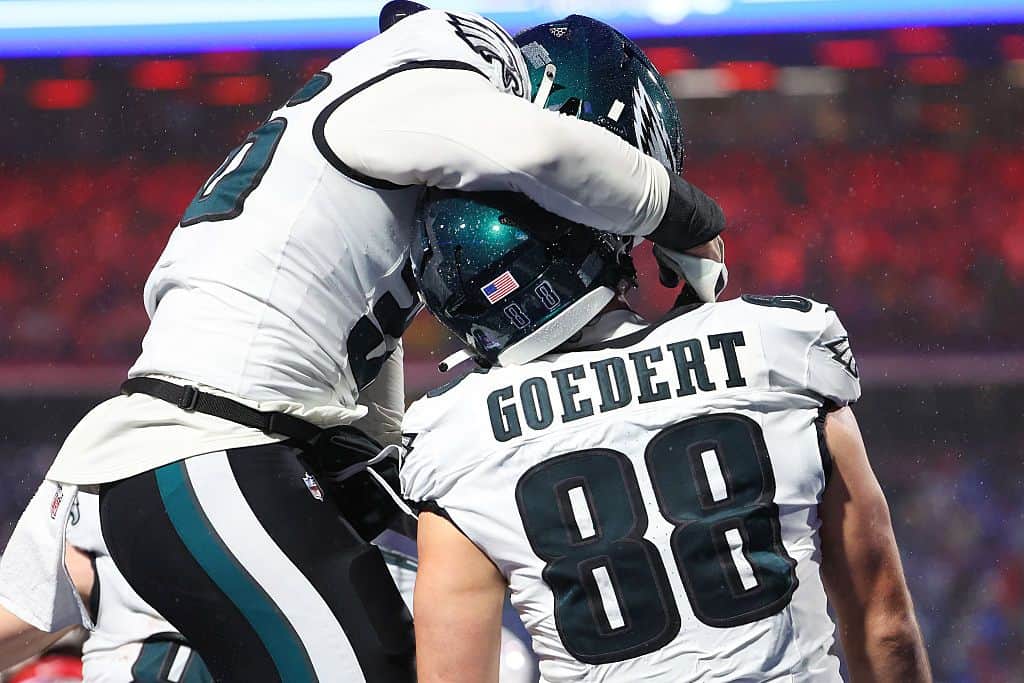
If you watched football last season, then it is not surprising to see Dallas Goedert ranking highly here.
No player at any position scored more points over expectation in the red zone last season than Goedert.
Goedert was second among all tight ends in fantasy points scored inside the red zone while ranking seventh in expected points.
Goedert only had 15 targets in the red zone, but 10 of them were touchdowns.
He scored 6 touchdowns from inside the 5-yard line.
The next closest tight end had 3.
What is even more of an outlier is that only 3 of Goedert’s touchdowns were on passes actually thrown into the end zone.
The Eagles adopted their own passing version of the “Tush Push” last season, with Goedert scoring on several variations of the shovel pass.
Goedert had a 27.8% target share for the Eagles in the red zone (TE4) compared to a 15.3% share outside of the red zone (TE9).
35.7% of his fantasy points were via touchdowns.
The only tight ends with a larger dependency on touchdowns were Darren Waller (40.6%) and Colby Parkinson (36.9%).
Before last season, Goedert had a career-high of 5 touchdowns.
Gamers have priced in the glaring expectations that Goedert ran hot in the scoring department into his 2026 ADP.
Mark Andrews 2026 Fantasy Outlook
Sometimes regression hits hard.
In this article last year, Andrews was in the same position as Goedert, scoring the most points over expectation in the red zone.
This year, he sits at the bottom of the list.
Andrews has always been a good touchdown scorer throughout his career, but in 2024, he had insane efficiency converting his end-zone targets.
He caught 9 of his 10 end-zone targets that year, the highest rate among players with double-digit end-zone looks in a season since that information has been available.
Last season, Andrews only caught 3 of 10 targets in the end zone.
The good news is that Andrews still ranked as the TE6 in expected points. The tables just flipped.
He still accounted for 26.9% of Baltimore's targets in the red zone (TE6) and received 30.3% of the team's throws into the end zone (TE3).
Baltimore did add rookie receivers Ja’Kobi Lane and Elijah Surratt, who profile as red-zone additions, but we do not know how many snaps those guys will actually see in 2026.
Andrews is the only reliable pass catcher on the roster at tight end, making him a high bet for playing time, especially near the end zone.
Isaiah Likely is no longer on the roster.
The team added Durham Smythe in free agency.
Matthew Hibner (Round 4) and Josh Cuevas (Round 5) were Day 3 picks in the draft with an eye on the future.
I am not betting on Andrews being a demon between the 20s, but he still is drawing live to lead the position in touchdowns this season, which makes him a solid bet at a depressed cost if playing the waiting game at tight end this year.
Tyler Warren 2026 Fantasy Outlook
Right above Andrews in terms of points scored below expectation, Tyler Warren was fourth at the position in expected points but finished 10th in actual output.
Warren had great usage rates in his rookie season.
He was on the field for 88% of the team dropbacks in the red zone (TE4), accounting for 27.5% of the red-zone targets (TE5).
His shortcoming was a lack of end-zone targets.
Warren only had 17.9% of Indianapolis' targets into the end zone, which was TE10.
I would anticipate that looking better in 2026.
The trade of Michael Pittman leaves a 25% end-zone target share on the table for Warren to cut into in his second season.
He also had a 21.1% end-zone target rate when Daniel Jones was on the field, then only had 1 more target in the end zone after Jones was lost for the season.
Trey McBride 2026 Fantasy Outlook
We have covered how much McBride stomped on his peers last year, to a degree never seen before.
Not only at tight end, but McBride also scored the most fantasy points of any pass catcher in the red zone last year.
Near the end zone, he massively stacked more opportunities than any other tight end and, for the first time in his career, cashed in on those chances.
After catching 3 of 15 career end-zone targets over three seasons, he collected 7 of 18 in 2025 (38.9%).
Only Davante Adams (28) had more targets in the end zone last season than McBride.
McBride ran 106 routes in the red zone last year, the most in the league.
The only other players with 90-plus routes in the red zone were Michael Wilson (95) and George Pickens (94).
I do expect regression here in top-down opportunities for the Cardinals that I covered in the tiers, but McBride's usage rates at the position will remain high.
If Arizona does end up surrendering in the scoring department, that further aids any dip.
He was on the field for a league-high 97.2% of his team’s dropbacks in the red zone.
His 33.3% share of red-zone targets was second, and his 37.5% share of end-zone targets was also second.
Brock Bowers & Colston Loveland 2026 Fantasy Outlook
It seems fitting to pair these two, since both players were limited in their participation last season but have strong data points to draw on moving forward.
Brock Bowers was on the field for 66.6% of the Raiders' total dropbacks last season (TE16) due to a PCL injury that hampered him.
He was on the field for 63.2% of the dropbacks in the red zone (TE19).
Colston Loveland was on the field for 59.8% of Chicago's dropbacks last year (TE19) due to a slow ramp-up as a rookie, paired with a return from a shoulder injury in college.
He was on the field for only 53% of the red-zone dropbacks (TE24).
Despite that, Bowers still ranked eighth in expected points in the red zone at the position, and Loveland was ninth.
Trey McBride ran 106 routes in the red zone compared to 44 for Loveland and 43 for Bowers.
Expecting each to make a significant jump in playing time, that gives you an idea of why these guys are in the same consideration set as McBride in the 2026 ADP.
Bowers was targeted on 37.2% of his routes in the red zone (TE2) while Loveland was targeted on 31.8% (TE4).
Even with all of his missed time, Bowers commanded 41.9% of Las Vegas' throws into the end zone, which led all tight ends.
George Kittle & Tucker Kraft 2026 Fantasy Outlook
Another duo that feels right to put together.
George Kittle and Tucker Kraft ranked second and third in points scored over expectation in the red zone last season.
In 2024, they also ranked second and third.
Both Kraft and Kittle have been highly effective near the end zone, as they are great after the catch.
Unfortunately, they are also returning from serious injuries that could limit them early in 2026.
When we do see both on the field this season, Kraft begins to separate in terms of red-zone opportunities.
Whereas Kittle will now contend with the addition of Mike Evans, Kraft has potential openings in his passing game near the end zone with Romeo Doubs leaving in free agency.
When Kittle and Brock Purdy have played together, Kittle has received a team-high 32.8% of the team’s end-zone targets.
The next closest 49er on those snaps is at 19.4%.
There have been 17 seasons of 20-plus end-zone targets over the past decade.
Evans has the most (3) and a league-high 41.8% end-zone target share when available.
When Evans was on the field last season, he commanded 58.3% of Tampa Bay's end-zone targets.
In 2024, Evans was second in the league in end zone targets (18).
Doubs was the WR11 in expected points in the red zone last season.
In 2025, Doubs had 17 targets in the red zone while playing 82.3% of the dropbacks in that area of the field.
I do expect those vacated opportunities to trickle into more opportunities for the remaining Green Bay wide receivers.
Still, there is also an outcome in which Kraft is the clear dominant target for the offense near the end zone, just as he was at the start of last season.
While active, Kraft was targeted on 36.4% of his routes in the red zone, which was third among tight ends.
Jake Ferguson 2026 Fantasy Outlook
Jake Ferguson was third in fantasy scoring in the red zone last year while sitting second in expected points scored.
While unflattering between the 20s due to his lack of athleticism, this is what is keeping Ferguson afloat. He is more of a touchdown-dependent player.
Ferguson received 23.5% of Dallas' targets inside the red zone (TE7) compared to a 15.5% target share outside the red zone (TE14).
He had a career-high 11 targets in the end zone after 12 total over his first three seasons in the league.
Not only did he have a spike in scoring chances, but he also caught 6 of those (54.4%) after a prior 33.3% conversion rate.
That was the highest rate for any tight end with double-digit end-zone targets in 2026.
We already identified both CeeDee Lamb and George Pickens as positive regression players near the end zone, making Ferguson a tough player to chase.
The positive spin is that, like Goedert, Ferguson is another player gamers have accurately priced this offseason.
Hunter Henry 2026 Fantasy Outlook
Sticking with that train of thought, another player that gamers have trouble leaning into this season solely based on 2025 output is Hunter Henry.
Henry was TE5 in fantasy points inside the red zone on TE3 opportunity.
He led the position in red-zone target share (33.8%) in 2025 while receiving 22.2% of the New England end-zone targets (TE7).
Like Ferguson, that was his entire profile.
Outside of the red zone, Henry had a 15.6% target share (TE13).
Henry averaged 17.1 points per game in his weeks with a touchdown compared to 6.9 points per game without.
Last year, Henry did not have much competition near the end zone.
This year, the Patriots have added A.J. Brown and Romeo Doubs.
Colby Parkinson 2026 Fantasy Outlook
Colby Parkinson is partially adjacent to the previous two guys we have covered, but on wildly different playing time.
We do not know whether the Rams will play as many heavy-TE sets in 2026 as they did in 2025, and even when they do, their tight end room remains muddled.
We are also anticipating passing touchdown regression for the Rams in general, which would directly impact Parkinson more than anyone else.
Parkinson was the TE4 in points scored inside the red zone on TE5 usage.
He led all tight ends with a target on 42.6% of his red-zone routes but was only on the field for 43.1% of the dropbacks in that area of the field (TE35).
Outside of the red zone, Parkinson was targeted on 18.2% of his routes (TE33), which was a lower rate than Tyler Higbee (18.3%).
Reaching 50 yards twice in the regular season, 36.9% of Parkinson’s fantasy points came via touchdowns, second behind Darren Waller (40.6%).