

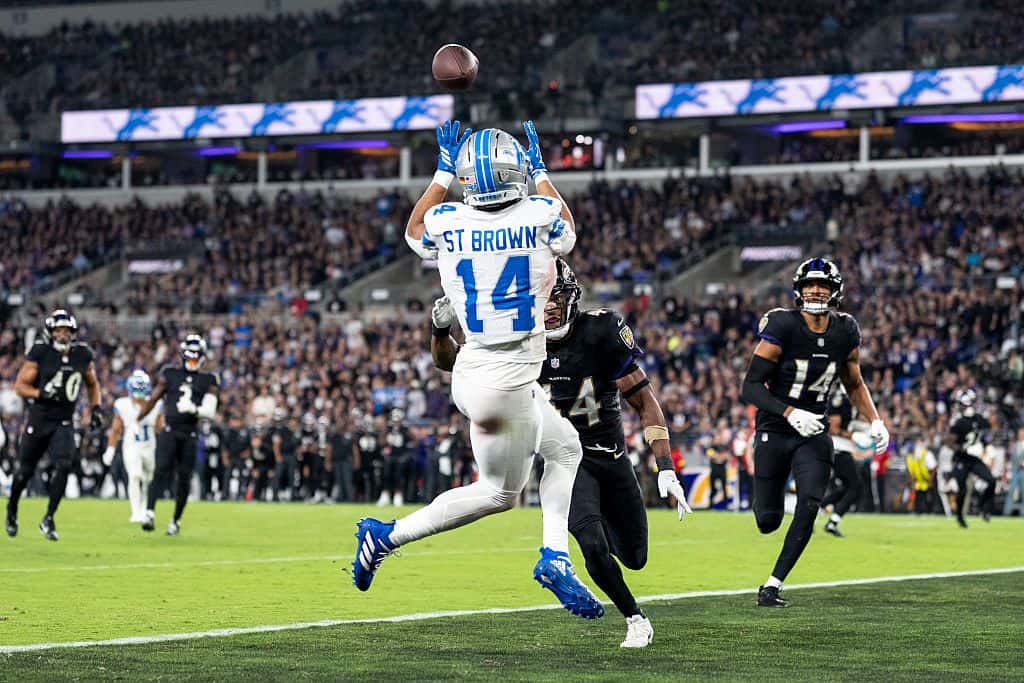
Every offseason, I break down the NFL offensive trends that will shape the upcoming season, including a deep dive into wide receiver red-zone performance.

The goal for these articles is straightforward.

We are monitoring the league's current state to identify any outliers, which we can then incorporate into the upcoming season while also gauging league trends.

While we have already examined all the positional tiers for 2026, it is always beneficial to review the league's overall landscape.

Every NFL season is unique, so this is always a great way to lay some groundwork.

2026 Fantasy Football Odds & Trends
Draft Kit Hub
2026 League Trends
Quarterback Trends
Running Back Trends
Wide Receiver Trends
Tight End Trends
NFL Team Per Drive Trends
NFL Red Zone Trends
NFL Yardage to Touchdown Trends
Touchdown Trends
Red Zone Regression: Quarterbacks (Coming soon)
Red Zone Regression: Running Backs
Red Zone Regression: Wide Receivers
Red Zone Regression: Tight Ends (Coming soon)

Don't Miss Out on The Best Fantasy Football Coverage in the Business

Like the NFL, fantasy football never sleeps.

From rankings to the best draft strategies, Sharp Football has everything you need to get ready for the fantasy season in our Fantasy Football Draft Kit, powered by premier fantasy football analyst Rich Hribar.

Save more by bundling the Draft Kit with our in-season fantasy package that features Rich's comprehensive “Worksheet” preview of every game, every week of the NFL season.

Click here for more information about our fantasy coverage!

Red-Zone Fantasy Points Vs. Expectation

We are following up on our examination of league and team performance in the red zone last season and extending it to individual player analysis.

In that top-down team post, we covered not only how the majority of touchdowns scored in the NFL come from inside the red zone, but also that not all red-zone touches are created equal.

We also showcased in that post how NFL offenses have become more reliant on red-zone production as part of their scoring output.

The discovery of true regression candidates in this area of the field could prove pivotal, given the rising need for offenses to succeed in the red zone.

To reiterate some notes from that article that relate to passing production near the end zone since 2010:

  • 67.1% of all passing touchdowns come from inside the red zone. In 2025, that rate was 69.1%.
  • 43.8% of all passing touchdowns scored overall come from inside of the 10-yard line. In 2025, that rate was at 44.0%.
  • 22.7% of all passing touchdowns scored overall come from inside the 5-yard line. In 2025, that rate was 23.8%.

Over the past decade, a target from the 19-yard line has been worth 1.8 fantasy points on average.

A target from the 10-yard line jumps up to 2.2 points on average.

A target from the 5-yard line climbs to 2.8 points on average.

A target in the actual end zone is worth 3.0 points on average.

You get the drift.

The closer you get to the end zone, the more valuable the opportunity is for fantasy points.

With that knowledge in place, the next step is to dive into red-zone production versus fantasy-skill-player expectations based on their actual opportunities, and weigh where those opportunities came from inside the red zone.

2025 WR Red-Zone Fantasy Points Vs. Expectation

WRRZ FF PtsEXPECTED PTSDIFFERENCE
Drake London56.233.522.7
Isaac TeSlaa42.922.320.6
Ja'Marr Chase65.047.117.9
Jayden Higgins34.016.317.7
Jauan Jennings61.544.616.9
Jaxon Smith-Njigba52.338.913.4
Chris Olave43.430.113.3
Marvin Harrison Jr.34.922.512.4
Garrett Wilson16.04.511.5
Malik Washington39.128.810.3
Josh Downs39.330.39.0
Parker Washington36.327.98.5
Tetairoa McMillan42.434.08.4
Quentin Johnston41.533.38.2
Amon-Ra St. Brown93.585.58.0
Puka Nacua50.342.38.0
Tre Tucker27.820.57.3
Alec Pierce25.318.07.3
Deebo Samuel37.830.96.9
Michael Wilson39.332.76.6
A.J. Brown33.327.06.3
D.J. Moore38.131.96.2
Jaylen Waddle33.026.96.1
Tyquan Thornton15.69.66.0
Tory Horton15.810.25.6
Stefon Diggs37.431.85.6
Ryan Flournoy23.718.25.5
Kayshon Boutte15.910.55.4
Jayden Reed11.15.85.3
Tee Higgins39.234.25.0
Tyreek Hill9.25.04.2
Keon Coleman27.723.74.0
Troy Franklin47.443.53.9
Romeo Doubs45.141.63.5
Devaughn Vele15.812.43.4
Davante Adams91.588.23.3
Dontayvion Wicks12.59.62.9
Tre Harris11.69.12.5
Michael Pittman Jr.32.630.22.4
Rashod Bateman20.418.02.4
Jalen Coker9.37.22.1
Terry McLaurin19.417.32.1
D.K. Metcalf37.535.71.8
DeVonta Smith23.722.01.7
Khalil Shakir28.026.81.2
Mike Evans24.122.91.2
Jordan Addison30.529.60.9
Christian Watson17.616.80.8
Ladd McConkey33.933.50.4
Xavier Worthy13.313.6-0.3
Jalen McMillan0.10.5-0.4
Zay Flowers21.522.2-0.7
Chris Godwin16.317.4-1.1
Jalen Nailor26.928.1-1.2
Brian Thomas14.315.9-1.6
Calvin Ridley0.02.4-2.4
Cooper Kupp23.626.5-2.9
Adonai Mitchell11.514.4-2.9
Rashid Shaheed11.514.4-2.9
Jaylin Noel8.912.0-3.1
Matthew Golden1.75.0-3.3
Jakobi Meyers28.331.7-3.4
Luther Burden4.37.9-3.6
Jack Bech4.28.3-4.1
Christian Kirk10.615.1-4.5
Rashee Rice47.552.6-5.1
Rome Odunze25.530.7-5.2
Keenan Allen28.835.3-6.5
Ricky Pearsall2.09.1-7.1
Jameson Williams11.519.5-8.0
Travis Hunter3.411.5-8.1
Malik Nabers0.89.3-8.5
Andrei Iosivas9.518.2-8.7
Nico Collins34.543.4-8.9
Pat Bryant5.716.1-10.4
Darnell Mooney4.015.4-11.4
George Pickens40.752.4-11.7
Courtland Sutton29.241.3-12.1
Darius Slayton1.314.1-12.8
Wan'Dale Robinson11.826.6-14.8
Emeka Egbuka9.724.6-14.9
CeeDee Lamb25.840.9-15.1
Jerry Jeudy1.419.8-18.4
Justin Jefferson21.343.3-22.0

Amon-Ra St. Brown & Davante Adams 2026 Fantasy Outlook

I want to start by looking at the expected points column because Amon-Ra St. Brown and Davante Adams were so wildly ahead of the field in usage near the end zone.

Both players did outperform their opportunities, but it was nothing overly egregious, either.

St. Brown has established himself as one of the best receivers in the league.

There still seems to be some stigma that he is more of a floor-based or “safe” player, but he is also a receiver with a high ceiling.

He has now scored double-digit touchdowns in each of the past three seasons.

St. Brown ranks first, first, and eighth among receivers in red zone fantasy output over that run.

After seeing 34.8% of the Detroit targets in the red zone in 2024, he came back with a league-high 41.5% target share in the red zone last season.

St. Brown was targeted on 42% of his routes run inside the red zone last year.

He stayed hyper-productive through the top-down scoring regression Detroit had last year.

This year, the Lions are favored in 14 games entering the season, which is tied for third in the league.

Adams has made a career out of scoring touchdowns, which was part of his appeal going to the Rams.

In his first season with the Rams, Adams accounted for a league-best 62.5% target share inside the 5-yard line.

He had 28 end zone targets, the most recorded since that data was tracked.

The next closest player last season had 18.

Adams had 51.9% of the Los Angeles end-zone targets, an absurd rate that was impacted by the final three and a half games of the season.

Even accounting for his missed time, Adams led the position in expected points in the red zone.

Puka Nacua was still 10th, but he did get an end-of-the-year jolt from the missed time for Adams.

If Nacua has one minor bugaboo to this point, it is that the Rams have not always prioritized him near the end zone.

When Adams was on the field, he out-targeted Nacua 31 to 10 in the red zone and 28 to 4 in the end zone.

I do believe that St. Brown will weather any regression better than Adams does, but to be fair to Adams this offseason, gamers are already pricing that in for both him and Matthew Stafford.

If there is expected touchdown regression through the air for the Rams, then Adams stands to be most affected.

37.7% of his fantasy points came from touchdowns, the highest rate in the league.

Stafford posted a career-high 7.7% touchdown rate (his previous high was 6.8% in 2021).

There have been 55 times in which a passer has posted a 7% TD rate on 200-plus throws since 1990.

49 of those players threw fewer touchdowns the following season.

While regression is expected, not all regression is a boogeyman.

Even with a drop in scores, Adams is still a good bet to get tangible touchdown production.

Since he entered the league in 2014, only Derrick Henry has scored more touchdowns than Adams.

Since 2020, only Henry and Jonathan Taylor have more touchdowns.

Rashee Rice 2026 Fantasy Outlook

Rashee Rice played only eight games last season but ranked third among all wide receivers in expected points in the red zone and eighth overall in fantasy points scored there.

Rice was targeted on a position-high 43.9% of his routes in the red zone.

There are questions about changes to this passing game since they have struggled in recent seasons, but the Chiefs have also made no significant additions to the wide receiver room to push Rice.

That makes it hard to suggest they are going to do much differently than what they have done lately in the passing game when they are in the scoring area.

If anything, it makes sense to keep featuring Rice there since he draws targets near the line of scrimmage and creates after the catch.

Xavier Worthy had 6 total targets in the red zone last season, the same number as JuJu Smith-Schuster.

Marquise Brown had 9.

If there is something that impacts Rice’s utilization near the end zone, we would have to believe it is Kenneth Walker.

The Chiefs have a 56.8% dropback rate in the red zone over the past three seasons while sporting an anemic running game.

That pass rate ranks fifth in the league.

Justin Jefferson 2026 Fantasy Outlook

No player had a worse runout in 2025 compared to expected output than Justin Jefferson.

He ranked ninth in expected points in the red zone but finished 48th in red zone scoring.

Jefferson finished with a career-low 2 touchdowns despite 16 targets in the end zone (WR3) and a 42.1% target share (WR3) on those throws.

Before last year, Jefferson had converted 32.4% of his end-zone targets into touchdowns.

Only one receiver over the past 10 years had a worse end-zone conversion rate on as many scoring targets: Julio Jones in 2018 when he caught 2 of 19 end-zone targets.

Minnesota has our easiest passing schedule for 2026 as an added cherry in getting Jefferson back in the mix to compete as WR1 overall.

CeeDee Lamb & George Pickens 2026 Fantasy Outlook

It is interesting to see both Dallas wide receivers fall short of expectations last year.

George Pickens finished fourth in expected points and 15th in actual points produced in the red zone.

Pickens had 18 targets in the end zone, which was second to only Davante Adams.

He did collect 6 of them, but that was still below the base rate for wideouts last season (37.4%).

The question for Pickens will be how much he is impacted if we get a full season out of CeeDee Lamb this year to prevent a full spike in regression.

With Lamb on the field, Pickens had 28.1% of the end-zone targets and 19.7% of the red-zone targets.

With Lamb off the field, Pickens received 36% of the end-zone targets and 24.3% of the targets in the red zone.

Lamb shed some top-down target opportunities last year playing alongside Pickens, but the reason he still had such a lackluster fantasy runout was that he just had a down year in converting his scoring opportunities.

When Lamb played, he still commanded 37.5% of the team targets in the end zone and 27.9% of the red-zone targets.

However, Lamb only converted 2 of his 12 (16.7%) targets in the end zone for scores.

Before last year, he had converted 36.1% of those opportunities.

I believe both of these guys underperforming near the paint last year (based on expected output) bodes well for them if the Dallas defense is better and lowers the overall passing volume for this offense in 2026.

Nico Collins 2026 Fantasy Outlook

Nico Collins was another noteworthy fantasy asset who is set up for potential positive regression.

Collins was 26th in red-zone production for fantasy despite having the eighth-best opportunity.

When Collins was on the field, he posted a robust 53.8% share of the end-zone targets and 33.3% of the Houston targets in the red zone.

But he only scored 6 times (his fewest since 2022) on a career-high 120 targets.

Collins had 14 targets in the end zone, converting 4 (28.6%).

In 2024, he converted 45.5% (5 of 11), and in 2023 he converted 40% (4 of 10) of those targets.

In the red zone, Collins only corralled 37.5% (6 of 16) of his targets after rates of 53.8% (7 of 13) and 60% (9 of 15) in the previous two seasons.

Jayden Higgins is a potential impact player in that area, but Higgins also ran extremely hot as a rookie.

He nearly matched Collins in red-zone fantasy output, scoring the fourth-most points over expectations.

Higgins turned 5 of 10 end zone targets into touchdowns last year.

Jaylen Waddle 2026 Fantasy Outlook

Shifting gears a bit, I want to call out Troy Franklin ranking seventh in expected points in the red zone and how that opportunity could find Jaylen Waddle.

Franklin accounted for 11 targets in the end zone (30.6%) and 18 targets in the red zone (23.4%), all while only playing on 62.9% of the Denver dropbacks in the red zone.

Waddle will surely play more red-zone snaps.

Franklin also led all wide receivers in the league with 3 targets on 2-point conversions.

Courtland Sutton had 22.1% of the team red-zone targets while playing 89.9% of the passing snaps in that area of the field.

Sutton also still had 14 targets in the end zone, so there is room for him to still share those opportunities Franklin received while still being involved.

Waddle has converted 48% of his career targets in the end zone for touchdowns with a 30.8% red-zone touchdown rate.

Jauan Jennings, Mike Evans, Emeka Egbuka & Ricky Pearsall 2026 Fantasy Outlook

Building on the thought above, all of these players are interconnected.

Jauan Jennings was sixth among wide receivers in expected points in the red zone and finished fourth in scoring in that area.

Obviously, Jennings is joining a Minnesota roster where we are not expecting him to roll those opportunities over, but he leaves that in play for Mike Evans.

Evans has been a dominant red-zone target over his career.

There have been 17 seasons of 20-plus end zone targets over the past decade.

Evans has the most (3) and a league-high 41.8% end-zone target share when available.

When Evans was on the field last season, he commanded 58.3% of the Tampa Bay end-zone targets.

Like Davante Adams with the Rams a year ago, I expect Evans to be at least a major factor near the end zone.

Brock Purdy has been the most efficient passer on throws to the end zone.

Since entering the league, Purdy has completed 45.1% of his throws into the end zone.

That is fourth in the league.

In 2025, that rate was 46.2% (QB9) while Mac Jones was first (58.3%).

This is the toughest obstacle I have for Ricky Pearsall in 2026 as a target for managed leagues.

You can see how low Pearsall ranks on opportunity alone above.

When the 49ers are full strength (a fair fade, by the way), he is arguably their fourth-best option in the passing game near the paint behind Evans, George Kittle, and Christian McCaffrey.

Through two NFL seasons, Pearsall has only played 46.7% of the team's dropbacks in the red zone, but he also has only been targeted on 12.1% of his career routes in that area of the field as well.

With Evans leaving Tampa Bay, that creates an opening for Emeka Egbuka.

As a rookie, Egbuka had the fourth-worst differential in scoring output compared to opportunity in the red zone.

Egbuka caught 6 touchdowns as a rookie.

Only one was shorter than 20 yards, and that was a 15-yarder.

When Evans was unavailable, Egbuka received a team-high 21.6% of the red-zone targets and was targeted on 25.6% of his routes.

Without Evans on the field, Egbuka accounted for 30.8% of the Tampa Bay end-zone targets but only converted 1 of 8 for touchdowns.

Egbuka is definitely not Drake London in the contested catch game, but Zac Robinson has dialed up a wealth of scoring chances for London the past two seasons.

London accounted for 61.4% of the Atlanta end-zone opportunities when he played the past two seasons.

Rome Odunze & Luther Burden 2026 Fantasy Outlook

Continuing the trend, D.J. Moore also leaves a team-high 15 end zone targets (28.8%) behind in Chicago.

This one is a little trickier because Moore took a significant spike in scoring chances after Rome Odunze was injured.

Despite missing time, Odunze had 13 targets in the end zone, which was only two fewer than Moore.

When Odunze was available, he commanded 42.3% of the Chicago end-zone targets and 27.3% of the red-zone opportunities.

When Odunze played, Moore only had 13% of the team targets in the red zone and 26.3% of the end-zone targets.

Touchdown equity has been a consistent reason for believing that Odunze should be tighter with Luther Burden than where they currently are going.

Still, any vacated opportunities will surely give Burden more scoring chances than what he received as a rookie.

Burden only had 1 target in the end zone during the regular season (1 in the playoffs) while only having 4 red-zone targets (6%).

Moore himself goes to a Buffalo passing game with a wide-open passing tree near the end zone.

Keon Coleman led the Buffalo wideouts with 6 end-zone targets in 2025.

Khalil Shakir has 6 total end zone targets for his career.

Christian Watson, Jayden Reed & Matthew Golden 2026 Fantasy Outlook

We have one more vacated target opportunity to touch on, which is Romeo Doubs leaving Green Bay.

Doubs was the WR11 in expected points in the red zone last season.

In 2025, Doubs had 17 targets in the red zone while playing 82.3% of the dropbacks in that area of the field.

Christian Watson only had 6 targets in the red zone on 40.5% of the dropbacks.

Jayden Reed had 3 targets on 26.6% of the red-zone dropbacks, and Matthew Golden had 2 targets on 43% of the red-zone dropbacks.

Everyone here is going to get a lift (as well as Tucker Kraft), but Watson has the best career track record to back getting the largest spike, which is supported by his physical profile.

For his career, Watson has been targeted on 25% of his routes in the red zone.

Reed has been at 17.1%.

Over the past three seasons, Doubs has 30 end-zone targets (WR17)

When Watson has played over that span, he has 25 (and a 48.1% target share compared to 28.8% for Doubs with both available).

Drake London 2026 Fantasy Outlook

Drake London was dominant in the red zone last year, producing the most points above expectations at the position.

Despite his missed time, London was still fifth at the position in fantasy points scored in the red zone.

He led the NFL with 1.41 fantasy points per route in the red zone, turning 7 of his 8 red-zone catches into touchdowns.

That was a little hot compared to 2024, when he converted 6 of 14 (42.9%).

That said, when accounting for his missed time, London has a league-high 61.4% end-zone target share over the past two years.

Michael Penix has thrown 19 career passes into the end zone so far.

14 have been to London.

There is some coaching and potential quarterback turnover in Atlanta to keep in play here, and it's volatile projecting where London’s potential regression could slip in 2026, but he should still be a high-target earner when Atlanta is near the end zone.

Chris Olave 2026 Fantasy Outlook

Chris Olave enjoyed the best season of his career last year, producing a career-high 9 touchdowns.

He was the WR11 in red-zone points scored on WR30 opportunities.

Only 1 of Olave’s touchdowns was inside of the 10-yard line.

While there is a regression signal here in terms of outproducing his opportunities from 2025, we have also covered the Saints as a team that regularly showed up over our team series last week to bet on having more touchdowns as a team in 2026.

If New Orleans does raise that tide, then Olave can put his opportunity share into action to offset any potential dip in scoring rates.

Olave was the WR2 in red-zone target share (30.2%) and WR2 in end-zone target share (43.8%) last season over the full campaign.

Jaxon Smith-Njigba 2026 Fantasy Outlook

The same can be said for Jaxon Smith-Njigba.

Everything Smith-Njigba did last year was so incredible that it will be hard to replicate.

The same can be said for his production near the end zone.

Smith-Njigba was the WR6 in red-zone scoring last year on WR14 opportunities.

Of his 10 receiving touchdowns in 2025, just 3 were inside of the 10-yard line.

I do believe the loss of Kenneth Walker and Zach Charbonnet’s timeline being well until the season can help him offset running as hot, however.

Seattle had a dropback rate of 43.9% in the red zone (30th) and 37.5% inside the 10-yard line (28th).

When Seattle was in the red zone, Smith-Njigba still had 27.4% of the team targets (WR6) and 26.1% inside of the 10-yard line (WR9).

Ja'Marr Chase 2026 Fantasy Outlook

Ja’Marr Chase is coming off his best season in terms of points over expectations in the red zone so far.

In 2025, Chase converted 33.3% (7 of 21) of his red-zone targets into scores after rates of 22.9%, 21.1%, and 20.8% the previous three seasons.

A career-high 50% (5 of 10) of his end-zone targets were scores, besting his previous high of 42.9% as a rookie.

Chase still has a dominant role in the red zone, ranking top five in expected points in each of the past two seasons.

Chase was on the field for a league-high 96.8% of the red-zone dropbacks last year.

Isaac TeSlaa & Jameson Williams 2026 Fantasy Outlook

Isaac TeSlaa was the WR12 in red zone fantasy production as a rookie.

TeSlaa only had 27 targets as a rookie, but 11 of them came in the end zone.

We highlighted how large a role Amon-Ra St. Brown has had in the red zone.

Not only can TeSlaa expand his rookie year opportunities, but we also are not even factoring in Sam LaPorta to the fold.

All of those guys keep Jameson Williams in check near the end zone.

Williams was the WR49 in expected points in the red zone last year after ranking as the WR39 in 2024.

After being targeted on only 13.3% of his routes in the red zone in 2024, Williams was at 9.1% last season.

Fortunately, Williams has a trump card in having 12 touchdowns from outside the red zone the past two seasons, which leads the league.

Odds & Ends

  • Josh Downs was targeted on 28% of his routes in the red zone last year, which was WR12. In 2024, he was targeted on 30.8% of his routes (WR9). He has only been on the field for 60.1% of the red-zone dropbacks in those seasons.
  • Kayshon Boutte had the lowest target rate per route run (6.3%) among all wide receivers to run 100-plus routes in the red zone last year.
  • Jerry Jeudy has been last and second to last in points scored below expectations in the red zone the past two seasons. He scored 1.4 fantasy points in the red zone last season, catching 1 of 9 targets for 4 yards. In 2024, Jeudy caught 4 of 13 red zone targets for 21 yards and 1 touchdown.
  • Chimere Dike was fifth among wide receivers in red-zone target share (29.2%). Wan’Dale Robinson was sixth (26.9%).