

Exiting the NFL Combine, we are digging into the 2026 fantasy rookie class for Dynasty rookie drafts, startups, and seasonal formats.
Even before the NFL Draft in April, rookies are available in Best Ball formats across all platforms.
That information gets applied to athletic models and layered alongside production profiles to shape each prospect's complete portfolio.
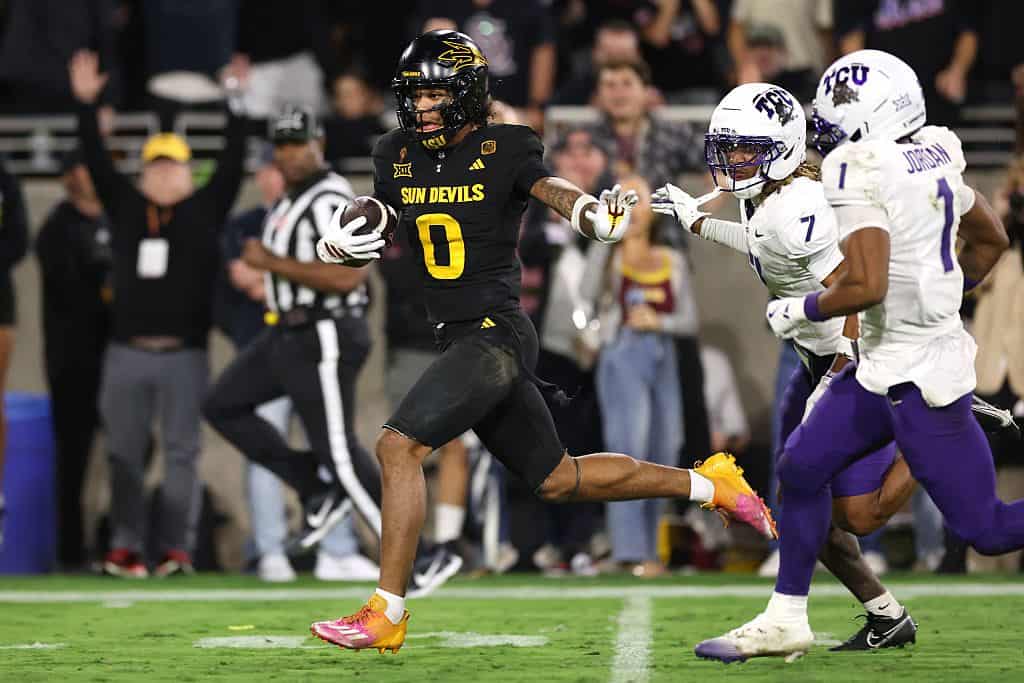
Let's look at the pre-draft profile for Arizona State WR Jordyn Tyson, including his strengths, weaknesses, and fantasy outlook for both redraft and Dynasty formats.
Don't Miss Out on The Best Fantasy Football Coverage in the Business
Like the NFL, fantasy football never sleeps.
From rankings to the best draft strategies, Sharp Football has everything you need to get ready for the fantasy season in our Fantasy Football Draft Kit, powered by premier fantasy football analyst Rich Hribar.
Save more by bundling the Draft Kit with our in-season fantasy package that features Rich's comprehensive “Worksheet” preview of every game, every week of the NFL season.
Click here for more information about our fantasy coverage!
Jordyn Tyson Pre-Draft Fantasy Profile
Rookie Age*: 22.1
*Age on 9/1/26
Tyson has one of the best production resumes in this class.
Over four seasons at Colorado and Arizona State, Tyson has averaged 4.8 receptions (6th in this class) for 69.2 yards per game (4th) and 0.67 receiving touchdowns per game (3rd).
When Tyson was on the field in college (more on this later), he was the most dominant player in this class, accounting for 46.7% of Arizona State’s receiving yardage and 64.7% of their receiving scores.
This past season, Tyson was targeted on 32.3% of his routes (2nd).
He was in the slot for 24% of his routes, where he gobbled up target opportunities, drawing a target on 37.5% of his routes.
Tyson tends to freelance more of his routes from this group in a Stevie Johnson (or Jerry Jeudy) fashion, if we’re being negative, which can be as much a positive as a negative depending on his system in the NFL.
One reason Tyson takes some liberties with routes is that he is one of the best receivers in this class at understanding leverage and getting open against man coverage.
While that was a staple of Tyson’s game in college against man coverage, his success versus zone coverage was more of a mixed bag, something he will see a lot more of in the NFL.
Tyson posted 3.02 yards per route against man coverage with a target on a class-high 43.6% of his routes.
Against zone coverages, he posted 2.18 yards per route run with a target on 27.2% of his routes.
Those are still good rates against zone coverage, and he regularly gets open against zone.
Still, it is telling in the disparity just how much some of the liberties he takes in route running can raise the ceiling while running himself into a few more outs when navigating complex coverages, since you need the quarterback to see things the same way.
That can impact him depending on what type of quarterback he plays with in the NFL.
If Tyson is playing with a quarterback who expects you to be on time and running a 12-yard out at 12 yards, then that can get him into trouble.
But if he is playing with a quarterback who sees things the same way he does, he can thrive.
This recently came up with Josh Allen in commentary following the trade for D.J. Moore.
One area where Tyson needs to grow to the next level is with the ball.
For as good as he is at getting open in space, that did not translate with the football in his hands.
He has only averaged 5.1 yards after the catch for his career.
That is the 20th percentile for prospects since 2015.
In 2025, Tyson had a lower rate of missed tackles per reception (9.8%) than lid lifters such as Carnell Tate and Denzel Boston while averaging 3.0 fewer air yards per target than those guys.
When on the field, Tyson has the strongest full-field profile and route versatility of this trio.
He has reps at all three receiver positions, has manufactured production, and wins in every area.
The rub is that he has to stay on the field.
Tyson has missed time in every season and has missed a third of his available games due to injuries.
In 2022 with Colorado, he tore his ACL, MCL, and PCL.
That caused him to miss the remainder of that season and limited his 2023 season to only three games.
In 2024, he fractured his collarbone.
This past season, he missed three games due to a hamstring injury.
That prevented him from participating in NFL Combine testing outside the bench press.
Training for the Combine and focusing on sprinting drills could have aggravated that injury, but that initial injury was nearly four months ago.
Jaxon Smith-Njigba sat out nearly his entire final college season with a hamstring injury and then did not run at the Combine, but he alleviated any concerns at his Pro Day.
He will not do any athletic testing at his Pro Day, but Tyson will do positional drills for teams on April 17.
You can make the case that all of Tyson’s injuries are unrelated and that he has been a victim of bad luck, but his medical history will surely carry weight with some organizations regardless.
He is expected to be drafted after Makai Lemon and Tate, but as noted in the opening of this tier, that could end up working out in his favor, given the landing spots at the top half of the draft.
If Tyson does slip into the back half of Round 1, the Eagles, Bills, 49ers, Chiefs, and Patriots all are in play for a wide receiver selection in that range, as well as not-so-fun spots in Cleveland (where his brother plays in the NBA) and Miami.
Explore all of our 2026 NFL Draft content: