
Subscribe to the Sharp Football Email Newsletter to receive all our 2026 NFL content:
No matter how well they did in free agency, all 32 NFL teams head into the 2026 NFL Draft with holes to fill on the roster.
Leading into the draft, we will identify the top needs for every team and break down the depth chart position by position.
What are the Bears' top positions of need heading into the 2026 NFL draft?
Who Did the Chicago Bears Select in the 2026 NFL Draft?
The Chicago Bears selected Dillon Thieneman (S, Oregon) with the No. 25 overall pick in the 2026 NFL Draft.
The Bears also selected:
- Logan Jones (C, Iowa)
- Sam Roush (TE, Stanford)
- Zavion Thomas (WR, LSU)
- Malik Muhammad (CB, Texas)
- Keyshaun Elliott (LB, Arizona State)
- Jordan van den Berg (DL, Georgia Tech)
Chicago Bears Needs: Top Positions of Need in 2026
- Edge Rusher
- Defensive Back
- Defensive Line
Contents
- 1 Who Did the Chicago Bears Select in the 2026 NFL Draft?
- 2 Chicago Bears Needs: Top Positions of Need in 2026
- 3 Chicago Bears 2026 Draft Capital
- 4 Chicago Bears Mock Draft Predictions
- 5 Chicago Bears Offense: Depth Chart, Analysis & Draft Needs
- 6 Chicago Bears Defense: Depth Chart, Analysis & Draft Needs
Explore all of our 2026 NFL Draft content:
Pre-Order The Best Analytical 2026 Football Preview
Don't miss out on Warren Sharp's 500+ page preview of the 2026 NFL season.
The preview is unlike anything you have ever seen, featuring stunning visualizations built with the reader in mind.
This preview shares insights into players, coaches, teams, and philosophies with one goal in mind: to get you prepared for the 2026 NFL season by delivering the smartest information in the fastest, most direct way possible.
Pre-order the 2026 Football Preview now!
Chicago Bears 2026 Draft Capital
The Bears have the 21st-most draft capital according to our Sharp Football Draft Value.
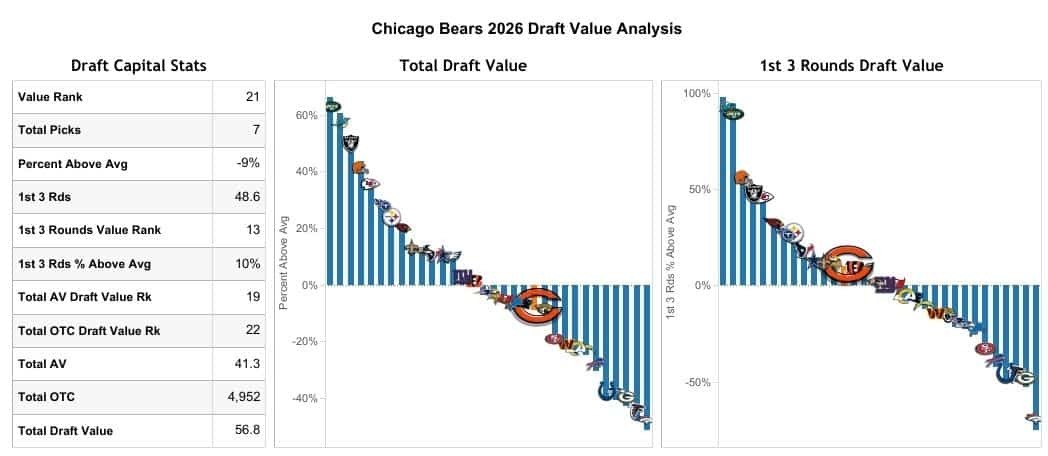
Our Sharp Football Draft Value is a valuation of draft capital based on a combination of average performance delivered and average dollars earned on second contracts.
Chicago Bears Mock Draft Predictions
Find out who our top-rated experts expect the Bears to draft:
- Brendan Donahue's 2026 NFL Mock Draft – Complete first round breakdown from the #2 most accurate mock drafter over the last five seasons.
- Ryan McCrystal's 2026 NFL Mock Draft – Complete first round breakdown from the #20 most accurate mock drafter over the last five seasons.
Chicago Bears Offense: Depth Chart, Analysis & Draft Needs
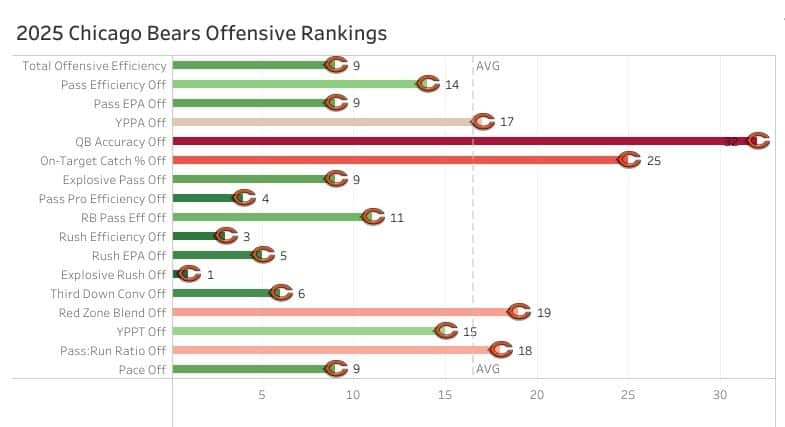
Rich Hribar breaks down the offensive depth chart by position for the Chicago Bears, identifying areas where the team could improve in the upcoming 2026 NFL Draft.
Quarterback
- Caleb Williams
- Tyson Bagent
- Case Keenum
Off a strong finish to 2025, Caleb Williams and the Bears are looking to take another step forward in his third season.
Williams made wholesale improvements in his second season with Ben Johnson.
He went from a 39.8% success rate in 2024 (30th) to a 42.5% success rate (22nd) last season.
24.6% of his dropbacks resulted in a gain of 1.0 EPA or more (14th) after a 20.4% rate as a rookie (30th).
Only 14.2% of his dropbacks lost 1.0 EPA or worse (6th), down from 18.6% in 2024 (29th).
After taking a sack on 10.8% of his dropbacks in 2024 (33rd), that rate was 4.1% last season (fourth).
Johnson had Williams playing more under center in his second season.
After a 28.8% under center rate as a rookie, Williams was at 48.4% last year.
That increased his play-action rate from 16.9% as a rookie to 33.3% last year.
The last hurdle Williams needs to clear is accuracy as a passer.
He still only completed 58.1% of his throws last year, ahead of only J.J. McCarthy (57.6%).
He had a 14.6% inaccurate throw rate, which was the worst among 33 passers who qualified for the league’s passer rating.
Williams was still sensitive to pressure.
He had a shaky completion rate regardless of pressure, but he averaged 7.6 Y/A (13th) when unpressured compared to 5.4 Y/A when pressured (26th).
Running Back
- D’Andre Swift
- Kyle Monangai
- Roschon Johnson
- Brittain Brown
- Deion Hankins
Ben Johnson’s impact was immediately felt with the Chicago run game.
Chicago running backs combined for:
- 4.8 yards per rush (6th)
- 40.8% success rate (2nd)
- 26.3% of runs resulted in a first down or touchdown (2nd)
- 11.8% rate of runs that gained 10 or more yards (7th)
If there was any shade to throw here, the Chicago backs averaged 1.79 yards before contact per rush (3rd) while ranking 21st in yards after contact per rush (3.01), but it was an excellent season for this running game.
This was primarily a split backfield over the back half of the season.
Over the final nine games, D’Andre Swift had 139 touches (55.6%) compared to 110 touches (44%) for Kyle Monangai.
Swift was more effective over that period with 730 yards and 5 touchdowns, compared to 502 yards and 4 touchdowns for the rookie.
Swift ended the season handling 257 touches for 1,386 yards from scrimmage and 10 touchdowns.
The yards and touchdowns were career highs.
His 5.4 yards per touch were his best rate since 2022.
Swift produced a run of 10 or more yards on 13.5% of his runs, which ranked sixth in the league.
Swift is in the final year of his current contract.
Monangai was a hit as a seventh-round pick in year one.
He turned 187 touches into 947 yards and 5 scores as a rookie.
That was the most touches for a seventh-round rookie running back since 2019.
Monangai got to play one game without Swift active, and although it was against the Bengals, he throttled them for 198 total yards.
Monangai and Deion Hankins are the only backs here currently signed for 2027.
I am not labeling this a “need,” but with Swift’s contract in the final season and Johnson utilizing multiple backs so far in every offense he has helmed, I believe the Bears are live to add another rookie this spring.
Wide Receiver
- Rome Odunze
- Luther Burden
- Kalif Raymond
- Jahdae Walker
- Maurice Alexander
- JP Richardson
This is another one I am not labeling as an outright need, but I do expect the Bears to add a receiver to this room following the trade of D.J. Moore and Olamide Zaccheaus leaving in free agency.
Moore was on the field for a team-high 87% of the dropbacks last season, while Zaccheaus was on the field for 52%.
Chicago added Kalif Raymond as a direct replacement for Zaccheaus, while Rome Odunze and Luther Burden are expected to see a significant spike in playing time with Moore no longer on the roster.
The next-closest player to Moore on the team (Odunze) was on the field for 65.6% of dropbacks, while Burden was at 41.1%.
We only have a small sample of Moore missing time last year, but Odunze was targeted on 28.3% of his routes with Moore absent (46 routes).
Colston Loveland was at 24.2% (62 routes), and Burden was at 20.3% (64 routes).
Those are all reasonable proxies heading into this season.
Burden (3.20 yards per route run on those plays) will have an efficiency dip on a larger sample size, but he will get much more top-down opportunity.
Burden closed the season quietly (6 catches for 66 yards in the postseason), but he flashed on his limited opportunities, drawing a target on a team-high 24.3% of his routes with a team-high 2.36 yards per route run.
Those totals are influenced by a sample size impacted by entering games for designed play calls when the team was at full strength.
Still, when Odunze missed the final five games of the regular season, Burden led the team with 324 receiving yards despite missing a game himself over that span.
In the four games that Burden played without Odunze over that stretch, he had 21.1% of the team's targets and posted 3.52 yards per route run.
Going back to his rookie profile, I always considered Burden to be misrepresented as a slot-only player, which played out as a rookie.
He played 57.4% of his snaps out wide and 40.7% from the slot.
The one area where Burden can be much more involved is that he only had 2 targets in the end zone as a rookie.
Moore also leaves a team-high 15 end zone targets (28.8%) behind.
Those will definitely go up since Moore is leaving some on the table, but Odunze is a thorn in that area.
Odunze opened last season hot, scoring 5 touchdowns over the opening four games.
He had over 60 yards receiving in three of those four games.
Then the wheels came off.
He scored 1 touchdown the rest of the season and missed the final five games with a foot injury.
Before his injury, Odunze led the team with 23.7% of the targets and 38.2% of the air yards.
While Caleb Williams still had accuracy issues despite growth in 2025, Odunze again took the brunt of it because his route tree offered higher-variance target opportunities.
Over those final eight games, 27.3% of Odunze’s targets were inaccurate.
No player with as many targets had a higher rate of off-target opportunities.
As a rookie in 2024, 26.7% of Odunze’s targets were inaccurate.
No player had a higher rate with as many targets.
What we are left with is nearly a two-year sample of Williams and Odunze being disconnected, which spans two different schemes.
Where Odunze still has upside is the types of targets he gets and his continued profiling as a vertical and red zone option.
Despite missing time, Odunze had 13 targets in the end zone, which was only 2 fewer than Moore.
Odunze had 39.3% of the end-zone targets before his injury, which was WR9 at the time.
Raymond has familiarity with Johnson during his time in Detroit, but the depth behind Odunze and Burden leaves a lot to be desired in terms of big-picture upside, while the team has little contractual depth at wide receiver.
Outside of Odunze and Burden, only Jahdae Walker is signed for 2027.
Tight End
- Colston Loveland
- Cole Kmet
- Nikola Kalinic
- Stephen Carlson
- Qadir Ismail
It took a bit for Colston Loveland to get going as a rookie as he worked his way into the lineup and recovered from an offseason shoulder injury, but the wait was worth it.
Loveland ended the season with at least 15% of the team’s targets in each of the final nine games, drawing a target on 24.7% of his routes for 1.97 yards per route run over that span.
Over the final five games of the season, Loveland was on the field for 80.9% of the team's dropbacks, receiving a target on 30.5% of his routes with 2.34 yards per route run.
He caught 31 passes for 408 yards and 2 touchdowns over that span.
As Loveland came on to close the season, the Bears and Ben Johnson took a page from Sean McVay’s 2025 game plan.
From Week 10 on, the Bears played 12 personnel on 35.4% of their snaps (6th) and 13 personnel on 13.4% (2nd).
They averaged 5.8 yards per play on offense with two or more tight ends on the field over that stretch compared to 5.1 yards per play with one or fewer on the field.
Cole Kmet did not stuff the stat sheet with the arrival of Loveland, but he was a contributor in the base offense when Chicago was at their best, catching 30 passes for 347 yards and 2 touchdowns.
Kmet is still under contract for two more seasons.
Offensive Line
LT: Theo Benedet, Jedrick Wills, Ozzy Trapilo
LG: Joe Thuney, Jordan McFadden
C: Garrett Bradbury, Kyle Hergel
RG: Jonah Jackson, Luke Newman
RT: Darnell Wright, Braxton Jones, Kiran Amegadjie
Chicago made wholesale changes to their offensive line in 2025, paired with the arrival of Ben Johnson, and the impact was felt.
Chicago ranked first in ESPN’s pass block win rate (74%) and fifth in run block win rate (74%).
At Pro Football Focus, they ranked fifth in pass blocking as a team and fifth in run block grade.
There are a few moving parts up front heading into 2026.
The first is at left tackle.
The Bears started three different players at left tackle last season.
Ozzy Trapilo was a second-round pick who eventually took over the job, but he suffered a torn patellar tendon in the playoffs last year and is expected to miss most (if not all) of 2026.
Trapilo took over the job from Theo Benedet, who made eight starts last season.
Benedet allowed a 7.8% pressure rate, which was the second-highest rate on the team, ahead of only Braxton Jones (11%).
Chicago retained Jones on a one-year contract to potentially compete again at left tackle while taking a flyer on Jedrick Wills.
Wills is a former first-round pick who sat out all of 2025 with a knee injury.
Drew Dalman made a surprising retirement this offseason at age 27 after starting all 19 games last season.
In an effort to quickly pivot, the Bears traded for Garrett Bradbury.
Bradbury has not been the same player since early in his career, but he started all 17 games for the Patriots last season.
Bradbury is only signed for 2026, so the door is open for Chicago to add competition and contractual depth here.
The rest of the starting spots are locked up with quality starters between Joe Thuney, Jonah Jackson, and Darnell Wright.
Thuney and Jackson are under contract for multiple seasons.
Wright is in the final season of his rookie contract, with the Bears expected to pick up his fifth-year option for 2027 before the May 1 deadline ($19.1 million).

Chicago Bears Defense: Depth Chart, Analysis & Draft Needs
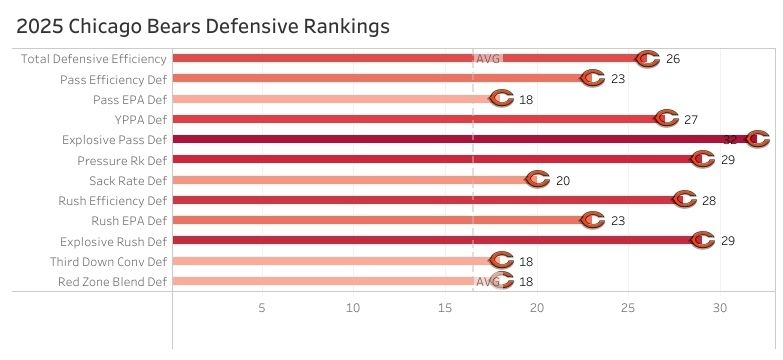
Raymond Summerlin breaks down the defensive depth chart by position for the Chicago Bears, identifying areas where the team could improve in the upcoming 2026 NFL Draft.
Defensive Line
- Gervon Dexter Sr.
- Grady Jarrett
- Shemar Turner
- Kentavius Street
- Neville Gallimore
- James Lynch
The Bears struggled to slow down running backs in 2026, giving up 4.8 yards per carry to the position and ranking 30th in yards before contact allowed per carry.
Signed last offseason, Grady Jarrett continued his career decline that began in Atlanta, getting pressure on just 5.6% of his pass rush snaps.
Gervon Dexter was better as a pass rusher, recording 6 sacks with a 10.3% pressure rate, but he did not make many plays in the running game.
2025 second-round pick Shemar Turner did not do much before suffering a season-ending ACL tear in October.
The Bears might also view him more as an edge defender when looking at his limited usage as a rookie.
Kentavius Street and Neville Gallimore were added in free agency.
Both can help out in a rotation, but neither player has been a difference maker.
Dexter is headed into a contract year, and the team can get out of Jarrett’s contract after this season.
Depending on how they view Turner and what they want to do with Dexter’s contract, they could be in the market for two long-term starters.
Edge Defenders
- Montez Sweat
- Dayo Odeyingbo
- Austin Booker
- Daniel Hardy
- Jamree Kromah
- Jonathan Garvin
- Jeremiah Martin
The Bears ranked 29th in pressure rate (31.5%) last season, finishing 22nd with 35 sacks.
Montez Sweat is coming off a good season, recording 10 sacks with a 12.5% pressure rate, but the rest of the group added next to nothing.
Dayo Odeyingbo only played eight games in his first season with the team, recording 1 sack with a dreadful 5.3% pressure rate before suffering a torn Achilles in November.
Austin Booker was third on the team with 4.5 sacks, but his 9.4% pressure rate was less than ideal.
Odeyingbo’s return will give the Bears an experienced enough top three, but they need a real impact addition to their edge group.
Linebacker
- Devin Bush
- T.J. Edwards
- D’Marco Jackson
- Noah Sewell
- Ruben Hyppolite II
- Jack Sanborn
- Dominique Hampton
- Nephi Sewell
The Bears made a splash in free agency, signing Devin Bush to a three-year, $30 million contract.
He will replace Tremaine Edmunds, who the team released ahead of free agency.
Bush was outstanding last season, putting up good stats against the run while allowing just 5.4 yards per target and a 64.2 quarterback rating in coverage.
The rest of the linebacker group is in flux.
T.J. Edwards is recovering from a broken leg suffered in the playoffs, and he has been the subject of trade rumors.
The Bears brought back D’Marco Jackson, who started four games last year and looked good in his first real playing time in the league.
Noah Sewell is recovering from a torn Achilles suffered in late December.
A fourth-round pick last year, Ruben Hyppolite struggled through a few injuries and was not a factor as a rookie.
Chicago has a quality starter up top and enough options behind him to be fine at linebacker for 2026, but there are questions in this group.
Cornerback
- Jaylon Johnson
- Kyler Gordon
- Tyrique Stevenson
- Zah Frazier
- Jaylon Jones
- Josh Blackwell
- Terell Smith
- Dallis Flowers
- Dontae Manning
Not helped by a non-existent pass rush, Chicago’s secondary allowed 7.6 yards per attempt (28th) last season and finished 19th in EPA allowed per pass attempt.
The Bears also did not field the corner group they expected for most of last season, with Jaylon Johnson playing just seven games, Tyrique Stevenson playing 13, and Kyler Gordon appearing in just three.
On top of that, 2025 fifth-round pick Zah Frazier missed his entire rookie season with a “personal issue.”
Jaylon Jones was re-signed in free agency, but it was a small one-year deal.
Stevenson is also scheduled to be a free agent after this season, and while he played the most snaps among the returning corners last year, his role was greatly diminished once Johnson returned from injury.
All of those moving parts make this cornerback room difficult to judge.
Even when on the field, Johnson has not lived up to his contract the last two seasons, but he obviously earned that deal with some great play.
Gordon struggled when on the field last year, but that was a very small sample.
How do the Bears feel about Stevenson?
Will they get anything out of Frazier?
There are bigger defensive needs on this roster, but a case could be made for cornerback being a primary target in the draft.
Safety
- Coby Bryant
- Elijah Hicks
- Cam Lewis
- Gervarrius Owens
The Bears lost a lot at safety in free agency, with Kevin Byard, Jaquan Brisker, C.J. Gardner-Johnson, and Jonathan Owens all set to play for new teams in 2026.
They also made a splash, signing Coby Bryant to a three-year, $40 million contract.
A nearly every-snap player for the Super Bowl Champions, Bryant will hold down one of the starting safety spots.
The other job is up in the air.
The Bears did bring back Elijah Hicks, who has some starting experience, but it feels like the Week 1 starter next to Bryant is not on the roster heading into the draft.
2026 Depth Chart Analysis & Team Needs for All 32 NFL Teams
| Team | Top Need | 2nd Need | 3rd Need | READ MORE |
|---|---|---|---|---|
| Arizona Cardinals | QB | DL | OL | Full Article |
| Atlanta Falcons | EDGE | OL | WR | Full Article |
| Baltimore Ravens | OL | WR/TE | EDGE | Full Article |
| Buffalo Bills | EDGE | DB | OL | Full Article |
| Carolina Panthers | DB | OL | WR/TE | Full Article |
| Chicago Bears | EDGE | DB | DL | Full Article |
| Cincinnati Bengals | EDGE | DB | LB | Full Article |
| Cleveland Browns | QB | WR | EDGE | Full Article |
| Dallas Cowboys | CB | EDGE | LB | Full Article |
| Denver Broncos | TE | DB | DL | Full Article |
| Detroit Lions | EDGE | OL | DL | Full Article |
| Green Bay Packers | EDGE | CB | OL | Full Article |
| Houston Texans | DL | OL | EDGE | Full Article |
| Indianapolis Colts | EDGE | S | LB | Full Article |
| Jacksonville Jaguars | DL | EDGE | OL | Full Article |
| Kansas City Chiefs | EDGE | CB | WR | Full Article |
| Las Vegas Raiders | QB | S | OL | Full Article |
| Los Angeles Chargers | OL | EDGE | DL | Full Article |
| Los Angeles Rams | OL | WR | DB | Full Article |
| Miami Dolphins | WR | DB | EDGE | Full Article |
| Minnesota Vikings | DL | OL | DB | Full Article |
| New England Patriots | EDGE | WR/TE | DB | Full Article |
| New Orleans Saints | WR | CB | DL | Full Article |
| New York Giants | DL | OL | CB | Full Article |
| New York Jets | QB | EDGE | CB | Full Article |
| Philadelphia Eagles | EDGE | OL | S | Full Article |
| Pittsburgh Steelers | QB | OL | LB | Full Article |
| San Francisco 49ers | DL/EDGE | S | OL | Full Article |
| Seattle Seahawks | DB | EDGE | RB | Full Article |
| Tampa Bay Buccaneers | EDGE | CB | LB | Full Article |
| Tennessee Titans | OL | WR | EDGE | Full Article |
| Washington Commanders | DB | WR | OL | Full Article |